

photo by: Joselyn King
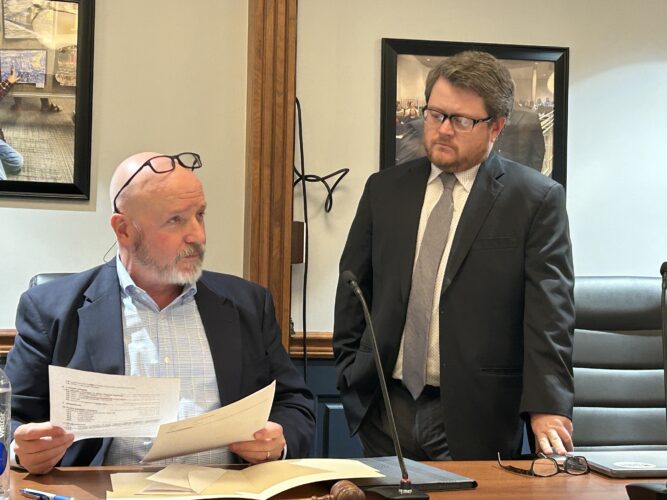
Ohio County Board of Education President David Croft, left, and Business Manager Steve Bieniek talk before a board meeting.
WHEELING – A new policy in Ohio County Schools seeks to stop students from engaging in cyber-bullying or causing harm to another through the use of technology.
The Ohio County Board of Education this week approved the policy that seeks to stop the harassment, intimidation or bullying (HIB) of a student through devices such as computers, tablets, mobile phones, wearable devices, cameras, social media, messaging apps, email, and related services.
The policy applies to all students enrolled in Ohio County Schools and governs the use of any technology, whether owned by the school district or personally owned, “when such use affects the school environment,” the policy states.
This means students are subject to the policy even when they are off school property or at home.
“With technology, harassment, intimidation and bullying could be anywhere,” explained Ohio County Board of Education President David Croft, an attorney who wrote the policy.
And if bullying is happening online, it could be “adversely affecting the school environment,” he continued. This differs from a physical fight between two students off school property that would not fall under the technology policy.
“With this policy, we are trying to curb the use of technology by students in creating an unsafe or disruptive school environment,” Croft continues. “(A physical fight) wouldn’t necessarily mean someone is being bullied. It could mean they are just not seeing eye to eye and want to settle it with an altercation.
“Kids have been getting into fights since the beginning of existence. Technology is more pervasive.”
Under the policy, HIB is defined as anything that will physically harm a student; damage a student’s property, place a student in reasonable fear of harm or property damage; create an intimidating, threatening, or abusive educational environment; or disrupt the orderly operation of the school.
HIB also includes conduct that embarrasses, threatens, insults, demeans, or targets a student’s race, gender, religion, disability, sexual orientation, or other personal characteristics.
“Cyberbullying” also is a form of HIB carried out through technology or electronic means.
The following is conduct specifically prohibited under the policy:
– Harassing, threatening, bullying, or intimidating another student.
– Creating, sending, posting, or sharing images, videos, recordings, messages, or digital content intended to embarrass, ridicule, or humiliate another student.
– Spreading false, misleading, or malicious information about another student.
– Impersonating another student or accessing another student’s accounts without authorization
– Non-consensual recording/transmission of audio/video/images in a manner that qualifies as HIB.
– Transmitting threatening, obscene, disruptive, or sexually explicit material.
– Encouraging others to participate in harmful or embarrassing conduct toward a student through technology.
– Any use of technology that substantially negatively disrupts the educational process.
The policy also establishes punishment for offenders.
First and minor offenses could result in the student’s device being confiscated. The school would have the right to hold the device, but would not review the contents of the device without the consent of the student and guardian. The school would be required to return the device to the guardian or the student at the end of the school day.
Moderate offenses would involve detention or an in/out-of-school suspension for up to 10 days, and the student also could lose the use of in-school technology privileges for one week. Those found guilty of more severe or repeat offenses could be expelled for up to one year, or recommended for placement in an alternative school.
Criminal offenses, such as those involving personal threats or sexting, would be referred to law enforcement under the policy.
Croft believes as photo manipulation and other technological practices become law, more will be added to the list as being “criminal” offenses.
But what if two consenting teenagers are caught exchanging explicit photos online?
“I’m not sure how that would be handled,” Croft said. “The way to know is to report it to the prosecutor. It would be considered sexually explicit material.
“But the question is how does this affect the school environment. At what point can they not exchange photos? At what point are they treated as adults in the eyes of the justice system?”
The policy was to be posted as soon as Tuesday afternoon on the Ohio County Schools website, boe.ohio.k12.wv.us.