

Russia has increased its hybrid and military activities on and around Svalbard to secure its strategic position in the European Arctic.
 Barentsburg, the Russian mining settlement on Svalbard, serves as Moscow’s permanent foothold on NATO territory. © Getty Images
- Svalbard is central to Russia’s defense and nuclear deterrent posture
- Hybrid Russian tactics are exploiting legal gray zones in the Svalbard Treaty
- NATO remains cautious, prioritizing de-escalation over confrontation
- For comprehensive insights, tune into our AI-powered podcast here
Strategic-military interests are overtaking economic interests in Russia’s thinking about the Arctic. For the Kremlin, preserving its submarine-based nuclear deterrent and ensuring access to the Atlantic Ocean has become more important than protecting shipping routes and exploiting resources made accessible by global warming.
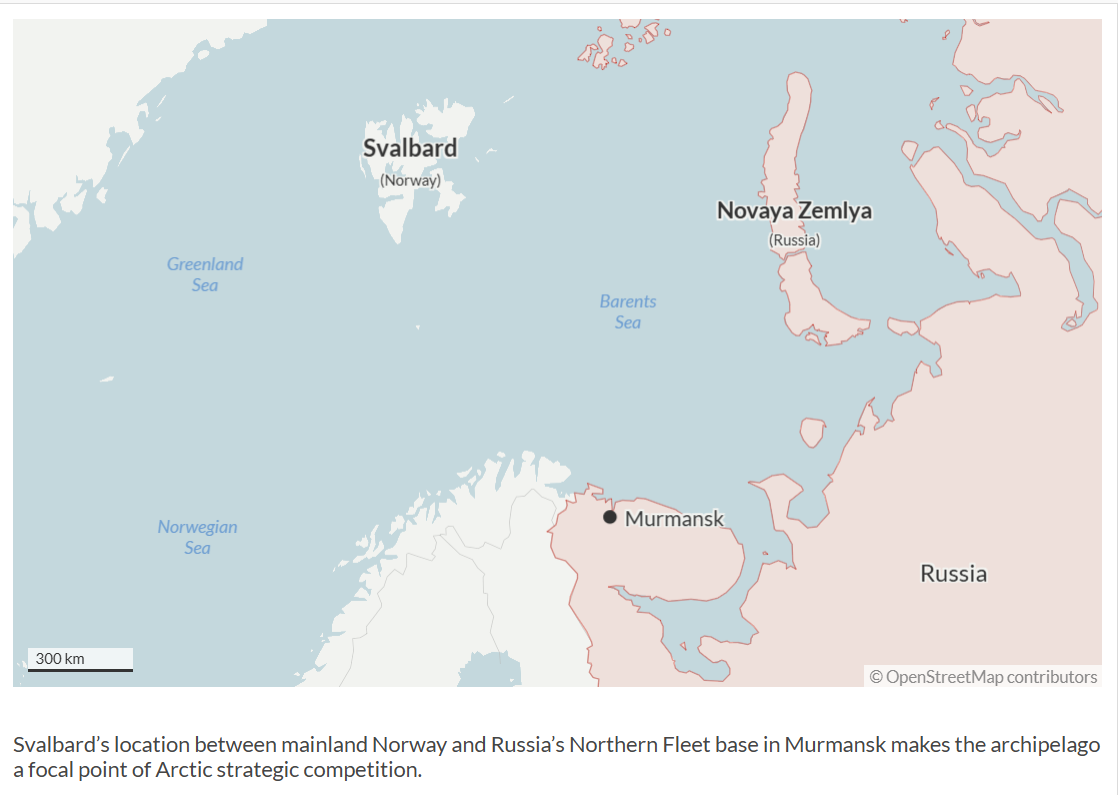
Moscow’s public rhetoric seeks to give the opposite impression. Russia controls over half the Arctic coastline, and the European part is essential to its national security. While Greenland has drawn attention following territorial claims by United States President Donald Trump, Svalbard, a Norwegian archipelago between mainland Norway and the North Pole, holds greater strategic significance for Russia because of its close proximity to the naval base in Murmansk.
Russian national security
The Kremlin is more concerned than ever with maintaining the maneuverability of its Northern Fleet because of its weakened naval power capability in three other theaters after 2022. Russia has been pushed onto the defensive in the Black Sea by Ukraine and constrained by Turkiye. It faces mounting pressure in the Baltic Sea following Sweden and Finland’s NATO accession, and has lost its Mediterranean foothold after Syria’s regime change.
The Northern Fleet based in Murmansk has become Russia’s most strategically important port, posing the most potent conventional threat to NATO both at sea and for long-range strikes. Not least, Murmansk hosts the majority of the sea-based strategic nuclear deterrent, which is crucial to Russia’s second-strike capability.
The Kremlin is highly alert to any suggestion that Svalbard could be used to weaken its position in the Barents Sea and its strategic nuclear deterrent. This concern has intensified since Finland’s accession to NATO, which exposes its land connection to Murmansk to enemy disruption. Svalbard Airport has the technical capacity to host reconnaissance and fighter aircrafts.
The latest innovations in drone technology, including sea drones, enhance Svalbard’s potential – especially the southernmost Bear Island – for detecting and attacking targets in the Barents Sea. Russia’s 2023 Foreign Policy Concept ranks the Arctic as the second-most strategically important region in the world, after its “near abroad” in Eastern Europe.
Hybrid testing ground
Norway governs Svalbard under the conditions of the 1920 Svalbard Treaty, which grants it sovereignty with two notable restrictions: It prohibits using the archipelago for “warlike purposes,” including the construction of naval bases and fortifications, and it gives all participants to the treaty (including Russia) equal rights to economic exploitation. This makes Svalbard fertile ground for various kinds of Russian hybrid and military activities.
Intelligence gathering: Russia is entitled to operate fishing and research vessels for economic exploitation, which it uses to gather submarine intelligence on how best to counter NATO underwater capabilities. The Norwegian broadcaster NRK has documented dozens of cases of Russian fishing vessels moving close to military sites and critical infrastructure such as airports, oil fields and undersea cables.
Russia also has plans for a satellite ground station on Svalbard. The island is well located for downloading data from surveillance and spy satellites, which typically circulate the earth north-south. This fuels suspicions of dual-use, as the radar could download satellite data for military purposes, potentially breaching Norwegian law. Moscow has sought to counter these concerns by protesting Norway’s data collection at its existing Svalbard satellite station, alleging that the information has been transferred to Ukraine.
Svalbard’s strategic location
Sabotage of undersea cables: In 2022, a Russian fishing vessel was tracked passing over the site where one of the two undersea cables linking Svalbard to mainland Norway was severed. A year earlier, a Russian trawler crossed the area where 4 kilometers of a subsea cable capable of detecting submarines was cut. Norwegian authorities concluded that both incidents were likely the result of human activity. Russia’s right to operate fishing and research vessels in Norwegian waters complicates efforts to prevent such sabotage.
Binding like-minded countries: Russia announced the development of BRICS-linked science stations on Svalbard, reflecting its broader ambition to increase its links with BRICS countries in science and tech after collaboration with Western countries largely ceased in 2022. Moscow’s openness to Chinese participation is particularly concerning, as it reinforces Beijing’s claim to near-Arctic status and supports its ambition to sustain Arctic infrastructure projects through cooperation with Russia. Oslo’s counterproposal to establish a Svalbard Science Office to coordinate research activities has gained little traction.
Legal challenges to maritime sovereignty: Russia uses its fishing rights to advance its interpretation of the Svalbard Treaty, which predates the concept of an exclusive economic zone. Norway has interpreted the treaty as giving it the right to designate “fisheries protection zones,” where it can allocate fishing quotas and enforce environmental regulations. Russia accepts Norway’s inspections of fishing vessels in practice, but it refuses to officially recognize Oslo’s jurisdiction in the fisheries protection zones and instructs Russian fishermen not to sign inspection documents. Russia has also disputed Norway’s right to explore the Svalbard shelf for oil and gas.
Military testing ground
Russia has demonstrated its readiness to deploy military force on and around Svalbard to protect its interests in case of perceived threat. It keeps its unprofitable coal mine in the town of Barentsburg to maintain a permanent settlement on NATO territory. In May 2023, 2024 and 2025, Russia held militarized Victory Day parades in Barentsburg featuring paramilitary symbols and low-flying helicopters, the latter drawing Norwegian fines for breaching flight regulations. Russia has also held marches and displayed similar symbols in the former coal-mining town of Pyramiden.
Russia previously had a military presence on the island for short periods of time. In 2016, Chechen special forces in full combat gear used Svalbard Airport for transit, and in 2019 a Spetsnaz reconnaissance mission reportedly scouted critical infrastructure across the archipelago. Russia has repeatedly dispatched, or threatened to dispatch, warships to protect fishing vessels against actual or potential Norwegian detentions.

Russia holds regular naval exercises and tests weapons at sea near Svalbard. During the Zapad exercises in 2025 and reportedly also in 2017, Russia simulated amphibious invasions of Svalbard, while closing off parts of the fisheries protection zones. Moscow held a major naval exercise there roughly a week before its February 2022 invasion of Ukraine and has since markedly increased the frequency of drills in the Barents Sea. Svalbard holds strategic value for the so-called Bastion defense, which aims to shield the Northern Fleet’s transit from NATO naval and air threats. In July 2025, Norway issued its first warning about disruptions to GPS signals in the airspace over Svalbard, including jamming and spoofing.
In what appears to be an effort to deflect scrutiny from its own activities, Russia regularly accuses Norway of militarizing Svalbard. Yet the Svalbard Treaty does not mandate demilitarization, and Norway’s routine presence is limited to a frigate and coast guard vessels to assert sovereignty. In early 2025, Moscow alleged that Norway was incorporating the archipelago into NATO military planning. The charge seemed to respond to calls by some Norwegian politicians for a stronger military presence, but the Norwegian government denied any plans to militarize Svalbard.
NATO and Norwegian responses
Russia’s hybrid and military activities in the Arctic receive far less attention than its activities on NATO’s eastern border in continental Europe. However, its right to economic exploitation and scientific exploration makes Svalbard vulnerable to hybrid and military pressure. They allow Russia to create strategic uncertainty about Norwegian rules and regulations on Svalbard, and about Russia’s legal position and military strength in maritime zones. They also test NATO’s threshold without risking a direct confrontation. Russia is ramping up its naval power toward 2050 in anticipation of a potential crisis with NATO stretching from the Baltic to the Barents Sea.
More about the Arctic
In response to Russia’s growing military deployments to the Arctic, NATO established a Joint Force Command Norfolk in July 2019 and regularly conducts joint operations and exercises above the Arctic Circle to test cold-weather capabilities. But NATO continues to see the Arctic as a flank region that has secondary priority compared to the preparations for a Russian attack against NATO in continental Europe.
NATO does not have a High North strategy and, moreover, as a defensive alliance, it is almost always looking for ways to de-escalate rather than opposing force with force. Countering Russian activities will likely require increased monitoring and surveillance, legal and diplomatic responses, as well as military investment.
Scenarios
Most likely: Russia maintains its hybrid and military activities in Svalbard
Russia maintains its hybrid and military activities in and around Svalbard to keep up the pressure on Norway. By keeping the option of intervention implicit, Moscow deters Norway and NATO from contemplating a stronger military posture on the archipelago. At the same time, Norwegian and NATO vigilance toward Russian hybrid and military activities, combined with a shared interest in maintaining practical cooperation on fisheries, reduces the risk that incidents spiral into open confrontation.
To strengthen the defense of its strategic projection out of Murmansk, Russia may increase submarine patrols, using the undersea intelligence it has gathered with fishing and research vessels. It may also strengthen its air defenses on the Kola Peninsula and on Novaya Zemlya, an archipelago north of mainland Russia in the Arctic Ocean, to increase coverage toward and over Svalbard.
This scenario is the most likely because it allows Russia to preserve the free navigation of its most potent naval force and its second-strike nuclear deterrent without risking an armed conflict with NATO.
Less likely: Russian aggression against Svalbard
Russian aggression against Svalbard could unfold in two ways. First, a broader armed conflict between NATO and Russia could break out on the European continent. Moscow might conclude that it must seize military control of the archipelago to secure the Northern Fleet and protect its bastion in the High North.
Second, Svalbard could become the target of a limited strike designed to test NATO’s credibility. In a moment of political strain within the alliance, such as open dissent among members, Russia might judge that an attack on a remote territory like Svalbard would expose collective defense guarantees as hollow if NATO failed to respond in unison.
Unless Norway stations modern air defense on Svalbard, Russia can attack the island with cruise missiles. For an incursion into Svalbard, Russia would need to rely on its Naval Infantry and Arctic Brigades. The scenario is less likely because a direct confrontation with NATO would be an extraordinary gamble for Russia, which is currently weakened by its war against Ukraine with much of its amphibious capability blocked in the Black Sea.
Unlikely: Russian detente with NATO in the Arctic
Russia pursues detente with NATO after a peace settlement in Ukraine, which is accompanied by an easing or cessation of its hybrid and military activities on and around Svalbard. Such a scenario would compel Norway and NATO to consider how to prevent unintended escalation arising from miscalculation or misread intentions. It would also raise the question of whether, and under what conditions, Russia could be reintegrated into pre-2022 frameworks of Arctic cooperation, particularly the Arctic Council, to shift the focus back toward the region’s enormous economic resources.
This scenario is unlikely, as ongoing strategic competition with the West is key for the domestic legitimization of Russian President Vladimir Putin’s regime. Moreover, detente would run counter to the logic of Russia’s militarization of its Arctic territory over the past decade.
Contact us today for tailored geopolitical insights and industry-specific advisory services.

Receive insights from our experts every week in your inbox.