
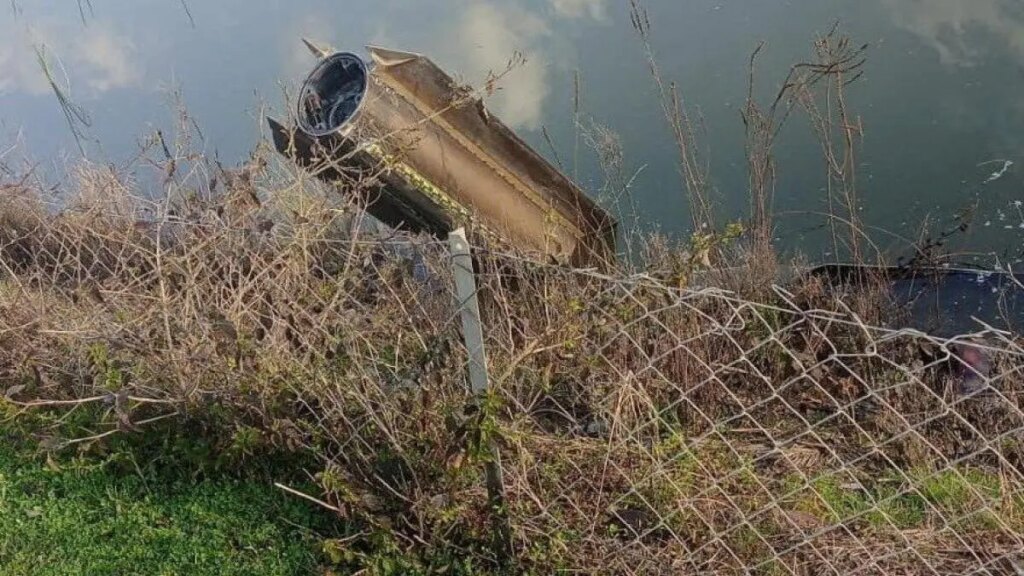
A series of missile launches from Iran toward Turkish airspace has triggered a quiet alarm in the region, with Turkish officials now assessing that the incidents may have been aimed at testing the North Atlantic Treaty Organization’s missile-defence network rather than targeting Türkiye itself.
According to officials briefed in Ankara, recent Iranian ballistic missiles appear to have been launched in trajectories that brought them close to Turkish airspace, prompting interceptions by NATO defence systems.
Although Iran has denied that any projectile was launched from the country, Turkish authorities say at least one of the missiles was launched from the Islamic Revolutionary Guard Corps base in Damghan, located in Iran’s Semnan province. The base is believed to house underground missile facilities and is considered one of the strategic launch sites used by Iran’s missile forces.
Ankara’s assessment gained urgency after a missile heading toward Turkish airspace last week was intercepted near Hatay in southern Türkiye, roughly 100 kilometres east of the Incirlik Air Base in Adana province. Incirlik has long served as a key NATO installation and previously hosted US forces and strategic assets.
A second missile fired earlier this week was also intercepted by NATO defence systems. According to military tracking data examined by Turkish analysts, both missiles appear to have been fired from locations east of Tehran and travelled westward toward Türkiye before being neutralised.
Turkish Foreign Minister Hakan Fidan spoke by phone with his Iranian counterpart Abbas Araghchi and conveyed that firing ballistic missiles toward Turkish territory was unacceptable, according to officials familiar with the conversation.
Iranian authorities have denied responsibility, suggesting the launches may have been false-flag operations intended to provoke tensions between the two neighbours. Tehran has also indicated that parts of its missile command structure may have been disrupted following recent strikes that killed several senior Iranian officials.
Araghchi previously stated that some Iranian missile command centres had been “isolated”, raising the possibility that fragmented command structures could lead to unauthorised launches.
Yet some officials in Ankara believe the explanation lies elsewhere. According to security sources, the missiles may have been deliberately launched to test NATO’s radar capabilities.
NATO Base in Türkiye
Türkiye hosts NATO’s strategically vital Kürecik radar base in Malatya province. According to Middle East Monitor, a not-for-profit press monitoring body, the base hosts a powerful TPY-2 X-band radar that forms a critical component of NATO’s European Phased Adaptive Approach missile-defence architecture. The radar is designed to detect and track ballistic missiles launched from Russia or West Asia toward Europe, providing early warning and targeting data for interception systems across the alliance.
Military analysts often describe the Kürecik radar as the keystone of NATO’s missile-defence network in Europe. A 2019 study by the Washington-based Center for Strategic and International Studies noted that the radar provides essential tracking data that allows NATO’s Aegis Ashore systems and interceptor missiles to engage hostile ballistic missiles outside the Earth’s atmosphere.
Without the Turkish radar, the report warned, NATO would lose early detection capability against missiles launched from Iran toward Europe. “Due to its position, it would be very difficult for a Europe-bound ballistic missile fired from Iran to avoid the radar’s field of view,” the report said.
The TPY-2 radar works as part of a broader “engage-on-remote” system that integrates satellites, forward sensors, and interceptor missiles positioned across Europe and the eastern Mediterranean.
Also Read | A dangerous war of choice and India’s diplomatic moment
The possibility that Iran might be probing this network is being taken seriously in Ankara. Reports in Western media indicate that Iranian strikes during the current conflict have already targeted radar, communications, and air-defence systems in several Gulf states, including Qatar, Jordan, and the United Arab Emirates.
NATO has now announced to reinforce its defensive posture in Türkiye. Alliance officials approved the deployment of additional Patriot missile-defence batteries to Malatya, near the Kurecik radar installation. The systems reportedly include the more advanced PAC-3 interceptors capable of engaging ballistic missiles.
These batteries are believed to have been redeployed from NATO’s Ramstein base in Germany. A defence official familiar with the deployment said the Patriot systems will complement missile interceptions already being conducted by US naval forces in the Mediterranean, creating a layered defence covering gaps in regional coverage.
Türkiye hosts several NATO installations while maintaining economic and diplomatic ties with Tehran, a balancing act that has often required careful diplomacy.
Regime change assessment
Israel and the US have conducted extensive strikes against Iranian military and strategic facilities, triggering a wave of Iranian missile launches across West Asia.
Israeli military estimates suggest that 60 to 70 per cent of Iran’s missile launchers have been destroyed during the campaign, though roughly 150 launchers remain operational. Analysts estimate that Iran possessed between 2,000 and 3,000 missiles before the conflict began, with around 600 reportedly launched during the first week of fighting.
A Turkish army personnel walks as they search a field after a piece of ammunition fell following the interception of a missile launched from Iran by a NATO air defence system, in Diyarbakir, Türkiye, on March 9, 2026.
| Photo Credit:
Sertac Kayar/Reuters
According to the website Al Monitor, despite the intensity of the campaign, intelligence assessments in the region suggest that the Iranian regime remains resilient. Experts caution that removing Iran’s leadership through external military pressure alone remains unlikely.
Michael Milshtein of Tel Aviv University’s Dayan Center noted that large-scale regime change typically requires internal opposition movements capable of mobilising sustained political pressure. “The aerial bombing operation against Iran, which does not include soldiers on the ground, is unlikely to generate the level of internal defection needed to topple the government,” he said.
Indeed, the swift appointment of Mojtaba Khamenei as Iran’s new supreme leader following the death of his father, Ayatollah Ali Khamenei, has reinforced the perception that the political system in Tehran remains intact despite the ongoing conflict.
For NATO planners and Turkish officials, however, the immediate concern is less about regime change and more about the evolving missile contest unfolding across the region. For Türkiye, both a collapsed Iran and its emerging as victorious in the war pose a challenge. Turkey had succeeded in neutralising Iranian influence in Syria with great difficulty in December 2024.
Also Read | America’s decapitation strike is becoming a strategic quagmire
If Iranian launches were indeed intended to probe NATO’s radar coverage, analysts say they may represent an effort to map vulnerabilities in the alliance’s missile-defence shield.
Such tests would allow Iranian strategists to better understand how NATO sensors detect and track incoming missiles, knowledge that could prove critical in any future confrontation.
For now, the skies over southern Türkiye remain quiet. But beneath that calm lies a growing technological duel between missile launchers and radar systems, one that could shape the next phase of the Middle East’s widening conflict.
Iftikhar Gilani is an Indian journalist based in Ankara.