
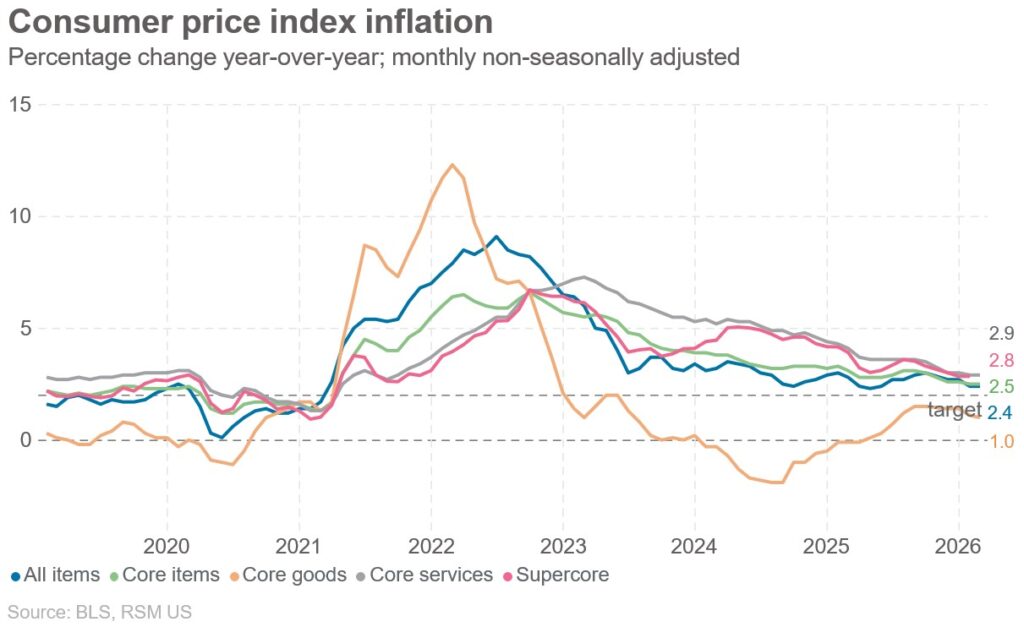
Because of the events in the Persian Gulf, policymakers and the public can effectively ignore the February consumer price index report that was released on Wednesday.
The data, which showed a 2.4% annual increase, was almost entirely collected before the outbreak of the war and does not capture the price increases that have been cascading through the economy since then.
Get Joe Brusuelas’s Market Minute economic commentary every morning. Subscribe now.
For this reason, investors should anticipate a monthly increase in top-line inflation of 0.6% in March because of a 0.4% rise caused by oil, gasoline and energy prices and a 0.2% increase excluding those items.
In addition, another 0.45% increase will eventually show up in the data as distortions caused by the government shutdown last fall are resolved.

The 0.3% monthly and 2.4% annual rise in the CPI for February will quickly turn into a possible top-line increase of 3% in March and 3.5% or greater in April.
Those rising prices will not provide much comfort for a Federal Reserve that will now be focused on short- and medium-term inflation expectations. The Fed will also be on notice for any bleeding through of top-line inflation in the core rate, which excludes food and energy, both in the consumer price index and in the Fed’s preferred inflation gauge, the personal consumption expenditures index.
The January PCE data, to be published on March 13, is expected to show both a top-line and core reading at or above 3%.
The energy shock
Policymakers, though, are working to slow the rise in energy costs. The International Energy Agency has coordinated he release of 400 million barrels of oil from global strategic reserves.
Such a move would slow rather than stop rising oil prices and offer a temporary salve to the searing burn of rising gasoline prices.
More important, it is critical not to just look at the total number of barrels released but also at the near-term flow and regional skews that will occur over the next 30 days.
Each economy will pursue its own interests. Investors should anticipate subsidies for gasoline purchases, rationing and gas tax holidays at a minimum to accompany the coordinated release.
Collective action requires cooperation and no ex-post reneging for the historical release of strategic petroleum reserves among the Group of Seven economies.
If one looks at the allocation of the G7’s 1.1 billion barrels of reserves, the U.S. holds 41%, Japan 26%, France 12%, Germany 11%, Italy 7% and the UK 4%.
Watch near term announcements by all G7 fiscal authorities for further steps to mitigate the energy shock.
This is a busy time, but there is no panacea.
The only duration that matters right now is how long the Strait of Hormuz remains effectively shut and the war continues.
The data
Inside the report, inflation increased by 0.3% in the top line and by 0.2% in the core, which translated to a 2.4% rise in the former and 2.5% in the latter from one year ago.
Energy prices jumped by 0.6%, energy commodities by 1.15% and gasoline by 0.8% on the month. All of those categories will soar in March, which we think will raise the top-line rate by 0.6% at a minimum next month.

Services advanced by 0.3% on the month and by 3.1% annually with services ex-energy up by 0.3% and 2.9%, respectively.
Housing advanced at a 0.3% pace on the month and by 3.0% on the year, while shelter and owners’ equivalent rent were up by 0.2% and 3.2%.
Fuels and utilities jumped by 0.5% monthly and by 5.6% annually. Those categories are also likely to have outsized increases in March.
Food and beverage prices increased by 0.4% on the month and by 3% over the past year while food on its own was up by 0.4% and 3.1% over that same period.
One under-examined aspect of the war in Iran and the closure of the Strait of Hormuz will be the price shock to the cost of nitrogen-based fertilizers which will bleed into the cost of food over the next few months.
Transportation and airfare costs will also increase in a painful way in the next couple of months. In February, transportation costs rose by 0.2% and airline fares rose by 1.4%, while the used cars and trucks declined by 0.4% as dealers attempted to clear 2025 models.
Recreation costs were flat, medical costs increased 0.5%, education and communication costs declined 0.2% and commodities prices increased 0.3%.

The takeaway
Investors, policymakers, chief executives and the public should take no solace from the modest top-line increase in the CPI. We anticipate that March data will show a sharp jump because of the energy shock that the economy is absorbing.
Depending on the length of the war and how long the Strait of Hormuz remains closed, businesses will be faced in the near term with decisions about what costs to absorb through thinner margins, what costs to pass along downstream to consumers and how many workers to lay off to bring balance sheets into alignment with inflation.
At the end of the day, duration matters both in terms of the war and how long the Fed will wait to move on to inflation if the rising CPI bleeds into the core.