
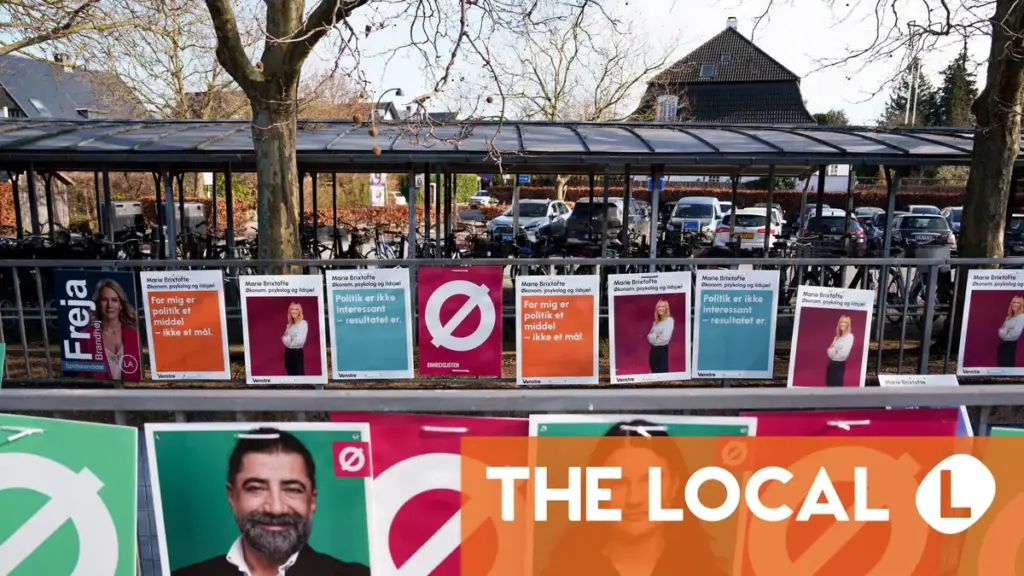
It’s hard to miss the campaign posters which have popped up all over Denmark since the election was announced earlier this month. But why do the Social Democrats have the party letter A, and why is the Danish People’s Party O?
Denmark has a lot of political parties. There are currently 12 of them holding seats in parliament (plus two Greenlandic and two Faroese parties).
Each party is assigned a party group letter, which are the same letters you’ll usually see used in the media. The Social Democrats, for example, have the letter S, while the Denmark Democrats use the letters DD and the Socialistisk Folkeparti (in English, Green Left), go by SF.
Below is a full list of the parties representing Denmark and the party group letters they use.
S – Socialdemokratiet/Social Democrats
V – Venstre/Liberal Party
DD – Danmarksdemokraterne/Denmark Democrats
SF – Socialistisk Folkeparti/literally the Socialist People’s Party, but they go by Green Left
LA – Liberal Alliance
M – Moderaterne/Moderates
KF – Det Konservative Folkeparti/Conservative People’s Party
EL – Enhedslisten/Red-Green Alliance
DF – Dansk Folkeparti/Danish People’s Party
RV – Radikale Venstre/Social Liberal Party
ALT – Alternativet/The Alternative
BP – Borgernes Parti/Citizens’ Party
Confusingly, these letters are not the same as the party letters used during elections, on ballot papers and in election materials. For example, the Social Democrats go by A, the Denmark Democrats go by Æ and Alternativet go by Å. The only parties to use the same party group letter and election letter are the Liberal Party, which goes by V, and the Moderates, who go by M. Here’s the full list of party letters used in elections:
Advertisement
A – Socialdemokratiet/Social Democrats
V – Venstre/Liberal Party
Æ – Danmarksdemokraterne/Denmark Democrats
F – Socialistisk Folkeparti/literally the Socialist People’s Party, but they go by Green Left
I – Liberal Alliance
M – Moderaterne/Moderates
C – Det Konservative Folkeparti/Conservative People’s Party
Ø – Enhedslisten/Red-Green Alliance
O – Dansk Folkeparti/Danish People’s Party
B – Radikale Venstre/Social Liberal Party
Å – Alternativet/The Alternative
H – Borgernes Parti/Citizens’ Party
You’ll notice that many of the letters near the start of the alphabet are already taken. That’s because in 1909, each party was allocated a letter based on its size.
The Social Democrats were given A, the Danish Social Liberal Party were allocated B and Højre (Right) which later became the Conservative People’s Party, was allocated C. The Liberal Party were given the letter D, which they swapped for V in 1971 as it better reflected the party name, Venstre.
The F used by the Green Left reportedly refers to the Folkeparti in its Danish name, while one of the founders of the Danish People’s Party, Pia Kjærsgaard, has said that the O stands for optimism, order and organisation (these words also all start with the letter O in Danish).
Advertisement
In later years, as new parties were formed and stood in Danish elections, the rules were changed, allowing them instead to pick their own (with some caveats). They’re only allowed to pick a letter once they’ve met the requirements allowing them to stand in an election – handing in the required number of voter declarations (20,195 for a general election or 70,680 for an EU election) and successfully registering with the Ministry of the Interior and Health.
Parties can express a preference for a particular letter, but the decision is ultimately up to the ministry, and as far as possible parties should use the same letter in each election. If a party chooses a letter previously used by a different party then the ministry will consider how long ago the letter was used in an election before deciding whether it can be allocated or not. Essentially, the ministry will as far as possible try to avoid a situation where a voter links a letter to a different party which used it recently.
There are also a few letters which are not available to be allocated to a party, whether due to a strict rule or potential issues. The letter S is reserved for the Schleswig Party, a regional party representing the German minority in Schleswig in South Jutland (it hasn’t stood in a general election since 1971, but it has the right to without having to collect voter declarations), while L and T are not used due to potential confusion with local and regional elections.
The letter W is avoided because it could be confused with V (they are pronounced the same in Danish), while X is banned as it could be confused with the X used to mark a ballot paper.