
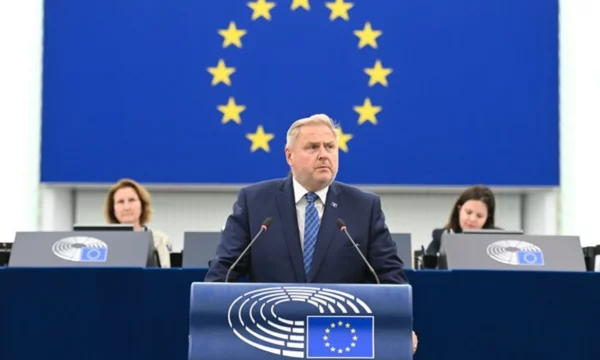
The rapporteur for Kosovo in the European Parliament, Riho Terras, has compiled a draft report on Kosovo that includes political developments, the rule of law, the economy, corruption, the dialogue with Serbia and Kosovo’s European integration process for 2025.
In this report, Terras saw the past year as a lost year for Kosovo, since after the elections of February 9, 2025, neither the Assembly nor the Government was able to become functional.
“Although all three elections held in Kosovo in 2025 – two parliamentary and one local – were conducted peacefully and orderly, the normal political process was severely disrupted. As a result, several political and economic reforms stalled and the Growth Plan for the Western Balkans could not be implemented,” the report states.
He said that Kosovo has made significant progress in electoral reform, economic sustainability and the protection of fundamental rights, but despite this, according to Terra, challenges continue to remain in justice reform, media freedom, public administration efficiency and digitalization of public services.
Terras said in this draft report that continued commitment to comprehensive reforms and inclusive governance is essential for Kosovo’s progress on the path to European integration.
Regarding the Kosovo-Serbia dialogue, he said that it has not yielded the expected results.
“In essence, the dialogue was almost suspended during 2025. This was also because Kosovo did not have a government with a mandate and authority, and negotiations in this form have no perspective. The European Commission, as well as the European Parliament and the member states, must definitely do everything to ensure that the Pristina-Belgrade dialogue continues with renewed energy. Therefore, the extension of the mandate of the Special Representative, Peter Sörensen, until February 2028, is very welcome,” the draft report states.
Regarding EU enlargement, he said that it is one of the most important success stories of the EU and, according to him, it should continue since the broader geopolitical goal of enlargement is to eliminate the so-called “gray areas” from the map of Europe.
“The major changes that have occurred in the context of Russia’s war of aggression against Ukraine should increase the European Union’s readiness to confront competing authoritarian global actors. Both Russia and China have shown that they have very clear interests in the Western Balkans. Kosovo’s European integration is a two-way process. For Kosovo to implement the necessary reforms, assistance from the European Union is also necessary. Visa liberalization has further strengthened people-to-people contacts and the European perspective of Kosovo’s citizens,” the draft report states.
Regarding the punitive measures that the EU imposed on Kosovo in 2023, he said that they had a very negative impact on Kosovo’s progress towards Europe.
“Although the EU measures have gradually started to ease, their impact on society remains very worrying. Particularly affected by these measures are various civil society organizations, national minorities, as well as small and medium-sized enterprises, which have received significant operational support from EU programs. The measures may also have a negative impact on the credibility of the European Union among the population of Kosovo. Although support for the European Union has remained very high, there is a risk that it will decrease as a result of these measures,” the report further states.
© BalkansWeb