
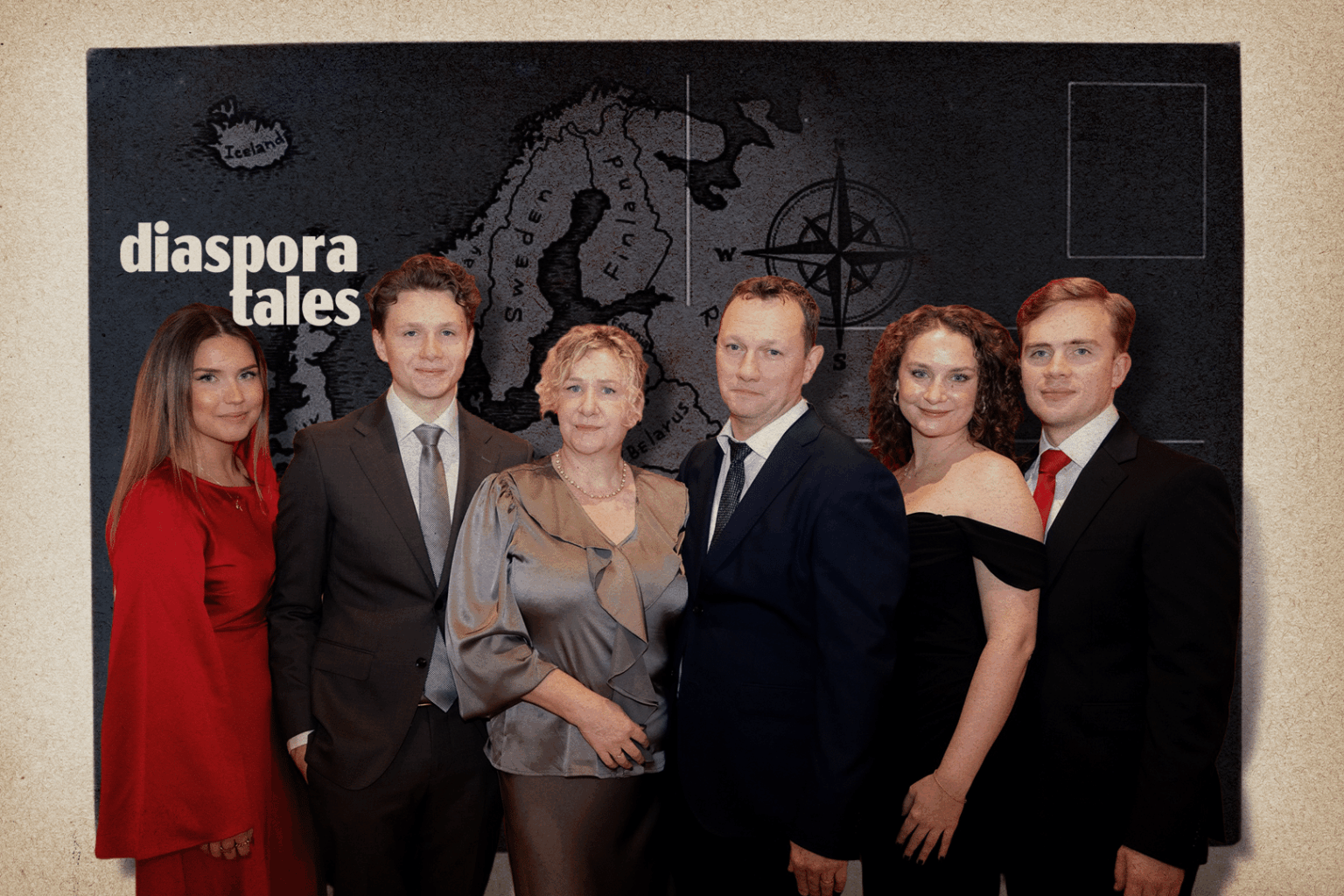
Havdic Cof was born in Tuzla, in northeastern Bosnia, in 1969. Her childhood was ordinary, framed by the rhythms of school and family life. She completed primary and secondary school and went on to study mining engineering.
Her trajectory was familiar, almost predictable: finish her diploma, begin a career, and perhaps explore the world beyond Bosnia. But everything changed in April 1992, when war erupted in her home country, which would last until November 1995.
“I had just started working on my diploma thesis when the war literally began,” she recalls. “That is how it was. I studied mining engineering and even had my first job at the Mining Institute in Tuzla. But the war had already started, and I spent the first two months down there, in the war zone.”
The war intensified a desire she had harboured even before the fighting started: to leave Bosnia and experience life abroad. Protected by her parents and growing up in a stable environment with her sister, Emira had never faced a world of daily uncertainty. The conflict, however, forced a choice – stay and endure, or leave and save herself.
By chance, she found her way to Sweden. Through a distant family connection, friends of her parents who had lived in Sweden since the 1970s, she was able to secure the necessary documentation to move.
“At the time, I thought I was the last person who would be affected by nostalgia, especially after everything that had happened. But the separation from my family and from Bosnia was extremely hard for me. I developed strong nostalgia despite the war,” she says.
In the first months at a Swedish refugee camp, she considered returning to Bosnia, even as the war raged. “I felt that something was wrong, that this was not right,” she says.
It was only when the Swedish government granted permanent residence permits to Bosnians that she could begin building a life beyond the confines of uncertainty. Language courses, diploma validation, and entry into the workforce marked the start of a slow normalisation.
In the camp, she met her husband, Davor Cof, a man from Banja Luka who had served in the Yugoslav People’s Army. Stationed in Pristina in Kosovo, he had witnessed the horrors of the battlefield firsthand. After his service, his parents warned him: “Do not come back here. Run wherever you can, but do not return.” He, too, found refuge in Sweden.
Together, they began the delicate work of rebuilding. Emira’s mother fell ill with cancer during the war and required treatment abroad. Davor’s family, too, eventually left Banja Luka, aided by the Red Cross. Life slowly stabilised: jobs were found, children were born, and the notion of returning to Bosnia became a distant hope rather than a plan.
Through it all, Havdic Cof carried a quiet, but persistent reflection on what had been lost in Bosnia. “From the very first day, I was haunted by a thought: what kind of country we once had,” she says.
“We had everything, things functioned positively. Of course, not everything was perfect, but it was a fantastic foundation on which something even better could have been built, instead of destruction through war. In Sweden, I always thought how little it would have taken for us to have the same. Just a little human wisdom and positive energy.”
Learning the ‘ping-pong effect’