
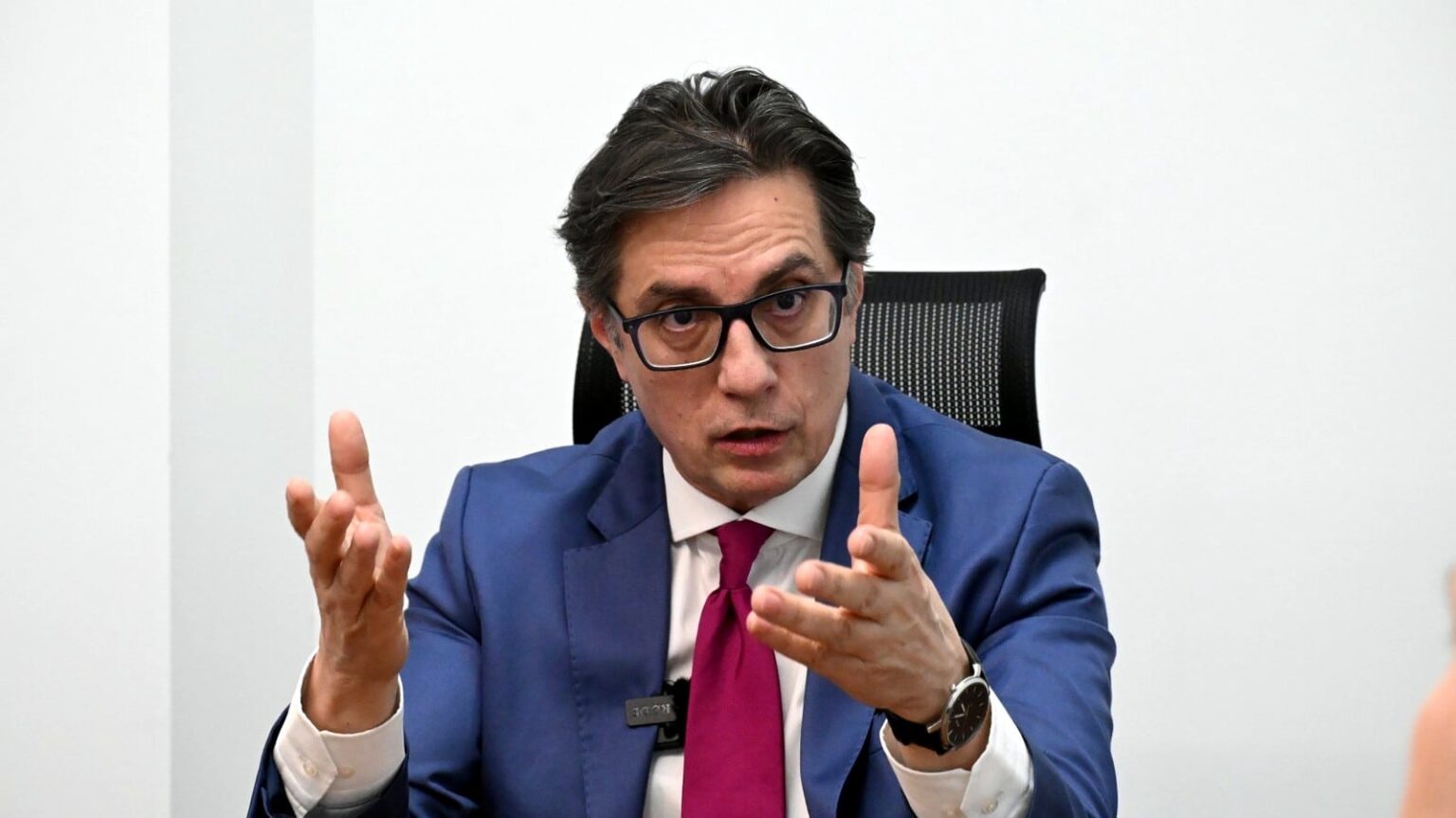
Pendarovski, who was endorsed by the Social Democrats when they were in power, has dedicated his political career to Euro-Atlantic integration. After his term in office ended, he returned to his work as a professor at the University American College, Skopje, specialising in security, geopolitics and foreign policy.
The year before he became president, Greece and Macedonia signed a deal to settle a decades-long dispute over Macedonia’s name, which led to the country being renamed North Macedonia. This was intended to unblock the country’s path towards EU membership.
But issues with another neighbour, Bulgaria, have continued to hold up accession. North Macedonia’s path to EU membership remains stuck on Sofia’s insistence that the country include Bulgarians as one of its “constitutive peoples” in its constitution. The constitutional change was agreed as part of a deal in 2022 to lift Bulgaria’s blockade against North Macedonian accession.
However, the current VMRO-DPMNE administration under Prime Minister Hristijan Mickoski refuses to do this, insisting it is derogatory and harmful for national interests.
As an alternative, Mickoski recently mentioned the so-called “reversed” EU membership initiative.
Some observers in the country have recently argued that North Macedonia could benefit from this mooted so-called “reversed” EU membership initiative, in which it would quickly gain EU membership but would not have full voting powers, while access to EU funds would be suspended until the country gradually meets the accession conditions. Under this suggestion, Western Balkans countries like Albanian and Serbia, along with Ukraine, could achieve rapid EU accession and fulfil the necessary conditions later.
Pendarovski, however, said this is “an absolute absurdity”.
“The idea is absurd because it is impossible without changing the fundamental documents of the EU, which would require the agreement of all member states,” he points out.
He insists that no matter how appealing this idea might sound to the average Macedonian, the big EU member states simply do not support it.
There is no official document regarding the initiative and, according to media reports, it does not have the support of the larger EU member states. On the contrary, it is said to originate from countries such as Hungary, which, besides having problems meeting democratic standards itself, maintains close relations with Russia despite its aggression against Ukraine, and often takes positions contrary to the Union’s security policies.
Without naming specific countries, Pendarovski says the idea of rapid EU entry without voting rights comes from states that would like to see members “similar to themselves” enter the European Union through a shortcut without fulfilling the obligations.
“That is a childish way of reasoning in politics – both domestic and international. Something like that will not happen,” he says firmly.
For Pendarovski, it is also indicative who supports the idea most.
“These are governments from the [Western Balkans] region that either are negotiating with the EU – but will hardly reach there – or have not yet started negotiations and are secretly praying never to enter the Union.”
Although the tough stance on changing the constitution was one of the reasons for the right-wing VMRO-DPMNE’s convincing victory in the 2024 parliamentary elections, Pendarovski is surprised that, once in power, the party did not continue on the previous government’s European path.
He expected Mickoski to follow the example of Greek Prime Minister Kyriakos Mitsotakis, who, although he was against the 2018 Prespa Agreement – which lifted the Greek veto on North Macedonia’s Euro-Atlantic membership – after coming to power, he respected its international obligations.
“Instead, our folks [the VMRO-DPMNE government of North Macedonia] have doubled down on their rhetoric. This is not done by statesmen, but by people who want to stay in power.”
No direct threat from Iran but risks exist