

Workers in Croatia take significantly fewer sick days than many of their European counterparts, according to new comparative data based on OECD labour statistics.
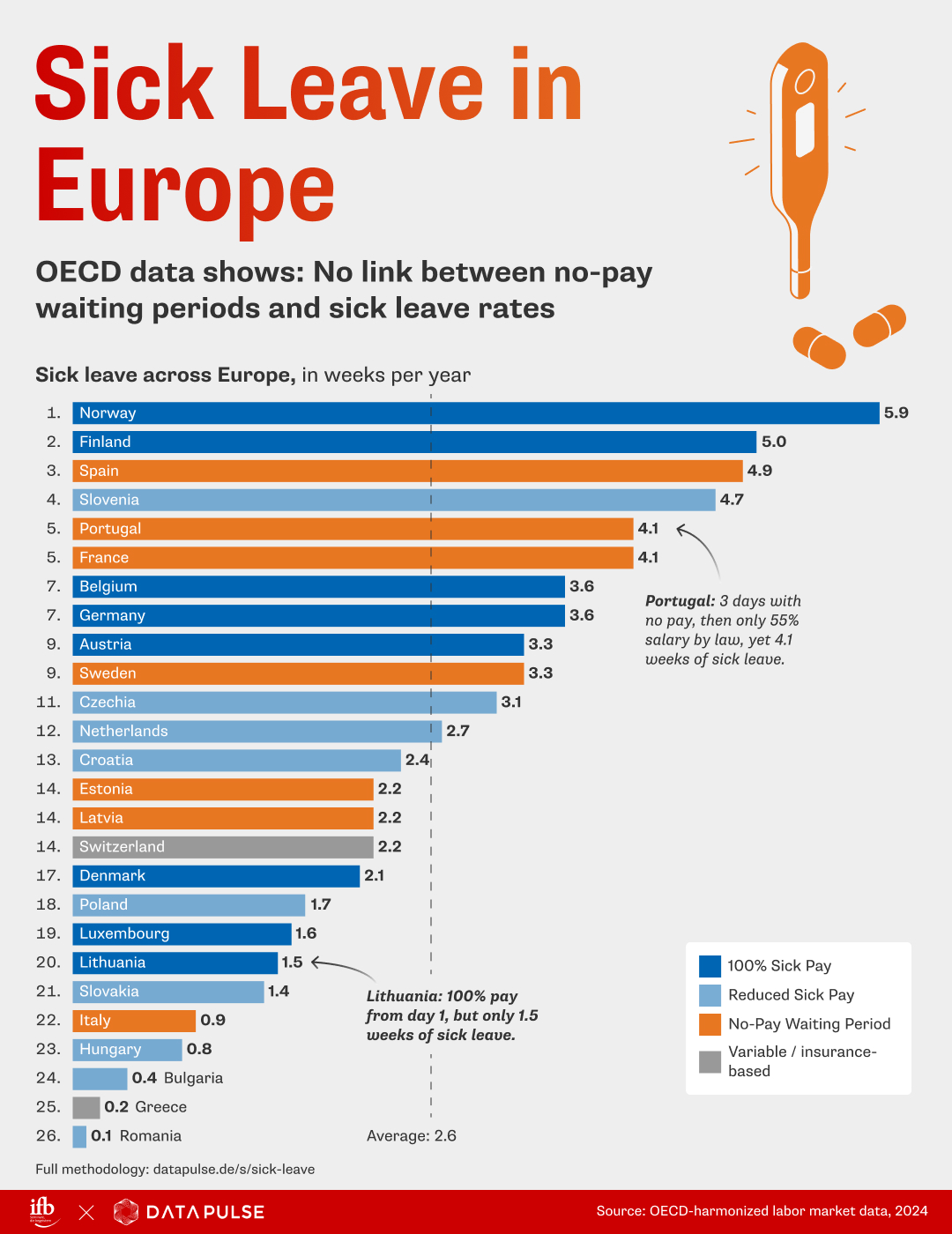
The data shows that Croatian employees take an average of 2.4 weeks of sick leave per year, placing the country in the lower half of European rankings and below the continental average of 2.6 weeks.
In contrast, Nordic countries top the list. Workers in Norway record the highest average with 5.9 weeks of sick leave per year, followed by Finland with 5.0 weeks and Spain with 4.9 weeks.
Croatia ranks 13th among the European countries included in the dataset, placing it behind countries such as Slovenia (4.7 weeks), France (4.1 weeks) and Germany (3.6 weeks).
Fewer Sick Days Than Many Neighbours
The figures highlight notable differences in sick leave patterns across Europe. Countries with generous sick pay systems do not necessarily record higher levels of absence, according to the OECD-based analysis, which found no clear link between waiting periods for sick pay and the number of sick leave weeks taken.
Within the region, Croatia’s average is lower than several neighbouring or nearby countries. For example, Slovenia records 4.7 weeks, nearly double the Croatian figure.
However, Croatia still ranks above several countries with shorter periods of sick leave. These include Poland with 1.7 weeks, Italy with 0.9 weeks, and Greece with just 0.2 weeks.
Sick Leave Trends and Workforce Impact
Sick leave remains an important indicator of workplace health and labour market dynamics. Across OECD countries, policies typically combine employer-paid sick leave for the first days or weeks of illness with longer-term support from national insurance systems.
In Croatia, the issue has also drawn attention due to the number of workers on long-term sick leave. Data from the Croatian Health Insurance Fund showed that an average of more than 39,000 people per day were on long-term sick leave in the first half of 2025, an increase of 10.7 percent compared with the previous year.
Despite this rise in long-term cases, the overall average number of sick leave weeks taken by workers remains relatively modest compared with many European economies.
Cultural and Policy Differences
Experts say differences in sick leave across Europe can reflect a combination of factors, including workplace culture, national insurance systems and public health conditions.
Research comparing OECD countries shows that sick leave absence can vary widely, from just a few days per worker annually in some countries to nearly a month in others.
For Croatia, the figures suggest that workers generally take fewer weeks off sick than the European average — a trend that may reflect both workplace practices and the structure of the country’s social insurance system.