
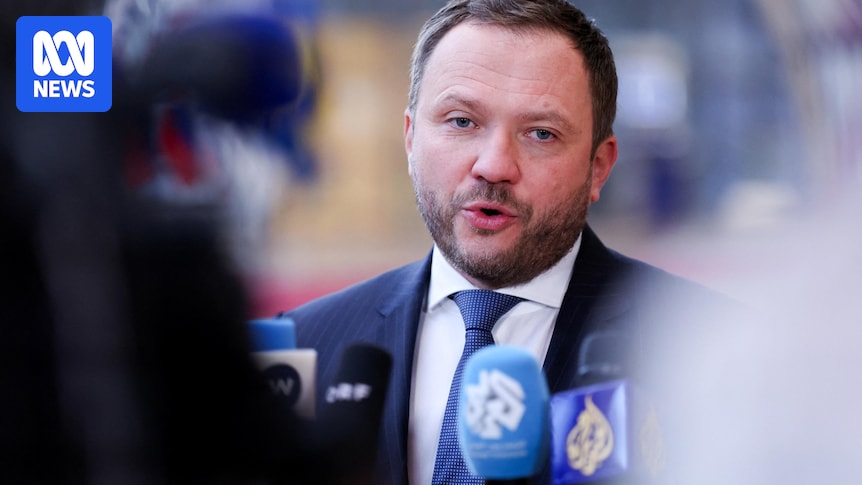
Estonia’s foreign minister has declared that Europe was like an “old fat lazy cat” in the aftermath of the Cold War and has vowed that NATO forces will strike “into the heart of Russia” if Moscow invades Baltic countries.
Margas Tshahkna has also encouraged Australia to join his country’s plan to block entry to Russian fighters, warning battle-hardened veterans could easily flood into Western nations to carry out acts of sabotage, particularly after the war in Ukraine ends.
Mr Tshahkna has travelled to Canberra for meetings with Foreign Minister Penny Wong and Home Affairs Minister Tony Burke as the small but successful Baltic nation — population 1.3 million — looks to deepen its strategic ties with fellow democracies beyond the US and Europe.
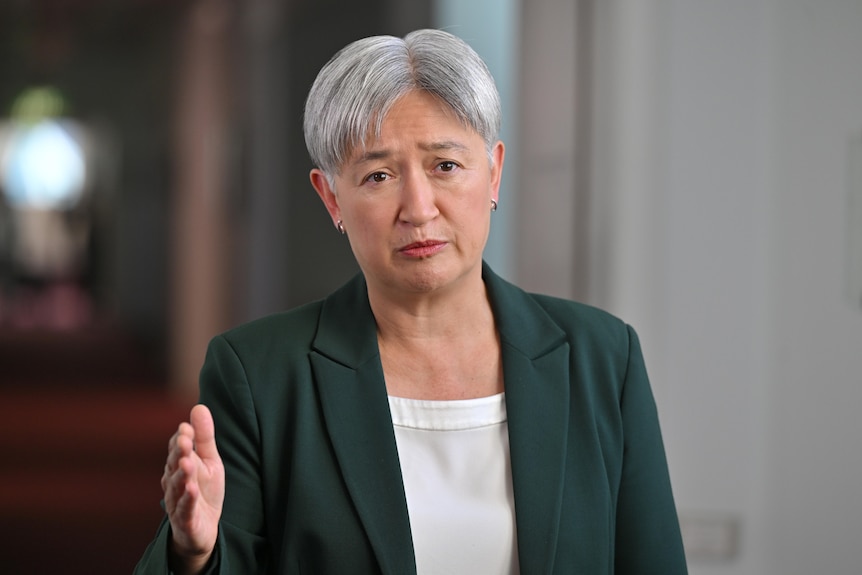
Estonia’s Foreign Minister Margus Tsahkna is in Canberra for talks with Penny Wong and Tony Burke. (AAP: Mick Tsikas)
Estonia was annexed by the Soviet Union during World War II before regaining independence in 1991, and has been one of Ukraine’s most forceful backers in Europe — pressing fellow EU and NATO members to grant Kyiv membership.
Mr Tshahkna said he was concerned that around 1 million Russian fighters with combat experience from the Ukraine War could provide a useful recruitment pool for the Kremlin if it wanted to wreak havoc in Western nations.
“It is already happening in Europe. Putin wants to get rid of these bad guys,”
he said.
“He cannot keep them in Russia … so probably they will come to Europe. Then we could have hundreds of thousands of people coming here.”
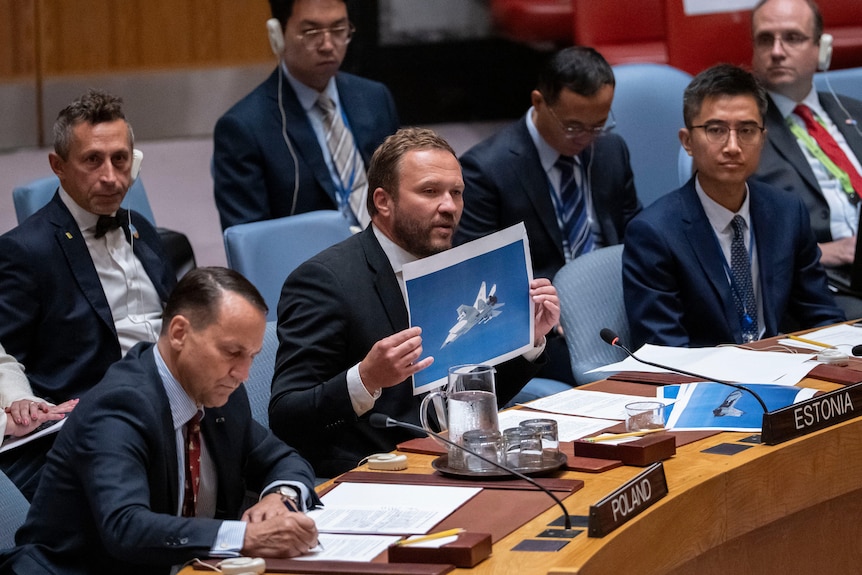
Estonia, annexed by the Soviet Union in World War II and independent since 1991, has been a strong European supporter of Ukraine, urging EU and NATO membership. (AP: Yuki Iwamura)
Estonia has already banned hundreds of Russian soldiers who invaded Ukraine from ever entering the country, and has been pressing the EU to do the same for the Schengen area, a passport-free zone covering most of its member states.
While the proposal is popular with many European nations some officials have questioned whether it would be practical to enforce.
Russian warplanes breach NATO airspace over Estonia
But Mr Tshahkna said even distant democracies like Australia should consider doing the same because of the sheer scale of the threat.
Estonia — which had mandatory military service — also remains deeply worried by the prospect of a Russian invasion, with three Russian fighter jets making a “brazen” incursion into its air space last year.
Mr Tshahkna said it was imperative for European countries to keep their recent commitments to rapidly escalate military spending, and said the Trump administration had shaken the region out of decades-long complacency.
“Europe, I’m sorry to say, has been like an old, fat, lazy cat … they really believed the end of history times were there,” he told the Australian Strategic Policy Institute in Canberra.
“Now we need to invest (in defence) more heavily. Unfortunately it wasn’t Putin who woke up Europe it was President Trump, being very clear about the message that this relationship will be strong, but it won’t be unconditional anymore.”
He also said Europe had to back up its “red lines” with “real force” in order to dissuade Vladimir Putin and the Russian military from taking advantage of Western weakness.
“We need to understand Putin is playing on our fears — fears of escalation, fear of nuclear weapons. We cannot have this fear,” he said.
Loading…
Mr Tshahkna said when Russia last massed soldiers on the border of his country there were no NATO troops within, but that situation was now very different.
“We now have NATO troops integrated into our troops. So our deterrent is, within the first minutes and hours (of the conflict) there will be dead soldiers from multiple countries,” he said.
“So if the war is starting we’ll hit into the heart of Russia. Because then it’s an existential question for us.”