
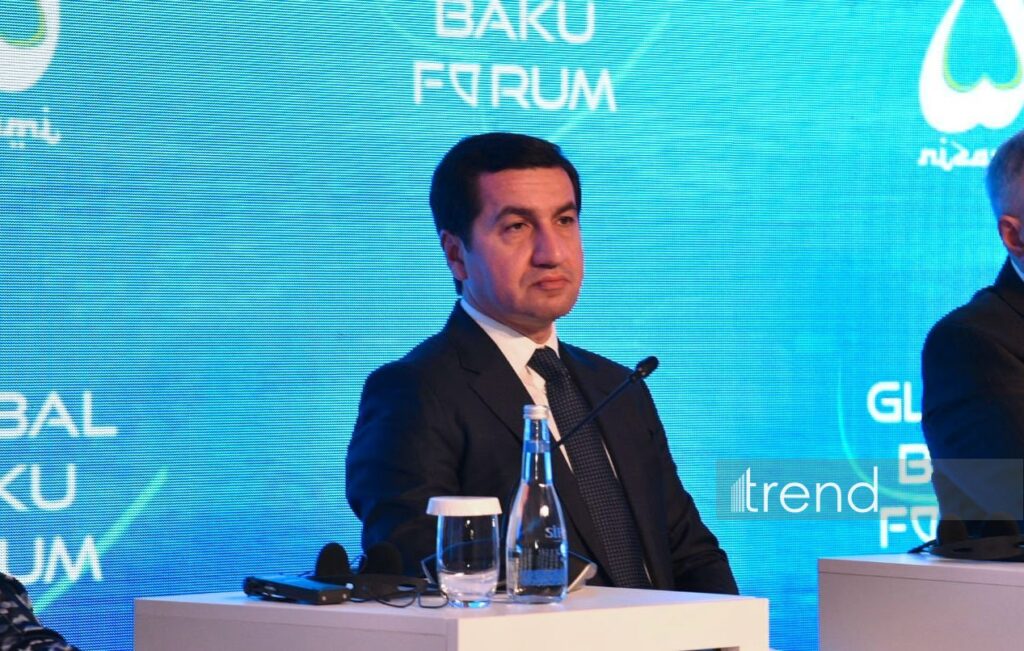
BAKU, Azerbaijan, March 12. Azerbaijan and
Armenia are currently working on the parameters of a future peace
agenda, said Hikmet Hajiyev, Assistant to the President of the
Republic of Azerbaijan, Head of Foreign Policy Affairs Department
of the Presidential Administration, Trend reports.
Speaking at the panel discussion titled “Crisis of
Multilateralism: Rethinking Global Cooperation” within the
framework of the 13th Global Baku Forum, Hajiyev stated that at the
regional level, Azerbaijan is also actively engaged within the
Organization of Turkic States (OTS) and contributes to the
institutional development of the organization.
“Recently, Azerbaijan also joined the Developing Eight (D8)
Organization for Economic Cooperation, and we support the further
institutionalization of this organization and the strengthening of
its functionality,” he said.
According to Hajiyev, it is sometimes evident that institutions
within the United Nations system compete with each other rather
than cooperate.
“Instead of using limited resources efficiently, competition
arises among these institutions. In such circumstances, when some
multilateral institutions prove insufficiently flexible, countries
like Azerbaijan turn to the concept of middle powers. What does the
concept of a middle power and multilateralism mean for us? It means
that instead of simply waiting for multilateral institutions to
make decisions, we take the initiative and bring together
like-minded countries around certain issues in order to bring about
real change. Two concepts stand out here: a ‘coalition of the
willing’ and ‘variable geometry.’ In this approach, geography is
not particularly decisive. For example, Azerbaijan, Australia, and
Türkiye can cooperate on specific issues,” he said.
Hajiyev noted that Azerbaijan is currently cooperating within
the climate agenda of COP and discussing how it can contribute more
effectively to the agenda of the next COP. Azerbaijan is also
cooperating with Ethiopia in the field of climate diplomacy.
“This demonstrates that flexible diplomacy and variable geometry
play an important role. When like-minded countries come together,
they can contribute to shaping the region. This approach is also
applicable to the peace and security agenda in our region,” he
said.
Hajiyev also recalled that Azerbaijan did not wait for
multilateral institutions to resolve its challenges.
“As our President has noted, we did not wait for multilateral
institutions to come and solve our problems. In the early years of
our independence, we entrusted certain responsibilities to
international institutions, including the Organization for Security
and Co‑operation in Europe. However, we must admit that the OSCE
also became one of the unsuccessful projects in terms of peace and
security in the Euro-Atlantic space. In particular, the OSCE Minsk
Group turned into a complete diplomatic failure in our case,” he
said.
Despite this, Hajiyev stressed that Azerbaijan presented a
unique model for ensuring peace and security.
“We resolved a long-standing conflict through military and
political means,” he noted.
According to him, there is now real peace in the region, and
both Armenia and Azerbaijan are working on the parameters of a
future peace agenda. Hajiyev added that energy security in the
region also represents a successful example of multilateral
diplomacy.
“Along the route stretching from the Caspian Sea to the Adriatic
Sea, many countries came together and implemented projects that
benefit everyone,” he said.
Another example, he noted, is cooperation between Central Asia
and Azerbaijan. Last year, Azerbaijan was accepted as a full member
of the Central Asia Consultative Forum.
“This shows that countries of similar size and with similar
views can come together and contribute to shaping both regional and
global agendas,” Hajiyev added.
Stay up-to-date with more news on Trend News
Agency’s WhatsApp channel