
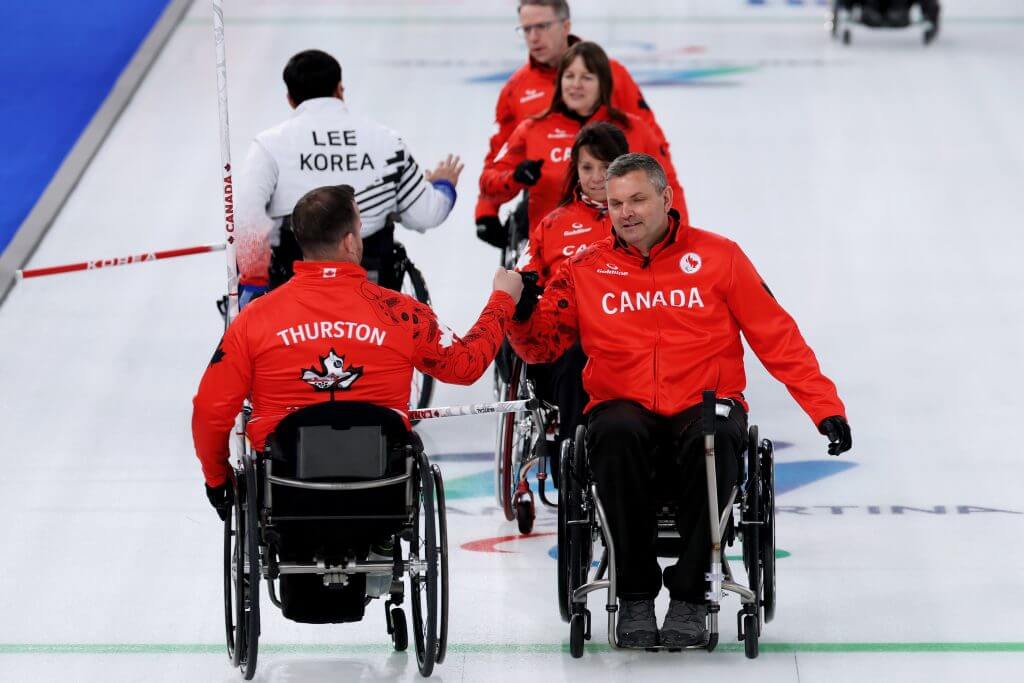
CORTINA D’AMPEZZO, Italy — The only thing Canada’s wheelchair curling team can be accused of is being too good.
They needed only seven of the nine matches to qualify for the Paralympic mixed team semi-finals and, after taking North American bragging rights with a 7-3 win over the U.S. in the final game Thursday, became the first team in Paralympic history to win 100 per cent of their round-robin matches.
Advertisement
Canada took down world No. 1 China 9-4 in the seventh session Tuesday morning and returned that evening to beat Sweden (6-5) with the final throw of the match. This team has many ways of winning.
“You still want to make the best shots you can and have a perfect record. Why wouldn’t we want to win every game?” Ina Forrest said Wednesday after Canada beat Slovakia 9-6. She throws second and has become indispensable on a Canada team that has not stopped achieving since 2006, when wheelchair curling debuted at the Turin Games.
Canada have made the podium in all five Paralympic Winter Games at which curling has featured, with Forrest on the last four of those teams. They won gold in the first three, victorious over Great Britain in 2006 and triumphing over South Korea on home soil (2010, Vancouver) before beating Russia in Russia at the 2014 Sochi Games. They’ve brought back bronze medals from the past two editions.
Compare them to Canada’s Olympic men’s team, who won gold in Cortina three weeks ago. The major difference between that team and this one is how they get to the medal matches.
Advertisement
The Olympic men were accused of cheating at the Olympics by Sweden, who said they had illegally touched their stone once it passed the hog line (where athletes must release it). That led to swearing and arguments on the ice and became an international headline. A day later, the Canadian women’s team was called for that same violation.
Now their wheelchair athletes have gone viral — for all the right reasons. Jon Thurston, their vice skip, who throws third, produced the shot of the tournament in their 9-2 win over Norway on Sunday evening.
He made a double takeout, hitting one Norwegian rock into another to remove both, while avoiding the five red Canada stones in the house (scoring zone). The game at that point was extremely tight. Canada were 3-2 up after five ends, until Thurston’s shot set up a match-winning six-point end — the most points anyone has scored in one end at these Games.
“(The gap) was only this wide,” Forrest said in the mixed zone, holding her hands out just wider than a curling stone to show the gap — between two Norwegian guard rocks — Thurston fired his takeout through.
Advertisement
“You need to have the weight to get through a tight hole, and you need the right line. It was a great shot, a great line call. Everything came together.”
They won the game — 9-2 after Norway forfeited the final two ends — and won attention. More than a million people have seen the clip of the shot on the Olympics-themed Instagram account of the CBC, Canada’s public broadcast company. Other clips, including from the official Paralympics account, have hundreds of thousands of views.
“I’ve heard that,” Thurston said in the mixed zone of his viral shot after beating the U.S. “It’s amazing. More eyes on our sport is a good thing. I was super happy with that (shot).”
Are takeouts his favourite? “No, honestly not,” he said with a laugh. “Because if you have to make them, you’re usually not in a good position. But they are nice.”
Advertisement
Thurston is phenomenal at them, successful with 78 per cent of his 45 takeout attempts in the round robin. His prowess was prevalent in the first end against the U.S., finding the gap again between guards. He hit one red stone into another, clearing both and preventing the Americans from taking control of the house.
In the seventh end — with the team up 6-3 after stealing two points in the sixth end — Forrest delivered two perfect takeouts of her own. She bounced away yellow stones by hitting them head-on, meaning her Canadian red rocks stopped dead in.
It put them in the enviable position of having three stones in a scoring position early in an end for which the U.S. had the hammer (final shot). Canada took a point from it, the 19th time these Games they have stolen an end — the most of any team.
Collectively, Canada put up shot success numbers of 70 per cent or higher in matches three through six and eight and nine. In wheelchair curling, where there’s no sweeping and athletes throw using a stick, those are outrageous numbers, the kind of levels that Olympic teams hit.
Advertisement
This Canadian team, coached by Mick Lizmore and skipped by Ontario native Mark Ideson (he throws fourth), is rich in experience together. Forrest (second), a left-handed thrower and British Columbia native, made her international debut in 2007.
Thurston, with fellow Ontarian Collinda Joseph, and Dennis Thiessen (from Manitoba), earned Paralympic bronze in 2022. That trio has competed for Canada at multiple world championships, making the podium at four of the past five editions — but with no golds, as China has started to dominate.
Ideson made sure to praise Gilbert Dash, their alternate from Kipling, Sask., after he played in Canada’s 11-1 thumping of Latvia in the round robin.
“Gil’s been knocking on the door for a while,” Ideson said. “We’ve just had some skilled players. We have a lot of depth in Canada, which is great for our programme. He’s a worthy player on our team.”
Advertisement
So good are Canada that they can rotate their squad as well as change who throws in what order — and still win.
They have an inevitability about them. Against Slovakia, China, Latvia and Italy, they produced four-point ends to take control. Only twice have they given up more than two points in an end, proving to be the hardest team to score against.
They did not panic when the U.S. went 2-0 up after the first end of the ninth match. Ideson had missed a takeout, and their opponents capitalised on a rare free chance for a two-point score. The four black-jacketed Canadians reconvened in the middle of the ice, talked, fist-pumped and set up again.
Joseph threw Canada’s first two stones of end two, arcing the second perfectly past a yellow American guard and taking out the yellow that Oyuna Uranchimeg had dropped on the button. Forrest followed with two pinpoint shots into the house, a back-and-forth game of takeouts occurred, and Canada tied the score.
Advertisement
What makes them so strong? “Just our processes,” Thurston said in the mixed zone after. “We’re doing a really good job at reading ice and rocks, communicating well. We’ve put a lot of time and effort into our preparations, and it’s definitely showing.”
They are now just one win away from another guaranteed medal. The benefit of topping the round robin is they play fourth-place South Korea for a place in the gold medal match, with 2022 champions China facing Sweden in the other semi-final.
For all their quality, they are still superstitious. Ideson hides a loonie, a $1 Canadian coin, everywhere he plays. He says it’s hidden somewhere on the ice. “It’s just become a tradition with some sports in Canada; it brings a bit of luck.”
They are keeping another Canadian tradition going: winning in curling.
Advertisement
This article originally appeared in The Athletic.
Olympics, Global Sports, Women’s Olympics
2026 The Athletic Media Company