
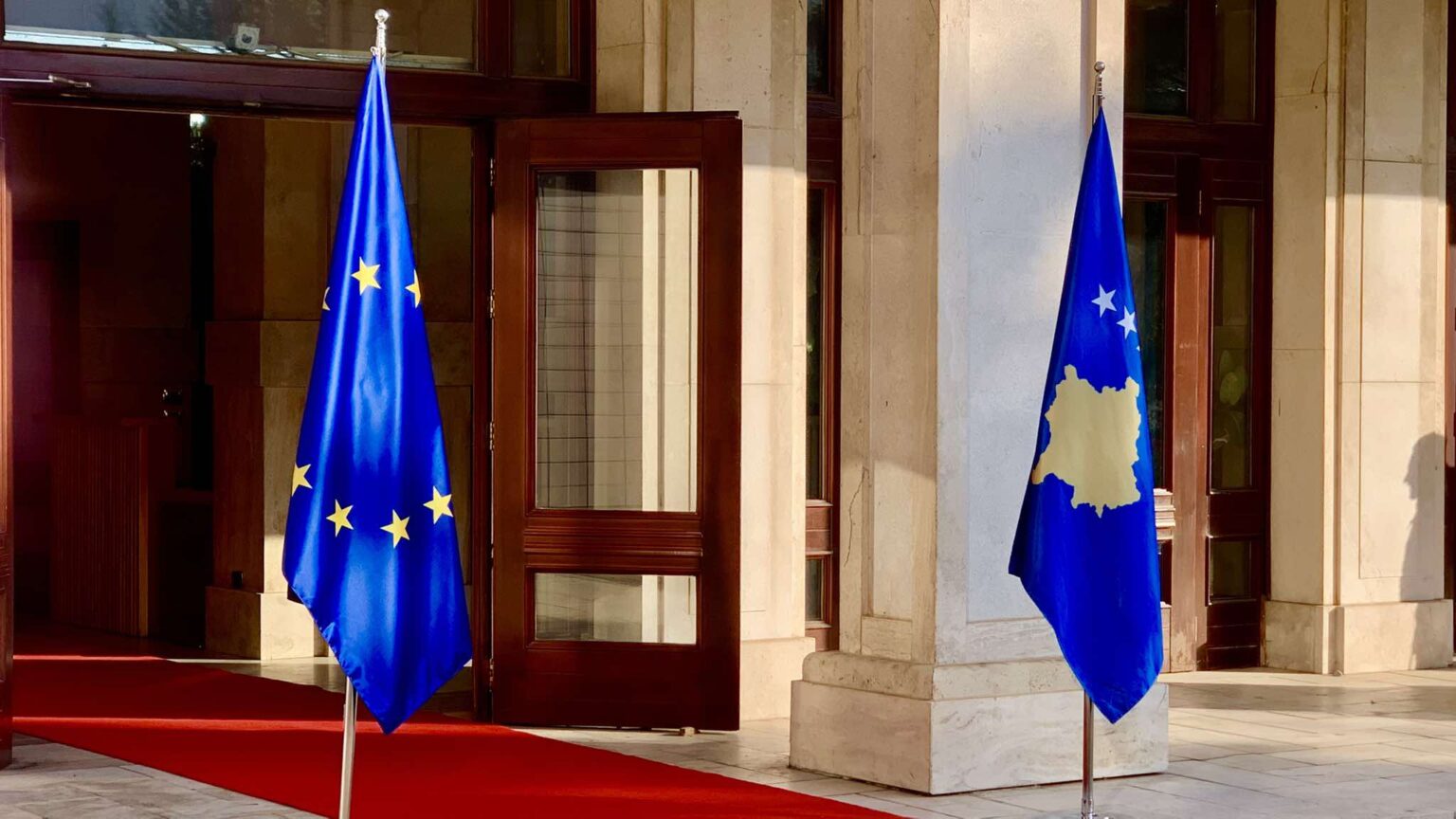
EU enlargement report: Kosovo’s integration linked to progress in dialogue with Serbia
The approval of the report on the enlargement strategy by the European Parliament has been assessed as an important signal for aspiring countries, including Kosovo. Members of the European Parliament emphasized that the enlargement of the European Union constitutes a strategic response to new geopolitical developments and an investment in the security and stability of the union.
Experts on the European integration process in Kosovo say the report confirms that enlargement has already become a geopolitical priority for the EU, but stress that Kosovo’s progress on this path remains closely linked to the dialogue with Serbia.
The executive director of the Group for Legal and Political Studies, Njomza Arifi, assesses that under the current security circumstances in Europe, the enlargement process is no longer seen only as part of the EU’s foreign policy, but as a strategic necessity for the stability of the continent.
She told KosovaPress that the approved report also mentions the dialogue between Kosovo and Serbia as an important element for the path toward European integration.
According to her, the European Union has made it clear that it does not want to accept into its ranks states that carry unresolved disputes with each other; therefore, progress in the dialogue will directly reflect on the advancement of both countries toward the EU.
“This year’s report that was recently approved confirms that the enlargement process for the European Union has already become a geopolitical priority due to the current security context in Europe. Inevitably, the enlargement process is no longer seen only as part of the EU’s foreign policy, but also as a strategic necessity for security and stability in the region… As for Kosovo, one of the issues mentioned in the report is the dialogue with Serbia. It is now clear that for the European Union, the integration process, both for Kosovo and for Serbia, is closely linked to the progress that will be made in the dialogue process, because the European Union has made it clear that it is not interested in importing into its ranks new member states that have bilateral disputes with each other. Therefore, any progress in the dialogue, both for Kosovo and for Serbia, will be progress on the path toward the EU. So, it is an issue that is now interconnected for both states,” she said.
On the other hand, European integration expert Adrian Zeqiri says that the dialogue between Kosovo and Serbia remains one of the main conditions for progress in the integration process.
He emphasizes that the lack of progress in this process also means stagnation on Kosovo’s European path.
According to him, the report reflects the current reality, assessing that the dialogue has stagnated and that without progress in this direction it is difficult to expect major steps toward integration into the European Union.
“The dialogue between Kosovo and Serbia is key for European integration. The EU has made this clear for both Kosovo and Serbia. We may choose not to engage in dialogue, but we will face stagnation in European integration. I think this is where we are, and this report reflects that situation by assessing that there has been stagnation in the dialogue, and no major step by Kosovo toward European integration will happen without progress in the dialogue process,” he said.
Meanwhile, GLPS researcher Arifi assesses that the internal political situation in Kosovo has also contributed to slowing down reforms related to the integration process.
She stresses that the country is now entering the second year of a political crisis and that the stagnation during 2025 has affected the lack of progress both in the dialogue and in the implementation of reforms necessary for the path toward the European Union.
“We have emphasized that we are actually entering the second year of a political crisis, and 2025 has been a year in which Kosovo has stagnated because of this crisis, and consequently we have not had progress not only in the dialogue but also in reforms that are directly linked to the European Union. At a moment like the one we are in today, when enlargement is a priority for the EU, we cannot afford to face new political crises that would affect all the reforms that Kosovo has committed to on its path to integration,” she said.
Members of the European Parliament further emphasized that EU membership for the countries of the region must remain merit-based and that no country should be treated as part of a package.
Recommended
PDK: The government with a pugnacious approach to the private sector, limps in attracting investments
The report also stresses that alignment with the EU’s Common Foreign and Security Policy is a key prerequisite for candidate countries seeking EU membership.