
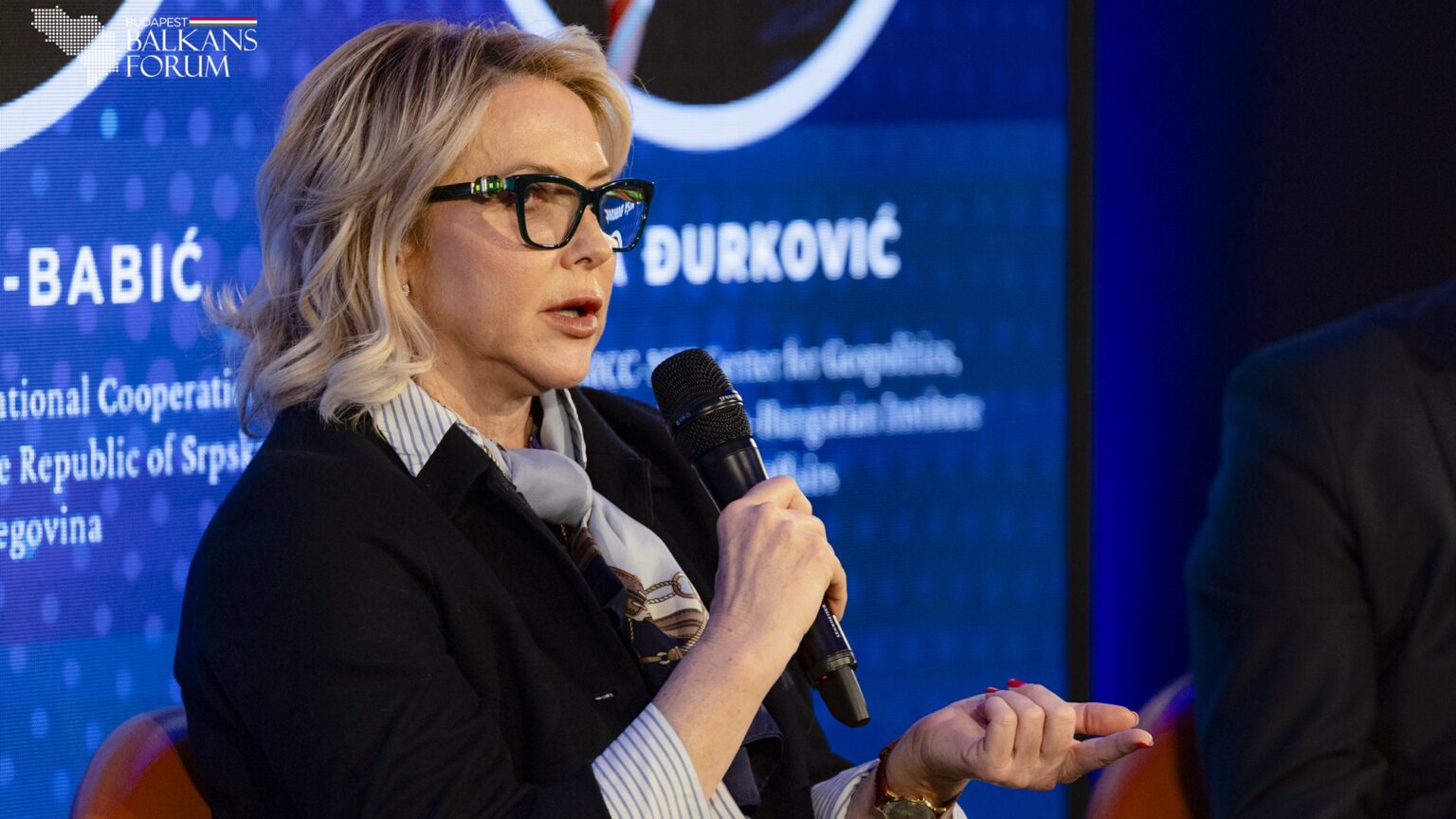
Ana Trišić-Babić served as the Acting President of the Republika Srpska autonomous region of Bosnia and Herzegovina between October 2025 and February 2026. Prior to that, she was the Deputy Foreign Minister of Bosnia and Herzegovina for nearly a decade, between 2007 and 2015. Ms Trišić-Babić was one of the distinguished guests at the Budapest Balkans Forum hosted by the Hungarian Institute of International Affairs in March 2026, where she was gracious enough to give an exclusive interview to our website.
***
The EU enlargement into the Western Balkans is the main topic of this conference, or at least one of the main topics. Bosnia-Herzegovina became an official candidate state of the EU in 2022, much later than the other countries in the region. Where does this process stand right now? What is a reasonable timeline for Bosnia to join the European Union?
The process is nowhere. Just to remind you and the readers: Bosnia-Herzegovina is the last colony in the world. We are a colony because we have a foreign emperor.
We have the foreign ruler in the office of the High Representative who can do everything that he wants. So because of him, Bosnia-Herzegovina is now nowhere in the EU accession process. Yes, it is true, Bosnia-Herzegovina in 2022 finally got the candidate status. Then, two days after that, this person, the foreign ruler Christian Schmidt, imposed the laws. And he stopped that process. So until that office leaves Bosnia and Herzegovina, the country, we can’t talk about the European Union because these are not European Union values. Everybody’s talking, in the enlargement process, about European Union values. But to have a foreigner who is ruling your country, this is not a European value.
You have talked a lot about Mr Schmidt during the panel. Can you tell our readers and me how he got his position as High Representative of Bosnia and Herzegovina, and what kind of powers does this position entail?
So Bosnia and Herzegovina, in accordance with the Dayton Agreement, has the Office of the High Representative. We all respect this. This is part of our institutions. The High Representatives are supposed to help us with authentic reading, authentic views of some issues in such a complex country where we are living. We used to have the High Representatives before as well, but all High Representatives were chosen and confirmed by the Security Council of the United Nations. That is because the Dayton Agreement is an international treaty, we have guarantors for it, and we are beyond the auspices of the European Union.
But Christian Schmidt came in a strange way. The group of ambassadors had a meeting in Sarajevo and then decided that the former High Representative, Valentin Inzko from Austria, who came in a legal way through the Security Council, is no longer the High Representative. And thus he resigned. Germany then suggested Christian Schmidt as the High Representative, and he was accepted only at the local level by the Quinta Ambassadors in Sarajevo. He was never approved by any of the United Nations bodies.
What about the relationship between the two autonomous regions of Bosnia and Herzegovina? Do they view EU enlargement the same? Do they have roughly the same level of public support for that? And do they have similar levels of development, Republika Srpska and Bosnia?
Bosnia and Herzegovina consists of two entities. One entity is the Republika Srpska. This is just one entity, with a government, president, and national parliament. The other entity is the Federation of Bosnia and Herzegovina. The Federation of Bosnia and Herzegovina has a different system from Republika Srpska because they have ten cantons. So there is the government on the federal level, but also each canton has its own administration.
So, is it similar to the United States of America?
Something like that. If we are talking about the European Union, yes, all citizens in Bosnia and Herzegovina, polls are showing, support joining. But this is a simple question. Do you see Bosnia in the European Union? Would you like your country to be a member of the European Union? Everybody’s saying yes. But this is natural. We are next to the European Union. We have borders with the EU and Croatia. Croatia is the country that has the longest border with Bosnia and Herzegovina, and it is an EU member state. So, of course, we are looking to join the EU.
Under Hungary’s presidency of the EU Council, the Western Balkan enlargement was a key agenda point. How has the relationship between Bosnia and Herzegovina and Hungary been in recent years? Has there been any serious level of connectivity, any serious level of involvement from Hungary in Bosnia or vice versa?
First, the Hungarian government. Personally, Prime Minister Orbán and Minister of Foreign Affairs Péter Szijjártó are the true friends of all of the Western Balkans. And I, coming from Republika Srpska, Bosnia and Herzegovina, can say that they are the true friends of Republika Srpska and Bosnia and Herzegovina. The citizens and officials of Republika Srpska see in them our real friends and anchors in this part of the world.
On the side of the Federation, it’s a little different, but Hungary is helping all of Bosnia and Herzegovina, advocating for it with both of its entities, and all the citizens in Bosnia and Herzegovina need the country to finally complete the process of becoming a member of the European Union.
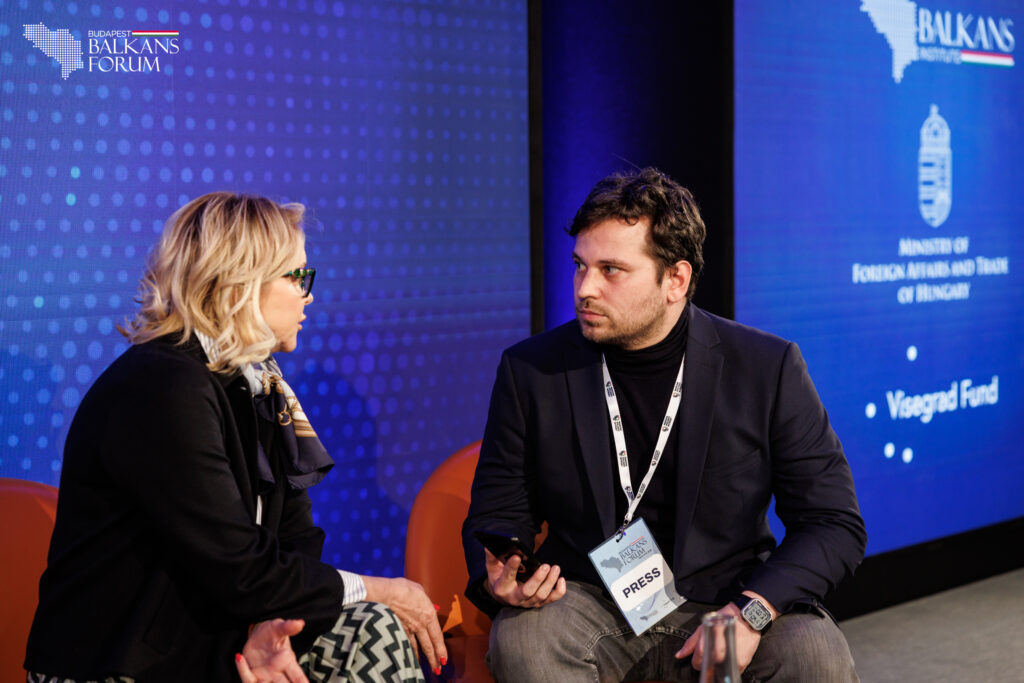 Ana Trišić-Babić (L) PHOTO: Hungarian Institute of International Affairs (HIIA)
The last question is about the energy markets recently. So there has been a big spike in crude oil prices and natural gas prices. Is the fact that Bosnia, as you said during the panel, still imports energy from Russia, helping to mitigate this price hike?
No, no, no. We don’t import anything from Russia. We don’t have the pipelines for that. If we’re talking about gas, about the pipelines, our infrastructure is close to zero. What we have in Bosnia and Herzegovina, especially in Republika Srpska, thanks to the rivers and water resources, are very good hydro energy plants. So if we are talking about electricity, we are good with electricity.
So you sustain your energy just by domestic production?
Just by domestic production.
That’s amazing.
But that’s also tricky now. We need to improve the system. We need to reorganize ourselves.
So, are you pretty much isolated from the international commodities markets? If the crude oil price jumps, Bosnians don’t feel it?
We do feel the difference in the petrol price, you know. Of course, we do feel it; we feel everything that is happening close to us in the European Union’s market. The temperature in our region and our country is even higher because we don’t have the same capacities that other countries have for reserves and purchasing power.
Related articles: