
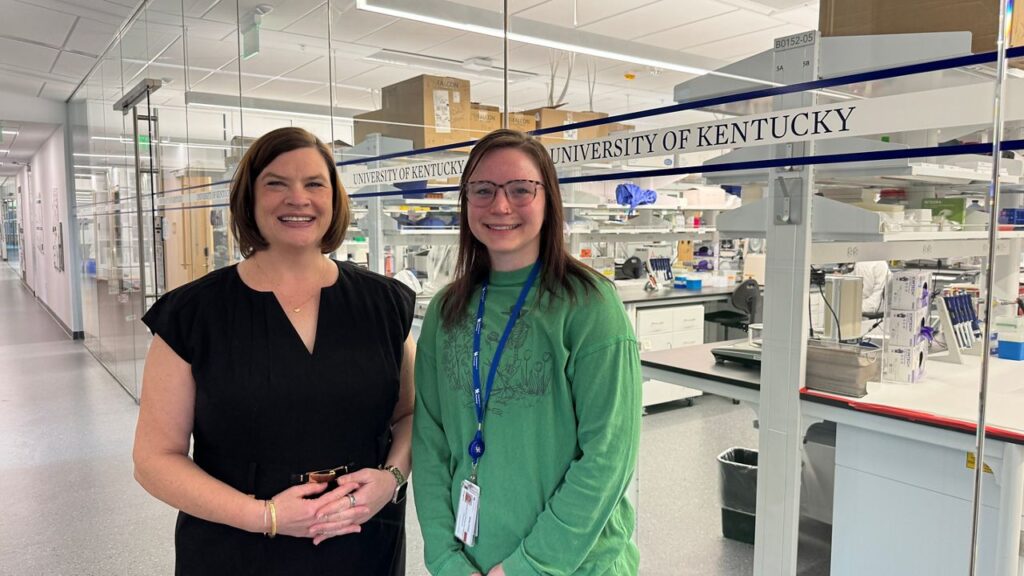
LEXINGTON, Ky. — Shannon Macauley has made strides in treating diseases that affect the brain.
What You Need To Know
- UK researcher Shannon Macauley studies how Alzheimer’s and dementia affect sleep and brain activity
- Her lab at the Sanders-Brown Center on Aging examines how amyloid plaques and tau tangles disrupt brain fuel use
- Recent findings published in a scholarly journal suggest different sleep processes are altered at different disease stages
- Macauley said the goal is to improve quality of life for patients and families in Kentucky and beyond
The University of Kentucky associate professor of physiology brings more than 15 years of research to the school’s Sanders-Brown Center on Aging and looks at ways the brain disrupts restorative rest, using studies she initiated at Washington University.
More than five years ago, the National Institutes of Health awarded her funding to further her research.
“It was during these initial studies that we started to understand that if you have too much fuel on board or you’re not using fuel properly, it impacts how excitable your brain is,” Macauley said.
Those with Alzheimer’s disease can be affected by amyloid plaques, which are blockages in the brain’s abilities to process information. Macauley said it’s like a barrier in the pathway of a moving car.
“That develops in the Alzheimer’s brain; it happens 20 years before you ever have that cognitive symptom or that cognitive change,” she said.
The lab also focuses on Tau pathology, a protein in the brain that moves nutrients. A person with dementia would experience neurofibrillary tangles that can affect regular function. Macauley said that’s when the car’s engine or “brain” doesn’t work regularly.
However, researchers have found that this protein can change how the brain uses glucose, causing energy misuse.
“What we’re finding is that changes in sleep happen when you have those plaques and you have those tangles, but there are very different processes that are affected; different aspects of sleep that are affected,” she said.
Earlier this year, that research was published in a global scholarly journal. Now, professionals in Macauley’s lab, along with graduate students, are building on decades of prior research, hoping to determine ways to intervene in different stages of dementia.
“Alzheimer’s disease and also some of these other age-related diseases are really prevalent in Kentucky,” she said. “They’re really prevalent in rural communities and inner-city communities.”
Macauley said dealing with age-related illnesses can be a life change for everyone.
“It doesn’t just impact the patient, but it impacts the family and loved ones that care for them,” she said. “In the absence of a cure, we want to treat people, and we want to treat their symptoms so they can have a really solid quality of life.”
According to the Alzheimer’s Association, general causes of age-related diseases come from age, genetics, family history, environmental factors and certain medical conditions.