
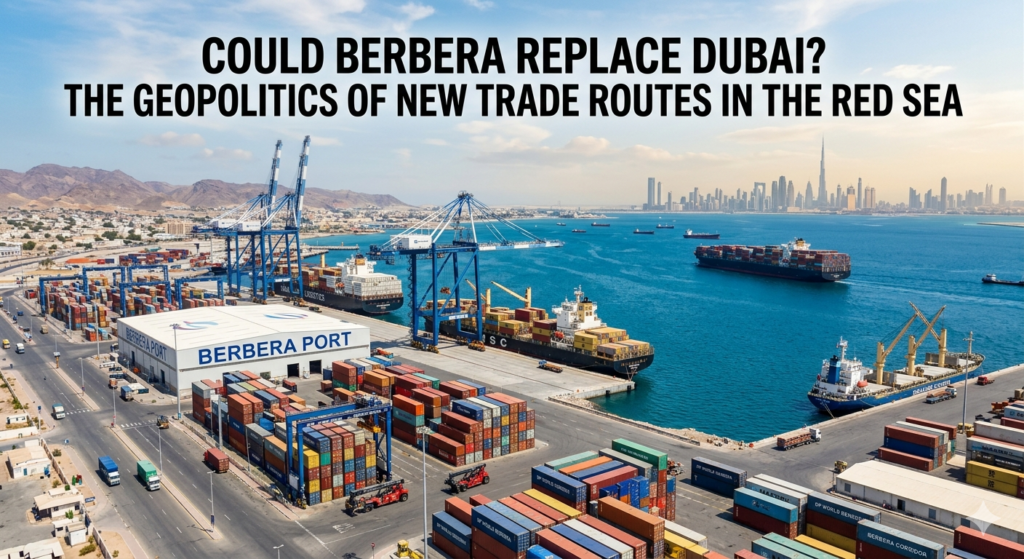
In recent years, geopolitical tensions and armed conflicts in the Middle East have begun to reshape global trade routes. Strategic maritime chokepoints such as the Strait of Hormuz and the Bab el-Mandeb have become increasingly vulnerable to instability. As a result, global shipping companies and regional powers are reconsidering the structure of logistics networks that connect Asia, the Middle East, Africa, and Europe.
For decades, the city of Dubai in the United Arab Emirates has served as one of the world’s most influential logistics and trade hubs. Through the massive facilities of Jebel Ali Port, Dubai has connected global supply chains, acting as a redistribution center for goods moving between continents. However, growing geopolitical risks in the region are forcing policymakers and businesses to explore alternative routes and ports.
One location gaining increasing strategic attention is Port of Berbera in Somaliland. Situated along the Gulf of Aden near the entrance to the Red Sea, Berbera occupies a geographically advantageous position in one of the world’s most critical maritime corridors.
A Strategic Geographic Advantage
The waters connecting the Red Sea to the Indian Ocean are among the most heavily trafficked maritime routes in the world. A large portion of global trade and energy shipments passes through this region before reaching the Suez Canal and entering European markets.
Berbera’s proximity to these routes gives it a natural advantage. Unlike ports located deep inside the Persian Gulf, Berbera lies directly along the Red Sea shipping corridor. This means vessels traveling between Asia and Europe can potentially access Berbera without navigating the geopolitical risks associated with the Persian Gulf.
The Role of Infrastructure and Investment
The transformation of Berbera from a modest port into a regional logistics hub is already underway. The global logistics company DP World has invested heavily in expanding the port’s container terminal and operational capacity. This investment aims to position Berbera as a gateway for trade in the Horn of Africa.
Equally important is the development of the Berbera Corridor, a transportation network linking the port to Ethiopia one of Africa’s fastest-growing economies and a country of over 120 million people without direct access to the sea. By providing Ethiopia with an additional maritime outlet, Berbera could significantly alter regional trade dynamics that have long depended on ports in neighboring countries.
Can Berbera Replace Dubai?
Despite its growing strategic importance, it would be unrealistic to assume that Berbera could replace Dubai in the near future. Dubai’s success is built on decades of infrastructure development, advanced logistics systems, global financial services, and a diversified economy that extends far beyond maritime trade.
In contrast, Berbera is still at an early stage of development. While its geographic location offers major advantages, the port requires continued investment in infrastructure, industrial zones, and regional connectivity in order to compete with established global hubs.
However, the question may not be whether Berbera can replace Dubai, but whether it can complement and diversify the regional logistics system.
The Emerging Multipolar Trade Network
The global trading system is gradually evolving toward a more decentralized structure. Instead of relying on a few mega-hubs, shipping companies increasingly prefer multiple regional nodes that reduce geopolitical risk.
In this emerging system, Berbera could become:
- A major logistics hub for the Horn of Africa
- A strategic maritime gateway for Ethiopia
- A supplementary route for global shipping networks
- A geopolitically important port along the Red Sea corridor
Conclusion
The instability affecting parts of the Middle East is forcing global trade to adapt. As companies search for alternative routes and strategic redundancy, ports outside traditional power centers are gaining importance.
While Dubai will remain one of the world’s dominant logistics centers, the rise of Port of Berbera highlights how geography, investment, and geopolitics can converge to reshape regional trade networks.
In a world where supply chains are increasingly influenced by security considerations, Berbera may not replace Dubai but it could become one of the most important emerging gateways in the Red Sea and the Horn of Africa.
Mohamed Abdi Idris is a Somaliland-based analyst specializing in international relations, geopolitics, and foreign policy. He holds a Master’s degree in International Relations and Diplomacy and is actively engaged in policy discussions on global security, regional geopolitics, and the evolving strategic dynamics of the Middle East and the Horn of Africa. He is also involved in initiatives promoting peacebuilding, climate awareness, and international cooperation through civil society platforms in Somaliland.