
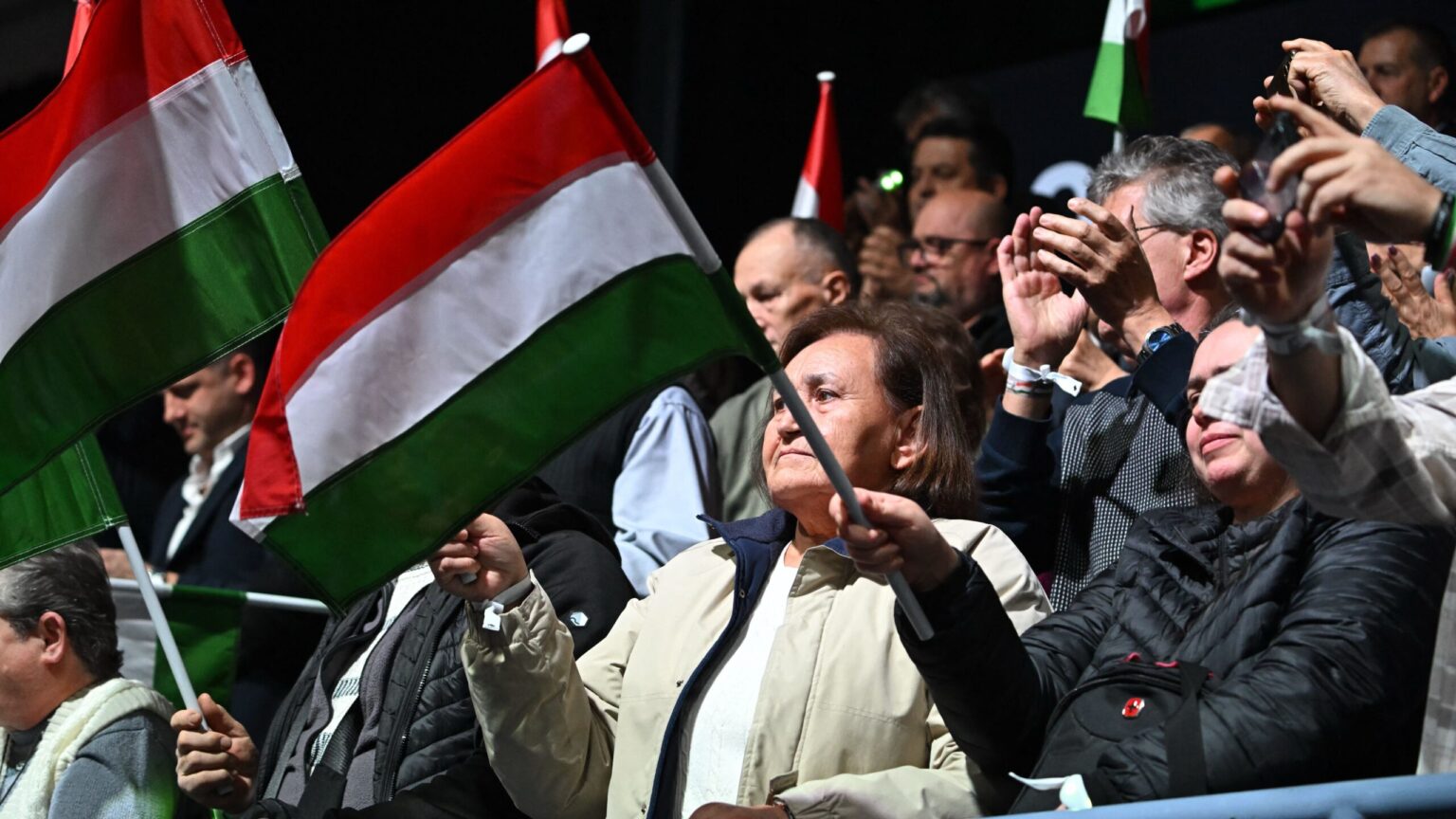
Throughout history, the Hungarian steppe (the Puszta) has been at the crossroads of great powers, strengthening the national consciousness of Hungarian identity. From the 1956 revolt to Hungary’s accession to the EU in 2004, numerous events have decided the destiny of average, hardworking Hungarians. However, the upcoming election in April will decide where Hungary will be in five years. It is a question of whether Hungary will stand among allies that enjoy sovereign autonomy, such as the United States under President Trump and Israel, a strong nation determined to protect its people from the same people the EU has filled Europe with, or among the likes of France, Belgium, and Germany, where over 1200 women are sexually harassed on the New Years Eve by non-European migrants from the third-world Middle Eastern countries and where men are beheaded for portraying a caricature in a classroom.
The European Union was founded primarily to protect European interests in the global arena, merging smaller states into a political bloc that advocates peace, prosperity, and regional security. In the age of the ‘New Global Order’, where might is right, such submissive political entities either cease to exist or are swallowed by stronger regional or global powers.
A project that was once about peace in Europe is now considering building its own army for so-called defensive reasons. However, an army with sufficient resources to defend a continent is, in theory, also capable of launching an attack on other political actors. This objective appears on the political agenda of two provocateurs: Ursula von der Leyen, the current President of the European Commission and former Defence Minister of the Federal Republic of Germany from 2013 to 2019, and French President Emmanuel Macron, a man who has been humiliated many times in front of the whole world, particularly by his wife.
‘An army with sufficient resources to defend a continent is…also capable of launching an attack on other political actors’
The current EU project to rearm Europe, Readiness 2030, will eventually transform into a fully functional army, depriving European nation-states of American protection and opening the door to full confrontation with the Russian Federation. The abandonment of the US will collectively deprive the EU member-states of American protection (which is practically the end of NATO and the Article 5 on collective defence), steering the entire continent to escalate militarily with the likes of Russia while leaving the Eastern front at the mercy of the Russians, as they did in Ukraine, where a proxy war between the EU and Russia is taking hundreds of innocent Ukrainian lives daily.
As Geoffrey Van Orden stressed: ‘an EU army can’t protect Europe, only NATO can.’ This exposes the hypocrisy found within the EU. They want countries like Slovakia and Hungary to fight their war while they reside in Brussels and Munich with their billionaire friends like Alex Soros (son of George Soros), who host dinner parties for von der Leyen.
The question of Hungarian sovereignty is likely to remain highly consequential for at least the next half decade. Based on the previous elections in the United States, Czechia and Israel, we can clearly observe similar patterns in which voters opted to elect strong leaders.
The Hungarian electoral momentum currently rests on the shoulders of everyone who genuinely wants to keep the country safe and free from foreign influence. This election is not only about Orbán running against Magyar, who betrayed his former party and would betray his country if elected, but also about Hungarian independence prevailing against globalist actors, who seek to force Hungary to submit to their demands.
‘This election is…also about Hungarian independence prevailing against globalist actors’
Eurocrats are mobilizing their media and political tools to intervene in the upcoming election in an attempt to oust the democratically elected Prime Minister of Hungary, whom they have portrayed as public enemy number one in the EU because of his dedication to the protection of Hungary’s national interests.
This is not the first case of European intervention aimed at destabilizing an EU member state (or a candidate to become a member state). Similar cases have been reported regarding parliamentary elections in Czechia, Romania, Poland and Moldova—and Georgia, where the EU is said to have used various means to influence the course of electoral outcomes under the Digital Services Act (DSA).
One of the most compelling arguments as to why foreign actors would like to see Hungary lose its strategic autonomy derives from supranational plans to erode the idea of the nation-state. Even as a member of the EU, Hungary’s political autonomy and independence vastly differ from the majority of decisions made in the European Parliament or the Council. The EU politically manipulates all member states to fight for a non-EU member state, Ukraine, while an actual member state, Cyprus, is under attack from Iran and its regional proxies.
Unlike the Eurocrats, who have isolated the European continent on the global stage, Budapest engages with the international community and organizations from the position of a multi-vector nation-state, extending the Central European country’s footprint across various platforms that serve the Hungarian national interest. For instance, Hungary became a founding member of the Board of Peace, making it one of only two EU member states in the newly founded international organization aimed at facilitating more pragmatic approaches to global peace efforts. This decision led to President Trump’s endorsement of PM Viktor Orbán, who also secured a one-year exemption from Russian energy sanctions, thereby enjoying warm and fruitful relations with the White House, whereas many European leaders are disfavoured in Washington, DC.
‘Budapest engages with the international community and organizations from the position of a multi-vector nation-state’
The National Security Strategy of the US also signals further divisions with Western European countries that have lost their civilizational culture. This strategic roadmap foresees increased American support for Hungary, which has managed to implement its own independent, domestically conservative and internationally pragmatic foreign policies. From actively participating in the Organisation of Turkic States (OTS) to drawing a red line against the mistreatment of Hungarian minorities in Ukraine, Hungary has mastered the art of sovereignty, which is now being challenged by EU- and Ukraine-backed Péter Magyar.
Budapest plays an instrumental role in Eurasian connectivity, developing plans to identify viable alternatives to Russian natural resources that currently transit Belarus and Ukraine through the Druzhba pipeline (currently halted by Ukraine). Hungary’s participation in the OTS enables it to operate within an energy-rich geopolitical space that includes countries such as Azerbaijan and Kazakhstan, whose natural resources may soon reach Budapest and potentially provide a more reliable alternative to Russian imports.
The recent agreement between SOCAR and MVM Group testifies to Hungary’s commitment to diversifying its energy portfolio. Under this arrangement, Hungary will import 800 million cubic metres of gas from Azerbaijan.
Hence, this election will mark a turning point in contemporary Hungarian history. It is up to the Hungarian people to decide their political future. Will it be sovereignty or total submission? Time will tell.
Related articles: