
Published on
March 14, 2026
Image generated with Ai
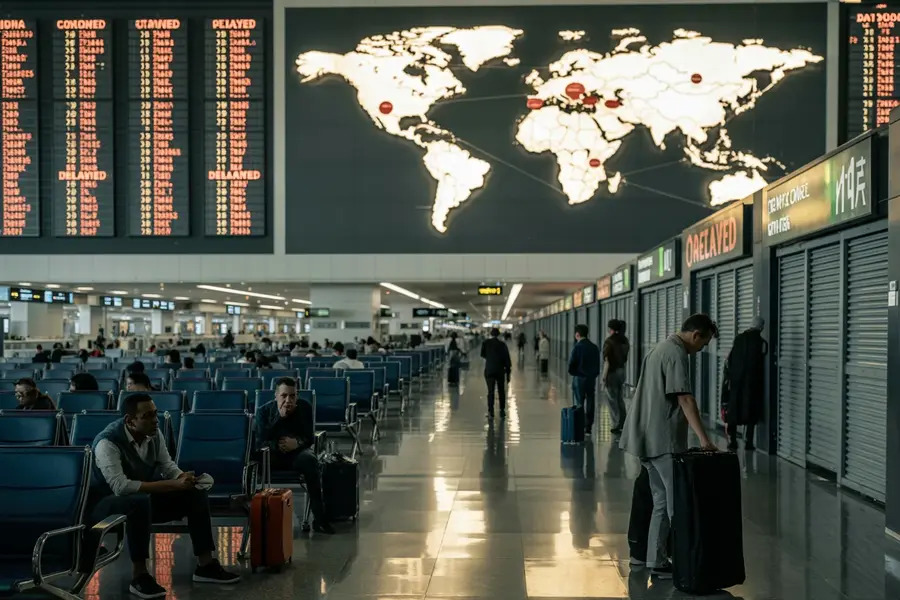
India, like many other countries including Turkey, Spain, Tunisia, Egypt, Greece, Thailand, Albania, Japan, and Indonesia, is facing significant declines in tourism due to a combination of geopolitical crises, economic instability, flight cancellations, and heightened security concerns. Political unrest, rising fuel costs, and economic volatility have led travelers to seek safer, more stable destinations, causing a drop in international visitors. Additionally, widespread flight disruptions and cancellations have made travel more unpredictable and costly, further deterring tourists. As a result, countries heavily reliant on tourism are struggling to recover from the lingering impacts of the pandemic while grappling with the current global turmoil. India’s tourism industry, once a global hotspot, is now facing similar challenges, with a notable reduction in inbound tourists, making the road to recovery increasingly difficult.
The latest Orchestra barometer from L’Écho touristique provides a detailed snapshot of how geopolitical tensions are affecting the tourism industry. Although Greece has not yet reached the “high-risk zone” in terms of the impact on tourism, the decline in organized holiday bookings for this destination in France suggests that the fallout from the ongoing geopolitical conflict extends far beyond the affected region. The most decisive factor in determining the scale of the impact on international tourism appears to be the duration of the conflict itself. As the situation persists, the risk of a broader, domino effect on international travel becomes more apparent.
Between March 1 and 10, 2026, holiday sales through French travel agencies fell by 17.6% compared to the same period in 2025, according to the barometer data. This marked decrease in bookings highlights the growing concern among travelers, who are now reconsidering their travel plans to destinations that could be directly or indirectly affected by the Middle Eastern conflict. The drop in sales illustrates how sensitive the travel market is to geopolitical instability, especially when it has the potential to disrupt key tourist regions.
Several destinations have seen sharp declines in bookings, with some countries bearing the brunt of the downturn. A Middle Eastern country, which has been directly involved in the conflict, saw the most significant drop, with holiday sales plummeting by 67.3%. Despite this, the country experienced a brief uptick in sales during February, driven by the inauguration of a major cultural attraction, which temporarily boosted interest. Other destinations facing steep declines include Greece (-25.6%), Tunisia (-29.5%), and Portugal (-38.4%), all of which have seen sales decreases of over 25%. This suggests that, while French travelers are still considering their holiday options, many are hesitant to book vacations to regions that may be affected by the ongoing turmoil. Instead, many are choosing to “wait it out” until the situation stabilizes and relative normalcy is restored to international travel.
The impact of the Middle Eastern conflict is not limited to the immediate region but has begun to ripple across a broader range of destinations. Turkey and Egypt, both of which have traditionally been popular vacation spots for French travelers, saw steep declines in bookings. Sales for Turkey dropped by 67.6%, while Egypt followed closely behind with a 67.3% drop in sales during the same period. These declines indicate that the effects of the war are not only limiting travel to the immediate conflict zones but also creating uncertainties about travel to neighboring regions that are perceived as being at risk. The widespread nature of these declines emphasizes how geopolitical tensions can affect global tourism, creating ripple effects that extend far beyond the epicenter of the conflict.
In contrast, Spain emerged as a relative safe haven for French travelers during this period of unrest. While many destinations have seen a decline in bookings, Spain managed to limit its losses to just 1.5%, making it the top destination for French holidaymakers. The country’s ability to offer a sense of security, coupled with its well-established reputation as a popular vacation spot, has made it an attractive option for travelers looking to avoid the uncertainties surrounding the Middle East conflict. As a result, Spain remains a steady choice for tourists seeking peace of mind and stability in their travel plans.
Advertisement
Advertisement
Beyond mainland Europe, several distant island destinations also showed strong performance in holiday sales. Guadeloupe and the Dominican Republic both continued to see solid bookings, further cementing their status as popular options for travelers looking for a getaway in a more stable environment. Despite the uncertainty surrounding other destinations, these islands continue to benefit from their ability to offer sun, sea, and relaxation away from the geopolitical tensions of the mainland.
A particularly noteworthy trend is Albania, which has emerged as a rising star in the European tourism market. The country saw an astonishing 171% increase in package holiday sales from the French market, largely attributed to improved air connectivity. As more airlines add routes to Albania, French travelers have increasingly turned to the country as an affordable and less crowded alternative to traditional Mediterranean destinations. Albania’s appeal lies in its unspoiled landscapes, rich cultural heritage, and affordability, all of which make it an attractive option for those looking to explore a new and emerging destination.
Meanwhile, Asian destinations have experienced significant losses in bookings due to the ongoing geopolitical tensions. In particular, many travelers who would have previously flown to Asia via hubs like Dubai, Abu Dhabi, or Doha are now avoiding these routes due to the rising costs of direct flights. These increased travel expenses have made trips to Asia less appealing, leading to a drop in demand for destinations such as Thailand (-51.6%), Indonesia (-63.6%), Vietnam (-39.5%), and India (-30.1%). Although these countries have been impacted by the conflict, Japan stands out as an exception. Despite a slight drop of 0.5% in bookings, Japan remains in the top 20 destinations for French package holiday sales. The country’s reputation for safety, culture, and modernity, combined with its long-standing appeal as a travel destination, has helped it weather the storm better than other Asian nations.
India, along with countries like Turkey, Spain, and Greece, is facing a significant decline in tourism due to geopolitical crises, economic instability, flight cancellations, and heightened security concerns, making travel less predictable and more expensive globally. These factors are reshaping tourist preferences and disrupting international travel.
The Orchestra destinations barometer reflects the holiday sales data from both online and physical travel agencies in France, providing a comprehensive overview of how global events are influencing tourism patterns. As the geopolitical landscape evolves, it is clear that the duration and intensity of the conflict will play a significant role in shaping the global travel industry. While some destinations may recover as the situation stabilizes, others may continue to feel the long-lasting effects of geopolitical instability for years to come.
