
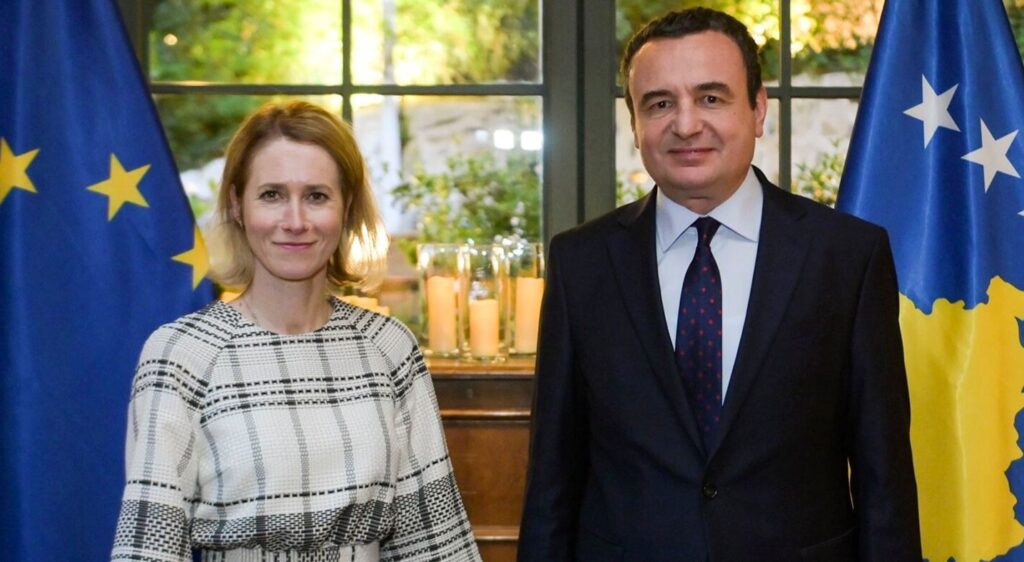
The European Union’s foreign policy chief, Kaja Kallas, said on Saturday that she is ready to mediate a high-level meeting between Kosovo and Serbia “soon” after Kosovo authorities granted temporary relief to the Serbian community in the Law on Foreigners. Writing in X, Kallas said that “a new momentum has been created to advance EU-Kosovo relations and the dialogue between Pristina and Belgrade”. This comes after Kosovo Prime Minister Albin Kurti agreed to offer temporary residence permits and temporarily recognize the identity cards of members of the Serbian community who do not have Kosovo documents.
“Today’s agreement on civil registration and the Law on Foreigners marks an important step forward for the benefit of all people in Kosovo. It is essential to ensure continuity in the provision of public services,” said Kallas. Kosovo aims to eventually merge parallel Serbian health and education institutions into its own system through this law, which will begin to be fully implemented from Sunday, March 15. However, the Kurti government agreed after a meeting on Saturday with the EU’s envoy for dialogue, Peter Sorensen, that members of the undocumented Kosovo Serb community will be able to obtain a 12-month temporary residence permit, as well as temporarily carry identity cards issued by Serbian authorities as a means of identification.
In recent years, Kosovo and Serbia have held a series of rounds of dialogue at the level of chief negotiators, but there have been no high-level political meetings since September 2023. At that time, the last round of high-level dialogue took place a few days before the armed attack in Banjska, Zvečan, when a group of armed Serbs killed a Kosovo policeman.
Kosovo blames Serbia for the attack, but Belgrade denies any involvement. The continuation of high-level dialogue stalled after that attack, after Kurti linked it to the handover of the suspected perpetrator, Milan Radoić, a move that Serbia has not made to date. Over a decade of dialogue, Kosovo and Serbia have reached a series of agreements, but not all of them have been implemented. In 2023, the parties reached the Agreement on the Path to Normalization, also known as the Ohrid Agreement, but the EU has said that it has not yet been implemented. Although this agreement has not been signed, according to the European bloc, it is binding on both sides. /REL
© BalkansWeb