
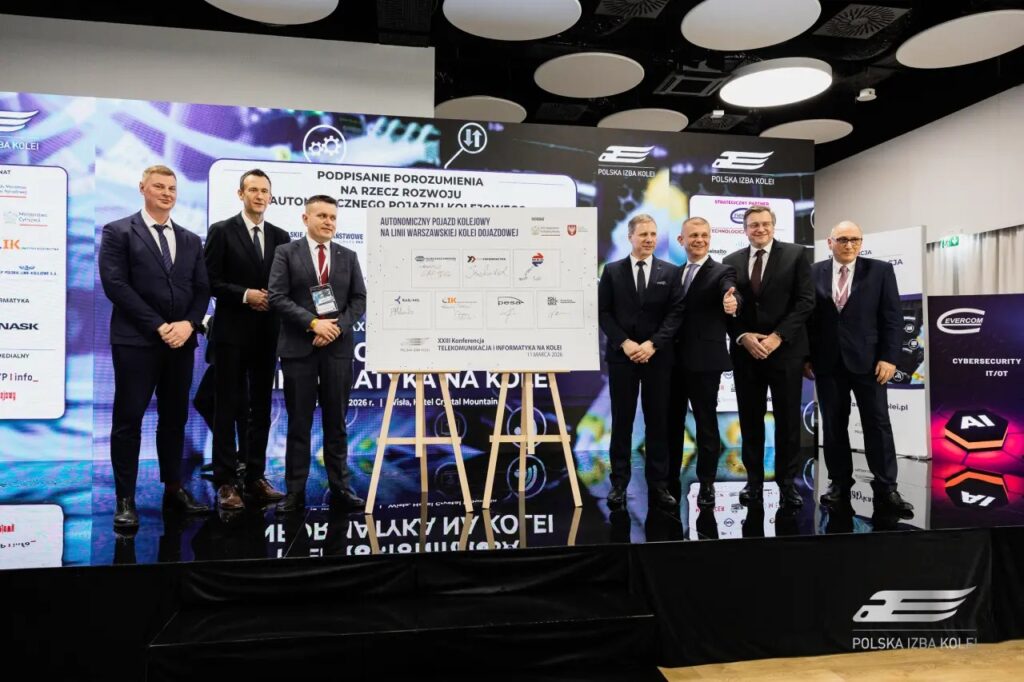
 The state-owned railway company PKP is participating in a project aimed at developing and testing an autonomous train for passenger transport. The initiative brings together companies from the railway industry, academia, and the IT sector and is being carried out under the patronage of the Polish Ministry of Infrastructure.
The agreement to launch the project was signed during the “Telecommunications and IT on the Railways” conference held in Wisła.
Consortium of industry, universities, and rail operators
The project to develop an autonomous rail vehicle based on the ATO (Automatic Train Operation) system is being carried out by a consortium consisting of: Each partner contributes expertise in areas such as rail traffic control, software development, visual recognition systems, and automation technologies.
- the state-owned company PKP;
- PKP Informatyka;
- the suburban operator WKD (Warszawska Kolej Dojazdowa);
- the train manufacturer PESA Bydgoszcz;
- the technology company Rail-Mil Computers;
- Częstochowa University of Technology;
- Polish Railway Institute.
PKP Vice President Dariusz Grajda emphasized that the railway sector has always been a field where advanced technological solutions have been tested.
“Railways have always been at the forefront of new technologies. For nearly 200 years, the solutions implemented in rail transport have been a symbol of modernity and innovation,” he said.
Tests planned on a commuter line near Warsaw
A section of the WKD Line No. 48, between Podkowa Leśna and Milanówek, near Warsaw, was selected as a potential test site.
The line was selected due to its characteristics: The first phase of the project will involve creating a “digital twin”, i.e., a digital simulation of the infrastructure and the autonomous train.
- relatively short length;
- single-track line;
- multiple level crossings with roads.
Based on images collected by cameras installed on the train, visual analysis algorithms will be able to identify obstacles and assist the driver in operating the train.
A train manufactured by PESA will serve as the test platform
In the next phase, tests will be conducted under real-world conditions using an EN97 train operated by WKD and manufactured by the Polish company PESA.
The vehicle will be equipped with sensors and specialized software to enable testing at the GoA2 (Grade of Automation 2) level—that is, operation with a driver, but assisted by automated systems.
The tests will involve shuttle-type runs between Podkowa Leśna and Milanówek, with the driver assisted by the systems developed in the project.
The possibility of fully autonomous trains, analyzed in the long term
In the longer term, project participants are analyzing the possibility of transitioning to fully autonomous trains, without a driver.
However, the project’s authors emphasize that such a phase would require extensive testing and rigorous safety checks, especially in the context of level crossings and interaction with road traffic.
Share on: 


