
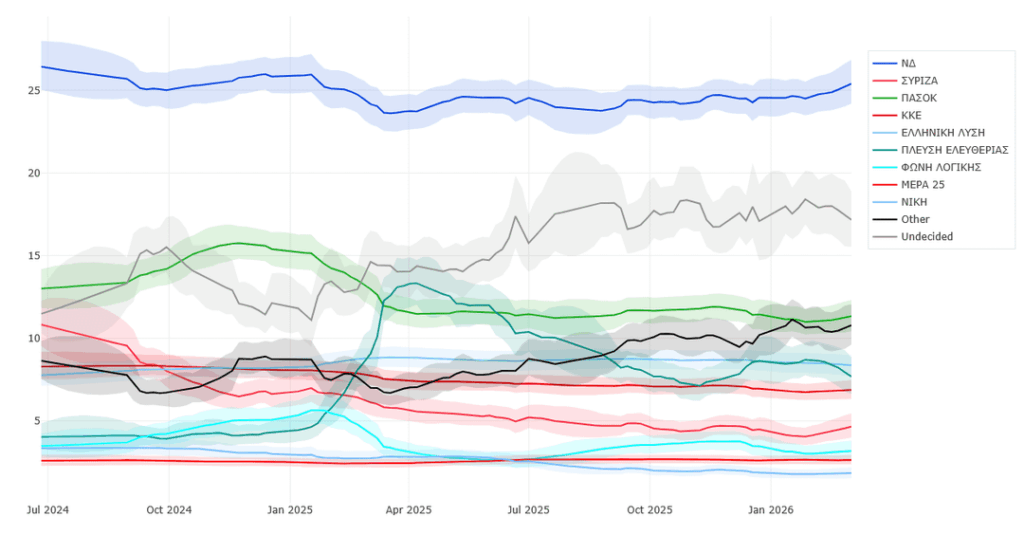
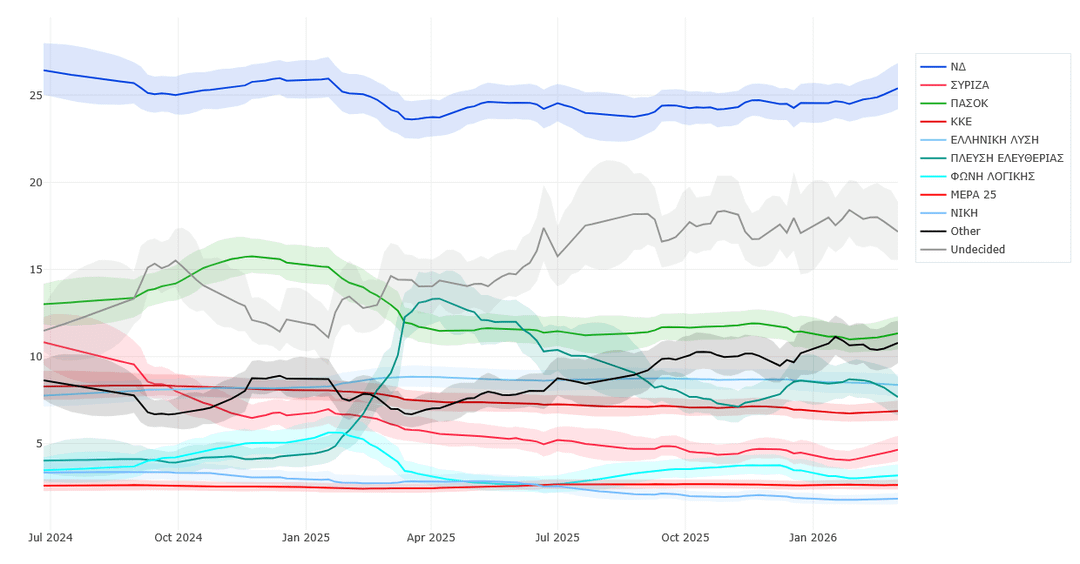
I need your feedback on a project I’ve been working on lately. It’s called KalpiCast and is an election prediction model for Greece, based on polls, economic data and Bayesian statistics.
It is not a simple poll average. It doesn’t do “put 15 polls and get an average”. It tries to answer the question:
If we take all the available data and model it correctly, what is the allocation of voting intention, which electoral scenarios and what chance does each have one?
What does he do?
- It takes into account that the percentages of the parties are not independent of each other (there are correlations).
- It thoughtfully models their dynamics over time (not a static photograph).
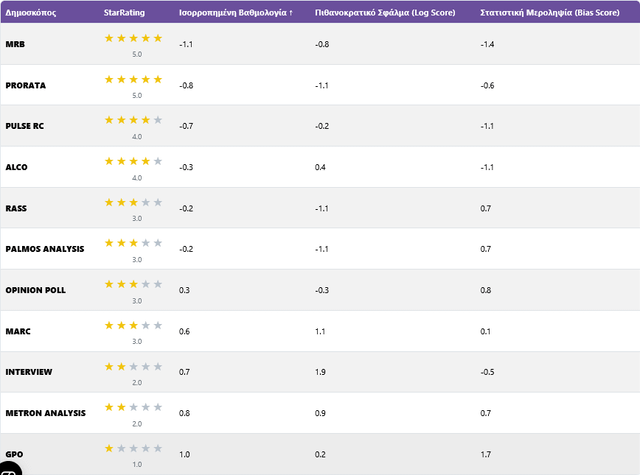
- It weights polling companies based on historical performance and impartiality.
- He does not consider that “n=1000” automatically means ±3%.
- It models the redistribution of undecideds as we approach the election
- It takes into account possible common systematic errors of polling companies.
- It incorporates economic data to improve the assessment of the ruling party.
- It simulates 50,000 scenarios via Bayesian Markov Chain Monte Carlo and gives probability distributionsnot deterministic “predictions”.
What does it show?
- Current estimate of voting intention
- Confidence intervals
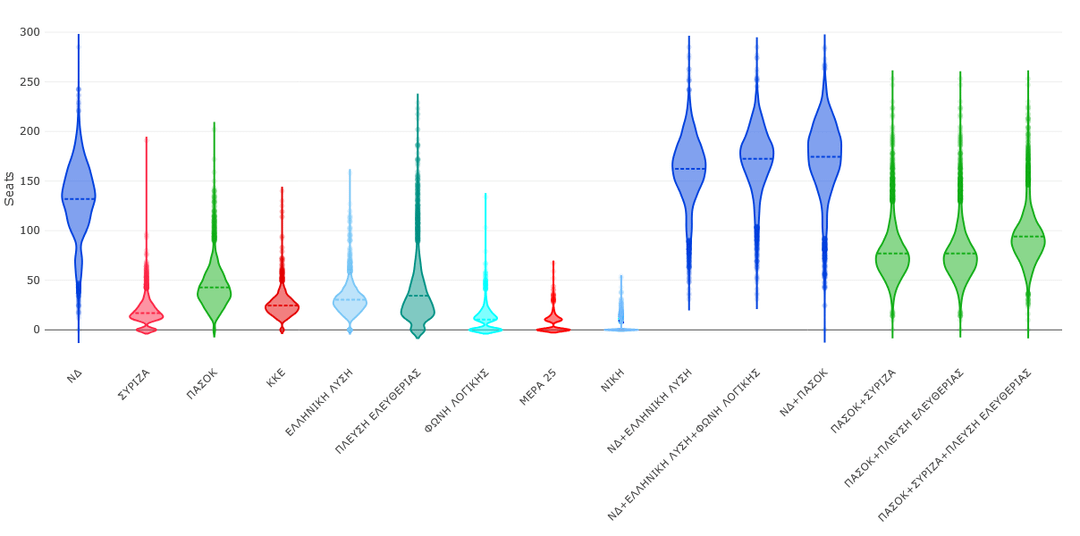
- Allocation of possible seats
- Probabilities for various scenarios
- Ratings of polling companies
In other words: it tries to show not only what is true on average, but also how certain we can be in each case.
Because I made it
Two main goals:
- There should be a transparent, technically documented model for the Greek case (no “magic numbers”, no political positioning).
- Let’s get a little more familiar with the concept of uncertainty.
In Greece we often treat percentages as if they were deterministic facts (everything is either white or black, and gray does not exist…).
But reality is contemplative.
The 25% we read is not exactly 25%, it is a range of possible values close to it.
And understanding probabilities is important — not just for elections, but for how we think in general.
Methodology
- Big Picture Polling & Forecasting Methodology
- Financial Data Model Methodology
- Evaluation Methodology of Polling Companies
I would like feedback
- Are you interested in such an approach?
- Are there any features you would find useful?
- You have proposed changes to the methodology
The project is personal, independent and unfunded.
https://kalpicast.gr/el/poll-aggregate
Posted by StructuredChaos42
9 Comments
Δυνατό φαινεται μακαρι να σου παει καλα
Γιατί έγραψες το ποστ με Ilm?
Εγώ σπουδάζω πληροφορική επιστήμη, αλλά είμαι ακόμα στα βασικά του machine learning, lìnear/logistic regression. Με αυτά που ξέρω όμως θα πρότεινα έρευνα για τα features gdp, gdp per capita, life expectancy, country population, για να δεις πόσο επεράζουν άμα θα ξαναβγεί το τωρινό κόμμα ή θα ψηφιστεί άλλο. Φυσικά αυτό θα ήταν ουσιαστικά εντελώς άλλο μοντέλο, αλλά όπως είπα σε αυτά που αναφέρεις δεν έχω εμπειριά για να προτείνω κάτι :/
Νδ παλι θα βγει τσαμπα εκανες τη μελετη. Αν υπαρξει σοβαρη αντιπολιτευση τοτε μιλαμε παλι
ΝΙΚΗ+ Undecided + other = Golden Dawn αν δεν ήταν όλοι στην φυλακή
Καλησπέρα , ενδιαφέρον φαίνεται. Με τι ασχολείσαι αν επιτρέπεται , εγώ είμαι 3ο έτος Στατιστικής και πρώτη φορά βλέπω στην πράξη ότι μαθαίνουμε.
Γιατί στην πιθανότητα για πρώτο κόμμα ή πλεύση έχει μεγαλύτερο ποσοστό από το πασοκ, όμως στη. Πιθανότητα εισόδου στην βουλή η πλεύση έχει πολύ χαμηλότερο ποσοστά από το ΠΑΣΟΚ, χαμηλότερο και από του ΚΚΕ και την λύσης;
Πάντως πληροφοριακά, η τρέχουσα πρόβλεψη είναι εντελώς λάθος, γιατί πρώτο κόμμα όχι μόνο δεν θα βγει η ΝΔ, αλλά ούτε καν κάποιο από τα αναφερόμενα. θα βγεί ένα outsider που υπάρχει μέσα στα ‘Other’.
Δηλαδή στο μοντέλο η ΝΔ εμφανίζεται με σχεδόν 30% πιθανότητα να έχει >150 βουλευτές;