
The failure of the Kosovo Assembly to secure the necessary quorum to launch the presidential election procedure has opened a broad debate on the interpretation of constitutional provisions and the role of institutions in overcoming the crisis.
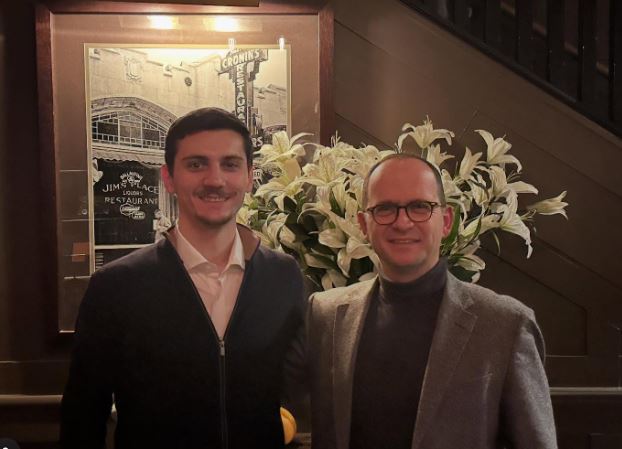
In a conversation on “Public Square”, Ditmir Bushati and Kosovar lawyer Yll Sadiku analyzed the legal dilemmas related to constitutional deadlines and the consequences that an institutional deadlock could have for Kosovo, both domestically and internationally.
Ditmir Bushati: I am Ditmir Bushati. My guest today is Ylli Sadiku, a lawyer from Kosovo, a man with experience in institutional life but also in the legal circles in Kosovo. Currently at Harvard University Law School. Yll, welcome to Public Square!
Sadiku Star: Thank you very much Ditmir! Thank you for the invitation.
Ditmir Bushati: As you can easily imagine, I want to have a discussion with Ylli about what is happening in Kosovo. So, we are in a situation where the Parliament of Kosovo, the main parties failed to generate the necessary quorum to initiate the procedure for electing the President of the Republic.
What is happening in Kosovo Yll?
Sadiku Star: The current President’s term ends on April 5, 2026. Based on a constitutional provision, the election of the new President must take place 30 days before the end of this term. This deadline was March 5, 2026.
However, this constitutional provision, while it gives us a deadline, does not give us any sanctions as to what happens if this deadline is violated. In this case, although on March 4, the Assembly placed on the agenda two names, two candidates for president, and it is considered that the procedure has begun. However, on March 6, President Osmani decreed the dissolution of the Assembly based precisely on this provision. However, there is another provision in the Constitution, which fully clarifies the manner of electing the President.
According to this other provision, the election of the President can go up to three rounds and must initially be by a 2/3 majority in favor, and then a simple majority can select the candidate in the third round.
This procedure must be completed within 60 days. The same provision also provides for the dissolution of the Assembly as a sanction for the failure of this procedure. Now we are in a situation where these two constitutional norms, not necessarily contradict each other, but still create a kind of ambiguity.
Now, we have political actors who believe that the dissolution of the Assembly is fair and in line with constitutional requirements. We have the other side who believes that this dissolution should not have been done because the 60-day deadline had to be exhausted.
In this situation, the Vetvendosje Movement, on March 9, submitted a decree to the Constitutional Court for the dissolution of the Assembly of the Republic of Kosovo. In that request, the imposition of a temporary measure was also requested.
Ditmir Bushati: I remember that even the election of President Pacolli, President Jahjaga, and President Thaçi, in one way or another, was associated with a kind of controversy, I would say.
Whether it’s the way they were elected, or the current president. The way the political forces are aligned. The intervention of the international factor, especially in the case of Mrs. Jahjaga. This time it seems to me that the international factor is silent and is observing the political class in Kosovo. Do you share this observation with me?
Sadiku Star: Yes. President Jahjaga is the only case that was elected in the first round. All other presidents have gone to the third round. As for the international factor, I share the same opinion. I do not see any interest or any involvement, at least not directly, in finding a consensual candidate. I believe that on the one hand this is showing us that political parties in Kosovo must have a higher level of maturity and find a consensual candidate and find a solution to not block the institutions without the need for the engagement of international actors.
Therefore, and I believe that without the engagement of international actors, political parties will provide a solution to this issue and will find a consensual candidate, either now or later by the decision of the Constitutional Court.
Ditmir Bushati: What are your chances of having a president in accordance with Kosovo’s constitutional provisions?
Sadiku Star: I believe that as long as the 30-day deadline has passed, there will always be claims by political parties that the election of the president was not made in line with constitutional requirements, but in any case, and in the event of raising such an issue before the Constitutional Court, the court itself should decide. Ideally, the election of the president would be made before the 30-day deadline and within the procedure that is foreseen. Ideally, the three rounds would be carried out before the 30-day deadline. However, I believe that we are in a situation of uncertainty and now the Constitutional Court should interpret the Constitution in line with its purpose.
I believe that the Constitution of the Republic of Kosovo does not at any time intend to block the institutions of Kosovo. In this case, the goal is the election of a president. But, of course, the election must also be held within the constitutional provisions. Therefore, for the Constitutional Court, I believe that the main question will be whether, with the passage of the 30-day deadline, with the passage of March 5, is it considered that all means and methods for political parties to find a compromise for a presidential candidate have been exhausted?
Or if, with the start of the procedure, we have a new deadline of 60 days and give political parties time to choose a candidate? If the elections continue, then it is very possible that after April 5, when President Osmani’s mandate ends and the acting Speaker of the Assembly becomes the Speaker of the Assembly, Kosovo will end up in a situation where we have a dissolved Assembly, we have an incumbent government and an incumbent president.
So, we have the main state institutions without a head who has a full mandate. And I believe this has many implications. Both in Kosovo and in the international arena, especially in recent times.
Ditmir Bushati: We are assuming the other scenario that you discussed. Early elections are held. In these institutions that I am calling representative institutions in office, starting with the President of the Republic, since his mandate ends after April 5, and so on.
The new parliament, from my reading of the Constitution of Kosovo, whenever it is constituted, will have to be subject to the same logic of numbers in Kosovo. My reading is that this kind of formula is an incentive for political compromise between the main parties. Do you see it possible for the new parliament to have a totally different reconfiguration?
So, for the majority to have even more votes, or for the minority to not only become the majority but also have a number of votes to elect the president? Or is it simply an even longer path to reach a consensus that you can’t hold on to?
Sadiku Star: I believe that this is actually the main concern of the citizens of the Republic of Kosovo. And if we go to new elections, there is no guarantee that we will not end up in the identical situation we are in.
Because of the weight of the role of the president and the Constitution foresees a 2/3 majority, I do not see any possibility that will be achieved by any single political party. So, we will again end up in the situation where the political parties have to sit down, have to discuss and have to come up with a joint candidate, with a candidate who comes from a political agreement to be elected president. We will again have to come to this situation. If this was inevitable, then I believe that the rightful frustration of the citizens of the Republic of Kosovo has been, why create new crises, only to come to the same conclusion.
The goal of our representatives should be to avoid crises, not create new ones. I believe that even if we go to new elections, it is up to the citizens of the Republic of Kosovo to have the chance once again to support their candidates, to change their vote if they have to, but, in the system we have, it is almost impossible for a political party to reach a 2/3 majority and compromise is necessary. The goal of the Constitution is precisely to encourage this kind of compromise. I believe that new elections will only prolong this crisis and we would have even greater consequences in the future.
Ditmir Bushati: As a lawyer, how do you see the tendency of the political class, which is actually not only in Kosovo but also in Albania, to follow the ball or find solutions in constitutional or legal instances, such as the case in question in the Constitutional Court for such issues. If we refer to the election of the president, there is a group of provisions in the Constitution of Kosovo and it turns out that the Constitutional Court of Kosovo has been set in motion by imposing through its decision-making the way in which voting is done. So, by clarifying the quorum and presence in the hall and the way in which deputies should vote. Are we in a situation where there is an inability to find compromise and political games tend to be resolved through a constitutional formula? In fact, Constitutional Courts, when they are put under pressure from politics and public opinion, confuse things even worse, to put it bluntly.
Sadiku Star: One of the purposes of the Constitutional Court’s decisions is also the interpretation of the Constitution. With that interpretation, very often the court, and especially ours, creates new constitutional norms. By creating constitutional norms, the Constitutional Court has provided solutions to problems that politics could not solve. However, I believe that this is not a good practice for the court because in this case the court plays a role in the manifestation of the will of the citizens. I believe that this is not the purpose of the Constitutional Court. In a state where there is political maturity, where there is mature diplomacy, the representatives are the ones who solve political problems and not the Constitutional Court. In our case, taking into account that our institutions have been blocked for political reasons but justifying constitutional issues. Then, the Constitutional Court has intervened and provided a solution. I believe that in this case it will do the same thing. I am not very much in favor of the court making interpretations of the manifestation of the will of the people. But, anyway, for now, it seems to be the only way out or to avoid a potential crisis.
Ditmir Bushati: We always talk about the challenges that Kosovo faces. I also find it difficult to think about what the main narrative would be if we were to go to early elections. All political parties would promise the people something that they do not have in their hands. Neither the majority can get more, under any circumstances it does not have the constitutional numbers. Neither can the minority, and if it becomes a majority, it cannot become a constitutional majority. I have the impression that Kosovo has been in a kind of vicious circle for a period of time. It seemed in my judgment that it came out with the elections of December 28, since the verdict was clear. Now, it seems as if it has re-entered this vicious circle. What are the main challenges that Kosovo faces when you also see the major events that are happening from the US? A kind of rift in transatlantic relations, a somewhat different security situation in the region. There is a tendency to revive the EU membership process. Where is Kosovo in the face of all these challenges, to put it bluntly?
Sadiku Star: You rightly mention that if it goes ahead, if there is a need for a new political campaign for elections, then political parties should take into account that the elections were in December and they do not have to present any new platform. Each candidate will try to blame the other candidates for reaching this point. Also, no one can promise that they can elect the president because it is known that it cannot be done.
This only leads to another crisis. The main crisis is that even if we have an acting president, the Constitution stipulates that that position can be exercised for up to 6 months. If we do not have an assembly, we do not have a government and a president for up to those 6 months, then we are in total legal uncertainty. We do not know what can happen because the acting president no longer has a mandate. This, I believe, has an effect on domestic policies, on laws, on everything that affects the life of the citizen, as well as on foreign policy. In foreign policy, it is not good for Kosovo to be represented by an acting president and by an acting government.
We are living in a time when wars are starting all over the world and when the security architecture is changing very quickly. At this time, Kosovo must have a consolidated leadership and must work towards alliances that guarantee the security of the Republic of Kosovo. And I believe that this alliance is NATO. Regarding relations with Serbia, we are not the first or the last case nor the only case when we have to share a border with a hostile state. I believe that we must find a way to live in the Balkans and to live as neighbors. We do not need to be allies, nor to be friends, but we need to be responsible neighbors. However, we must always act cautiously. We must be in full coordination with our allies.
Ditmir Bushati: You have been at Harvard Law School since August of last year, in what I would say is a fantastic experience. Both the school and the University as a whole do not need much commentary or publicity. Very briefly, what has impressed you the most from this experience and what would you say to people who want to follow more or less the same career trajectory?
Sadiku Star: In one sentence, it’s critical thinking. Critical thinking is highly encouraged here. There’s nothing that’s unchangeable here. Here, we’re always encouraged to challenge our colleagues, to challenge our professors. Always with the idea of coming up with a better result.
Ditmir Bushati: Yll Sadiku, thank you for being with me at Public Square!
Sadiku Star: Thank you Ditmir!
© BalkansWeb