
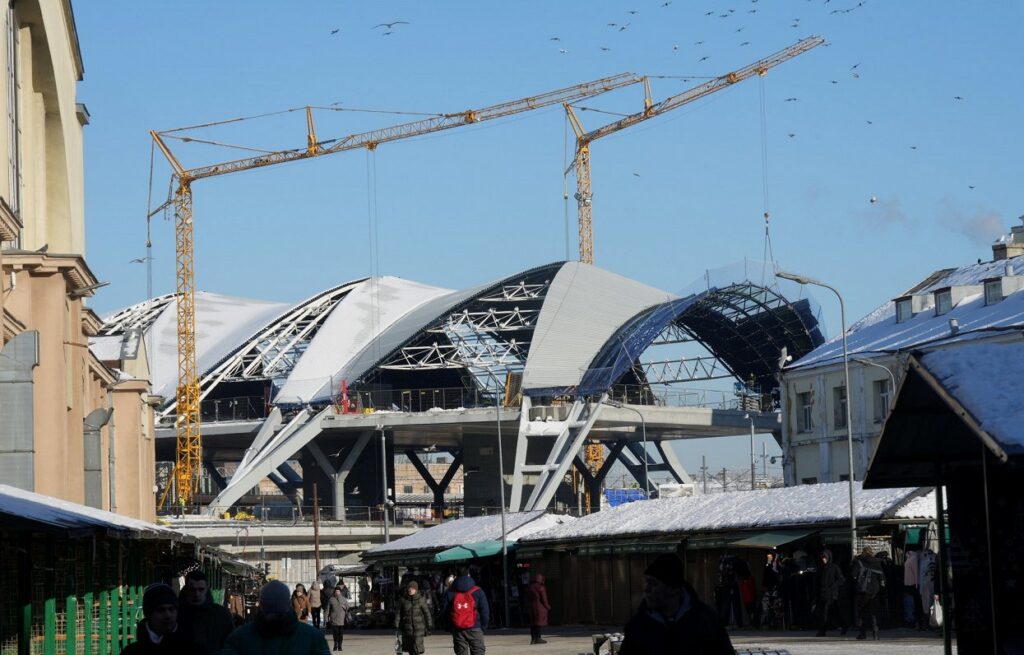
Of the total eight billion euros that Latvia had initially applied for, one billion euros was planned specifically for the Rail Baltica project. According to the latest estimates, the projected costs of the first stage of the project will increase by several hundred million euros.
The loan facility is a borrowing instrument called SAFE. Its total amount is 150 billion euros for all European Union member states. The goal is to develop military defence, military mobility and other strategic infrastructure projects. The money can also be dedicated to the Rail Baltica project. Though not originally pitched as a military mobility project, in recent years officials have increasing stressed the project’s potential defence aspects, as a result of Russia’s war in Ukraine and as a means of accessing more potential funding streams as Rail Baltica’s costs spiral.
RB Rail says that Latvia had applied for approximately eight billion euros from the SAFE instrument. 5.68 billion euros were allocated, but Latvia took only 3.49 billion of them, leaving more than two billion euros “on the table”. Matīss Paegle, the head of the council of RB Rail, is confused about this.
“It’s a very beneficial mechanism. I believe that Latvia is making a strategic mistake by not taking this money. And many people I’ve spoken to in Brussels are also surprised by this.”
“Because in principle, this is almost the first case in which a member state refuses very, very advantageous [terms for] money. And if we look at it from our own situation, this is money with which we could implement very important security measures, for example, buy anti-missile systems or Rail Baltica, which is part of military mobility. We could now start implementing it much more powerfully,” claims Paegle.
A billion would be spent on the mainline
RB Rail would spend a billion euros on the main line section from the Lithuanian border to Salaspils, Paegle says, with a 45 year loan, of which nothing needs to be paid back for the first 10 years. Latvia would start repaying the debt in 2036.
Transport Minister Atis Švinka from the Progressives says that for Latvia, an additional 2.2 billion euros in borrowing would create too much of a liability. At the same time, Švinka sees an opportunity to use the SAFE money.
“Other countries do it differently. They create these funds, which are off-budget infrastructure funds, where they exempt defence spending above a certain percentage of GDP from these borrowing restrictions. Latvia could also do it, where it could be either above 3.5% or above 2%, other countries above 1%. They free up [fiscal space]. At that point, the budget would be completely different and Latvia would have the opportunity to use these SAFE instruments,” says the minister.
Ints Dālderis – the Prime Minister’s adviser on European funds from the “New Unity” party – points out that the money will have to be returned and this would increase the state debt and affect the country’s long-term credit rating.
“If we really want to borrow, then we borrow for what we are absolutely sure we absolutely need and right now. I think the most important thing right now is to focus on ensuring that the implementer working on the Rail Baltica project uses the money that is already available right now – currently around 600 million [euros] – and then, if more borrowing is really needed and the state has such opportunities, the state will be able to use it later. The problem is that RB Rail itself cannot prepare projects in time to be able to give them to the builders to build, and we are very dissatisfied with the level at which this company has worked so far. The fact that they are commenting on the government’s – their owner’s – borrowing is, in my opinion, very unacceptable,” says Dālderis.
According to current estimates by RB Rail, the project’s first stage will probably cost Latvia several hundred million euros more, approaching six billion euros. The original estimate back in 2017 for completion of the entire Rail Baltica project across all three Baltic states was 5.8 billion euros. More recent estimates suggest the cost is more like 24 million euros with plenty of potential for that figure to rise even further.
Rail Baltica envisages the construction of an 870-kilometre European standard gauge high speed railway line from Tallinn to the Lithuanian-Polish border, in order to further connect the Baltics with other European countries by rail. It was originally supposed to be completed by 2026, and 2030 is currently being used as a tentative completion date, but that looks extremely unlikely to be realised.