
Following the fall of the Assad regime in December 2024, Syrian media are in transition. As part of the reconstruction process, the media are to be professionalized and should also take critical voices into account.
During the dictatorship under Bashar al-Assad, Syrian media were considered the ruling Baath Party’s mouthpiece. Opposition voices and independent journalists were systematically suppressed and persecuted. Now, state media have resumed operations under the transitional government of Ahmed al-Sharaa, the former leader of the HTS rebels.
DW Akademie spoke with Heva Abd Alkader, a Kurdish journalist at the independent radio station ARTA FM, and Omar Ferouan, editor-in-chief of the state-run news agency SANA, about their experiences during the civil war, the current situation, and their ideas about free journalism in Syria.
 During the civil war and today, Heva Abd Alkader reports for the independent Kurdish radio station ARTA FM from northeastern Syria Image: Lina Eikelmann/DW
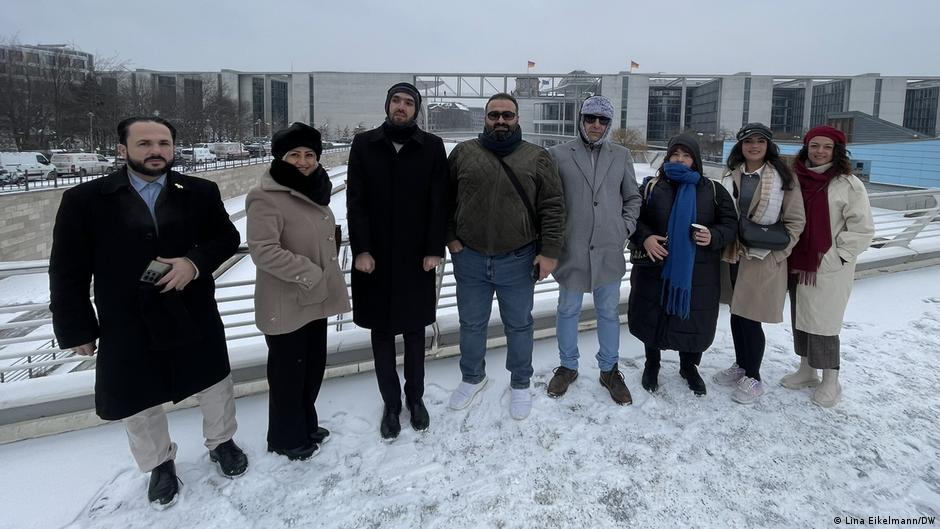
Together with other Syrian media professionals, they took part in a delegation trip to Berlin in February 2026, which was organized by DW Akademie and funded by the German Federal Ministry for Economic Cooperation and Development (BMZ).
Your youth was shaped in very different ways by displacement and war. How did you manage to cope?
Heva Abd Alkader: I grew up during the war as the daughter of a Kurdish family in Aleppo. We were in mortal danger every day, so survival became my greatest dream. I often had to study by candlelight for school, but my father told me almost every day: “Education is a woman’s weapon. You must learn, no matter what the circumstances.” During the war, I often wrote down my thoughts on loose pieces of paper. I tried to “write away” everything that was happening around me as best I could. Even though I always wrote about the reality I experienced for myself, Kurdish was banned by the Assad regime. I didn’t know anyone in Aleppo who wrote about the reality of the Kurdish people in a journalistic way.
 As editor-in-chief of SANA, Omar Ferouan is pushing ahead with the restructuring of the state news agency Image: Lina Eikelmann/DW
Omar Ferouan: I have always loved reading and later dreamed of becoming a journalist. I am more of a listener and observer, but I like to talk when it matters. As a teenager in my hometown of Homs, I often read the official newspapers — but never found what I was looking for in them.
What exactly were you looking for?
Ferouan: International news and analyses about political events in Syria. I had always been very interested in what was happening around us, but there was no free press in Syria. It was always just “the president did this, the president did that…” Later, I started watching the news channel Al Jazeera and recording my opinions and thoughts in diaries. But these documents were all destroyed in a bomb attack on our house.
Journalism in Syria
Heva Abd Alkader is a Kurdish journalist from Rojava working for the independent radio station ARTA FM. During the civil war, she reported from northeastern Syria, giving voice to the oppressed Kurdish population.
Omar Ferouan is editor-in-chief of the state-run news agency SANA. Under the transitional government, he is part of SANA’s new team, which aims to drive forward restructuring. Ferouan believes it is important to ensure that, in future, the media outlet stands for fact-based news in and from Syria.
During the revolution and civil war, you both resisted the Assad regime. How did that come about?
Abd Alkader: After school, I started studying economics in Aleppo—here I felt the systematic oppression of the Kurds by the Assad regime on a daily basis. After graduating, I moved to the city of Amuda, which is located in the Al-Hasaka Governorate—in the Rojava region.
There, in northeastern Syria, a de facto autonomous Kurdish self-administration emerged with the start of the civil war in 2011.
Abd Alkader: Exactly, in Amuda I found a completely new reality: for the first time, I was able to speak my own language and also work in the Kurdish language. For me, Kurdish journalism was a dream come true. I saw the opportunity to convey the Kurdish reality—and that’s how I started at ARTA FM.
It is very important to me to emphasize that I am not and have never been part of the political opposition. I am an independent journalist, not a political activist. I stand for democratic and liberal values—values that were incompatible with the Assad regime.
 The Syrian delegation also visited DW’s studios in Berlin Image: Lina Eikelmann/DW
Ferouan: I joined the opposition in 2011 when the revolution broke out. My father used to have a very good position in the government under Assad. But when he witnessed numerous cases of corruption, he gave it up. As a result, my family was systematically persecuted. In my youth, we were constantly on the run. Later, I began studying English literature in Homs. During my first year at university, the revolution broke out. At first, we demonstrated peacefully against the government, but street fighting broke out because the government claimed we were carrying weapons. I had to watch as hundreds of demonstrators were shot before my eyes – including my friend, whom I had to carry away. When you see something like that, you can’t help but join the opposition. When Homs was besieged, I continued my studies in Idlib.
Idlib in northwestern Syria was considered a rebel stronghold. Starting in 2017, a civilian administrative structure was established there by Hay’at Tahrir al-Sham (HTS) and other opposition groups, which effectively governed large parts of Idlib and the surrounding area.
Ferouan: Yes, Idlib was the region that was free. There were about 20,000 students at the university. Many Syrians who opposed the Assad regime fled either abroad or to the Idlib region. We had one thing in common: we no longer wanted to live under this government. We began to build our own media outlets that represented public opinion in these areas. I learned journalism through continuing education courses offered by regional media agencies. During the revolution, I also worked as a teacher in refugee camps, because children who have fled their homes should not be deprived of an education.
What prospects do you see for your journalistic work in Syria?
Abd Alkader: At ARTA, we will continue to report independently of government agendas and adhere to journalistic standards. The bloodshed has stopped and we are seeing signs of integration, but that will not stop us from demanding our full rights so that there will be no more oppression of Kurds in Syria in the future.At ARTA, we also have special training programs and the Radio Zîn project, in which women are trained in journalism and can talk about issues that are important to them. We will continue this work as well.
Ferouan: As editor-in-chief of SANA, I make sure that all ethnic groups are represented equally in the newsrooms. The previous government turned people against each other, whereas the current government wants to integrate everyone. We also want to reflect all opinions, including problems and suffering. It is important to always show the big picture. For example, it is routine at SANA to report on all religious festivals in the country. News must also be reliable and factual: we want to ensure this through reporters on the ground, government contacts, and interviews with eyewitnesses. We have retrained editors who previously worked under Assad.
Does SANA also employ women?
Ferouan: Certainly. I can’t give you a percentage, but they are there. The most talented members of our team are women.
During the delegation trip, you spent several intense days together as independent and state media professionals. Did you have different perspectives?
Abd Alkader: We learned, ate, and attended meetings together. There were no open conflicts or tensions. Of course, everyone has their own personal convictions, but we came here to learn from German media. Besides, I’m not here to settle political conflicts. Ultimately, we all want a better Syria.
Ferouan: Actually, the only thing we really got to know was the Berlin snow (laughs). Seriously, we got along well and spoke respectfully with each other. We had different experiences during the revolution and also have different views — but we agree that Syria must be rebuilt with our own hands and efforts.
Finally, in Berlin you spoke with the Federal Ministry for Economic Cooperation and Development, foundations, and media institutions, among others. What role could Germany play in rebuilding the Syrian media landscape?
Abd Alkader: We need long-term support so that we can survive as an independent media outlet. Experience from free press organizations, training, and cooperation are particularly important. There are many young, committed people in Syria whose energy we can put to good use if we train them professionally. We have lived in isolation for a long time. This trip has broadened my horizons. In return, I would like people from Germany to come to Amuda to get to know our city and culture. I was impressed by how Germany was rebuilt piece by piece, despite war and division. As part of the younger generation, this gives me great hope. In Kurdish, we say: “Jin, Jiyan, Azadî” – woman, life, freedom.
Ferouan: This trip was very interesting, and I was delighted to learn so much about the structures and workings of the German media system—the idea of the Federal Press Conference is particularly exciting. Now I have to think about how what we saw here corresponds to the reality in Syria. And then we have to see what can be implemented in practice.
Interview: Lina Eikelmann
Collaboration/translation: Maryam Kamel