
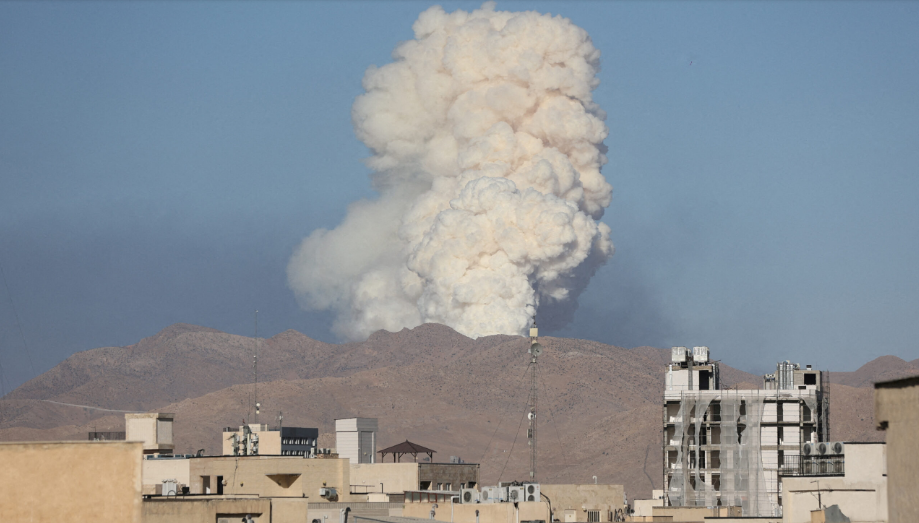
[Majid Asgaripour/WANA via Reuters]
The Iranian regime’s unexpectedly strong resistance and the apparent lack of US strategy is expressed in the most visible way by the scores of ships stranded in the Strait of Hormuz.
Although it was obvious to all that an attack on Iran harbored serious dangers for the global economy, it appears that the Americans did not take any measures to secure the safety of shipping through this crucial geographical point controlled by Iran.
And so, the economic fallout of the war speeds to every corner of the world, as the threat of shortages in gasoline, gas, fertilizers etc., has an immediate impact on prices and on the prospects of the global economy. The duration of the conflict, the final damage to infrastructure, the changes in international relations will determine, to a great extent, the cost for each country.
For Greece, much depends on the rise of prices and the impact of the war on tourism and investments. The fallout may be damaging. But there is also a possibility that Greece may absorb some of the traffic and capital that was concentrated in Gulf countries. These have found themselves unexpectedly in the line of fire, facing a future that they had not planned. Relations between Saudi Arabia and the United Arab Emirates are a case in point: old allies, they found themselves on opposite sides in various recent conflicts; now they both face attacks from Iran for harboring US forces on their territory. The course of the war will determine their relations.
Turkey, too, is under attack from Iran, and Recep Tayyip Erdogan is unable to play his usual role of mediating and having good relations with both sides. Now, he has no influence with Iran, nor with Israel, and there is always the danger of Donald Trump demanding Erdogan’s contribution to his war, something that the Turkish leader will not be able to provide because of strong domestic opposition to this. In this situation, despite the higher cost of energy and goods, Greece may be the most stable point in the broader region.
While much depends on how countries will be affected, and on the chain reactions that will follow, for Greece the future of NATO and the European Union are of paramount importance. If Trump demands NATO member-states’ participation in the war, this may be a serious test of the alliance’s cohesion, to the point that it might lose its credibility. This would have direct consequences on the relationship between Greece and Turkey, forcing our country to pursue bilateral alliances, such as the one it has with France, while not being sure of the reliability of its primary ally, the United States.
The deck of cards is in the air and each country must deal with this. The EU’s survival is vital for Greece. Our neighborhood will always be dangerous, while no military alliance can be considered permanent. Our participation in a robust Union gives us weight on the international scene, even as it is each country’s responsibility to ensure its diplomatic, military and economic reinforcement. In these uncharted waters, no one can make it alone, but the support of others is not enough. So far, the government has handled the situation with caution and daring. But greater difficulties lie ahead.