
By Mazahir Afandiyev I
AzerNEWS
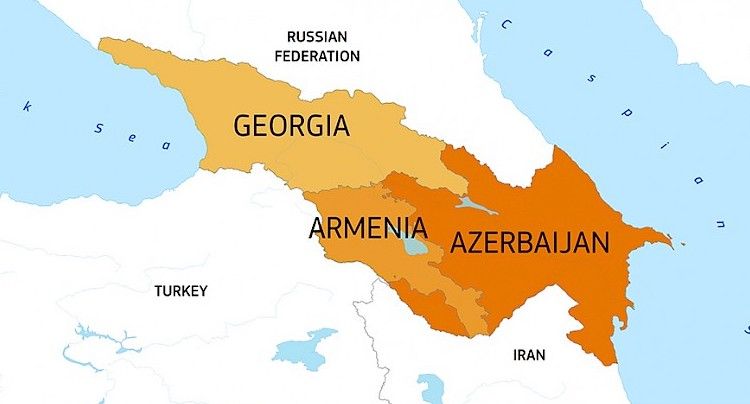
The South Caucasus region, located between the East and the
West, has historically served as the border area of several states
and as a place where different peoples have lived together. For
centuries, through the Silk Road, this region contributed to the
strengthening of economic relations between states and cultural
ties among peoples, creating conditions for people to live here in
prosperity.
From the perspective of cooperation with Europe, the South
Caucasus holds an important geopolitical position on the Asian
continent. However, geopolitical developments that have taken place
in the region over the past 30 years have affected the security and
peace of the peoples living here and have hindered sustainable
socio-economic development.
The magnificent Victory achieved by Azerbaijan in the Second
Karabakh Patriotic War created new realities in the region and laid
the base for discussions on fundamental development strategies.
On March 11 of this year, during the visit of the President of
the European Council, Antonio Costa, to Azerbaijan, it was
emphasized in the joint press statement with President Ilham Aliyev
that our country has always attached great importance to mutual
dialogue and close cooperation.
The remarks made by President Ilham Aliyev during his speech
once again demonstrated how actively Azerbaijan cooperates with the
European Union to ensure the integration of the region into the
newly forming political architecture of the world. The President’s
words — “In January of this year, 50 percent of our trade
turnover was connected with the European Union. Last year the
turnover was slightly lower, but it clearly shows that the European
Union is our number one trade partner” — are a clear
example of relations developing with positive dynamics.
In particular, after the signing of the Memorandum of
Understanding on a Strategic Partnership in the Energy Sector
between Azerbaijan and the European Union on July 18, 2022, our
country became a key actor for the EU in the region.
Today, against the backdrop of the Fourth Industrial Revolution,
the global political architecture is rapidly being reshaped. Under
the leadership of President Ilham Aliyev, Azerbaijan is not only a
country possessing energy resources within this architecture, but
also acts as a guarantor of global security and stability. The
visit of the President of the European Council to Baku demonstrates
that Brussels regards Azerbaijan as an indispensable partner in the
Eurasian space—one that pursues an independent foreign policy and
plays a decisive role in shaping regional configurations.
Based on the historic Declaration signed on August 8, 2025, in
Washington, D.C., the capital of the United States, the agreement
on launching the Zangezur Corridor will create new transportation
opportunities across Eurasia. This will increase the geopolitical
importance of closer connections between Europe and Asia and will
also strengthen Azerbaijan–EU partnership in practical terms.
The relations established so far between Azerbaijan and the EU
represent an effective example of cooperation based on mutual
respect and tangible results. Projects such as the Southern Gas
Corridor and Green Energy initiatives in the field of energy
security are successful outcomes of this cooperation. However, as
President Ilham Aliyev has emphasized, these relations now have the
potential to go beyond existing frameworks and encompass broader
areas.
In general, the issues discussed during the meeting indicate
that our partnership with the EU, alongside traditional fields, may
also include several new directions aimed at addressing the
challenges of the modern era.
Today, the application of artificial intelligence technologies
in ensuring sustainable development has become a matter of common
interest for all sides. Azerbaijan, as in many other fields, is
ready to bring advanced digital solutions into the partnership
framework in this area as well.
In this context, emphasizing the role of citizens and exchanging
experience in the further modernization of public services (such as
the ASAN Service model) also aligns with the EU’s social policy
agenda.
At the same time, joint efforts in protecting cyberspace—one of
the most sensitive areas of global and regional security—as well as
in intelligent border management could be considered a direct
contribution to the security of both the South Caucasus and
Europe.
Thus, by transforming Europe’s energy map, Azerbaijan is also
becoming a central hub for security and development corridors in
the new world order. It can be confidently stated that the
Azerbaijan–EU partnership both meets our country’s national
interests and creates a reliable foundation for achieving goals
arising from global challenges.
—–
The author is a Member of the Milli Majlis of the Republic
of Azerbaijan
The views and opinions expressed by guest columnists in
their articles may differ from those of the editorial board and do
not necessarily reflect its views.