
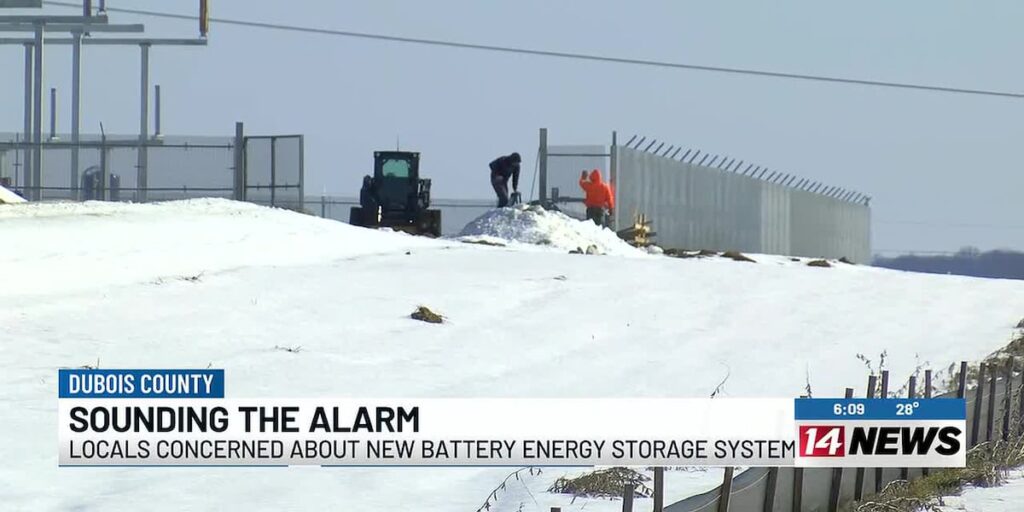
HOLLAND, Ind. (WFIE) – Nestled in a rural section of Holland, Indiana in Dubois County sits the site of the proposed Crossvine Solar Project.
Particularly, the BESS, which stands for a Battery Energy Storage System, that’s set to be a part of this project, has got some local residents speaking out.
14 News spoke with Chad Blessinger, who’s the president of the Dubois County Commissioners.
He says Dubois County has very limited zoning rules in place in regard to solar and energy storage projects.
Crossvine Solar and BESS problems in Dubois Co.
As such, he says companies like AES Indiana have reached out to local landowners to broker deals to utilize their property for projects like Crossvine.
“What it is, they create power, or they gather power from the sun. They collect it in these battery storage systems, and then they can use that power at another time whenever there’s more of a need for the energy,” says Blessinger.
Beyond issuing solar permits and ensuring the county property is protected, Blessinger says this kind of project rests almost exclusively with the landowners that made a deal.
“Local landowners have leased their land to these people for 20, 30 years, and they’re starting to put solar panels and battery storage systems in Dubois County,” he says.
However, those who live in the community, like Abby Wendholt, whose family property is right next to the location of the BESS, have sounded the alarm on potential safety concerns.
“The biggest risk is the fire. If they would catch on fire, the safety of our first responders, our firefighters, there’s really no way to put them out,” says Wendholt. “So, everyone within that two mile radius, which includes four schools, two daycares, we have the dairy up in Holland, including all the residents that live in this area, would have to evacuate within minutes before a lot of this toxic gas is released.”
It’s a sentiment shared by others in the community, including Jared Harris
“They’re basically putting 92 shipping container-sized batteries right in the middle of four schools within two miles of either direction,” says Harris. “The community’s not been well-informed.”
14 News also spoke with Southwest Dubois County School Corporation Vice President John Schroeder, who said the schools were not well-informed.
Schroeder says, in part, with the exception of local residents that have come to their public meetings and spoken, nobody else has approached them.
“With the exception of the local residents that have come to our public meetings and spoken, nobody else has approached us. Due to the proximity of the battery station, we were very surprised and disappointed there wasn’t more notice or information provided since again the safety of our schools is our number one priority. Even if highly unlikely, if there is a chance of a catastrophic event that requires specialized training, we should have been brought into the loop long ago.”
“Worst case scenario: these batteries start on fire, what are they going to do?” questions Harris. “I mean, evacuation, you got schools within minutes away. They’re not going to be able to evacuate those.”
“Just worrying about that, about our children,” says Wendholt. “Getting our children out, getting the town of Holland, that has no evacuation system put in place, just what is going to happen?”
According to the United States Environmental Protection Agency, or EPA, since 2020, BESS failure incidents have decreased.
Their website does go on to say, however, that some recent fires have gained attention in the media, including a fire in San Diego, California in 2024 that had continued flare-ups for seven days, as well as an early 2025 fire in Monterey County, California, resulting in a 24-hour evacuation of over 1,000 residents.
Blessinger says part of the state law and their local agreements with AES Indiana is they’re required to provide training to the local first responders in the area, free of charge.
“They’ve met with the locals, and they are working with our emergency management people, and they are trying to figure out the best way to provide that training,” says Blessinger, “and from everything that I’ve seen, any training that we want, they will bring it in.”
That said, Blessinger admits he understands local residents’ displeasure and hesitancy to embrace the project.
“I’m not necessarily happy about it. From my position as a commissioner, I don’t get to go around and tell people what businesses they can and can’t do on their property, and so when somebody comes in and they want to lease their land to someone, we don’t go in and say ‘you can’t do that,’” he explains. “The rules, as they are set up now, that’s a legal land use, and we have some minor guidelines in place to protect the citizens and to protect county assets such as roads, bridges, and ditches.”
For residents like Wendholt and Harris, the issue now is where to go from here.
Construction is set to begin in the spring, and they feel that not only is the BESS a significant safety hazard, despite what AES says in their numerous presentations and on their website, but that the local government can still do more.
“There’s a lot of people besides me that have done so much in trying to do the research that should’ve been done before this was ever passed. We’ve been going to Huntingburg City Council, we’ve been going to the Dubois County Commissioner meetings, just letting them know that we’re not for it,” explains Wendholt. “Again, it’s on private property, and we’re all for people doing what they can, but when it is affecting our whole community, I feel like we should have a say, and they do have an opportunity to stop it if they really wanted to.”
Blessinger says the county currently has a moratorium in place because of public feedback they’ve received about this project.
With that, they will not be accepting any new applications for solar field or project similar to Crossvine moving forward for the time being.
Looking ahead though, he says they’re considering changing zoning ordinances, restrictions on projects like these, and making sure those opposed to the Crossvine project have a chance to assist with change.
“Whenever we do look at our ordinances again, the goal is to have the people who are most against these kind of things, have them involved,” says Blessinger, “have them help write the rules going forward because we want to have all voices heard and involved.”
Along with local residents and officials, 14 News has also reached out to AES Indiana now on multiple occasions with questions regarding the project and potential safety concerns posed by residents.
While we’ve been told several different dates and times we would receive those answers over the course of several weeks, we’ve still yet to receive any official answers.
Copyright 2026 WFIE. All rights reserved.