
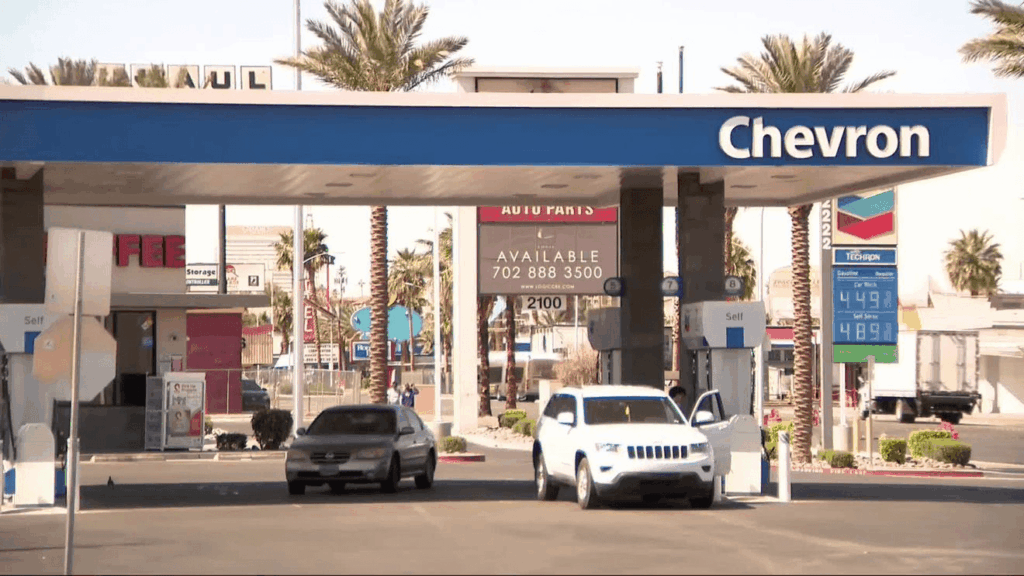
LAS VEGAS (KSNV) — Rising oil prices tied to an ongoing conflict are pushing gas prices higher, and the impact is spreading across Southern Nevada’s economy beyond what drivers see at the pump.
Higher fuel costs are raising expenses for workers, tourists and grocery shoppers as the Las Vegas area heads into what many economists had predicted would be a record summer travel season.
Lawrence Vierra, who said he commutes frequently, described the strain of higher prices. “I commute a lot, and these gas prices are outrageous right now,” Vierra said. He said filling up has become hard to justify: “Right now, I’m ready to start walking. I’m ready to start commuting because – 70 dollars, it’s just too much. it’s too much.”
Andrew Woods, director of UNLV’s Center for Business and Economic Research, said the region is vulnerable in multiple ways, starting with its large leisure and hospitality workforce and the visitor economy. “First and foremost is leisure and hospitality and the cost of gasoline for workers, for consumers, for visitors, also air fares,” Woods said.
Woods said hourly workers and many middle-class households are especially exposed when transportation costs rise on top of already higher prices for other essentials. “Anyone, pretty much, in that middle class bracket that has already felt the squeeze of higher prices in general, for everything from housing to automobiles, are going to be the first people to feel this too, in terms of, you’re probably going to pay $50 more a month in gas, gas prices alone,” he said.
Tourists who drive to Las Vegas from Arizona and Southern California are also feeling the impact. Artis Moore said the higher costs are affecting family plans. “It’s kinda stressful because we do have kids and it hurts us. we can’t do the fun activities sometimes,” Moore said. Asked whether it was getting to the point of reconsidering trips to Las Vegas, Moore said, “It is getting to the point to reconsider. even switching to an electric car sometimes, too. so, yeah.”
Higher fuel prices are also increasing the cost of farming and food production, and Southern Nevada’s reliance on shipped-in food adds another layer of vulnerability. With upwards of 90% of the region’s food needing to be transported in, higher fuel costs can translate into higher prices in the supermarket’s produce section and beyond.
Vierra said the surge is forcing broader cutbacks. Asked what the higher prices are doing to the rest of his budget, he said, “Oh. cutting everything. cutting everything. the plans that i have. wanting to go anywhere. i don’t want to go anywhere any more because of the gas prices are too much.”
Woods said there is at least one bright spot for household utility bills: Natural gas, not oil, drives energy costs, meaning residents do not need to panic about running air conditioning this summer.
Even so, higher energy prices are arriving as some parts of the local economy — including financial services and information technology — had been starting to see solid gains in real wages.