

Indian equities are trading below their long-term average valuations, but analysts remain cautious about turning buyers as rising oil prices and geopolitical tensions raise macroeconomic concerns for the economy.
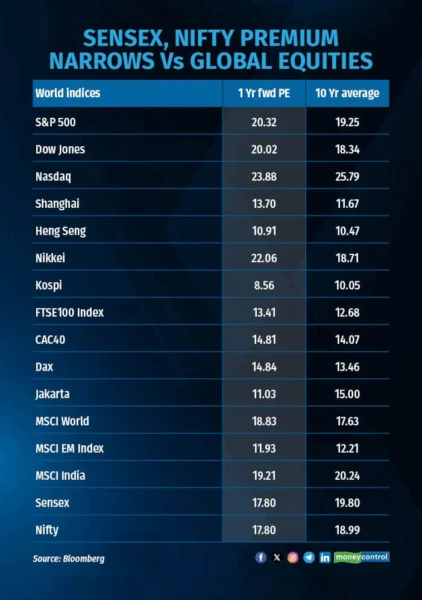
India’s benchmark Sensex and Nifty are currently trading at a one-year forward price-to-earnings multiple of about 17.8 times, the lowest level since April 2023. The valuations are below their 10-year averages of 19.8 times for the Sensex and 18.99 times for the Nifty.
Despite the moderation in valuations, earnings visibility remains a key concern, said Deepak Jasani. He said that while PE multiples have become more reasonable than earlier levels, they are still not particularly attractive. According to Jasani, the bigger uncertainty lies in earnings, especially over the next one or two quarters, as rising oil prices could disrupt cost structures and corporate profitability.
Inflation is another factor weighing on sentiment. Jasani said higher inflation could slow growth and force additional spending to provide relief to households. Reports of a harsh summer may also affect productivity in parts of the economy and weigh on rural earnings.
While Indian valuations have eased, several global markets continue to trade above their long-term averages. The S&P 500 trades at a one-year forward PE of 20.32 times compared with its long-term average of 19.25 times, while the Dow Jones trades at 20.02 times versus 18.34 times historically.
In Asia, China’s Shanghai market trades at 13.7 times compared with its long-term forward PE of 11.67 times, while Hong Kong’s Hang Seng trades at 10.91 times against its long-term average of 10.47 times. Japan’s Nikkei trades at 22.06 times compared with its long-term valuation of 18.71 times.
European markets also remain slightly above historical averages. France’s CAC 40 trades at 14.81 times compared with its long-term average of 14.07 times, Germany’s DAX trades at 14.84 times versus 13.46 times historically, and the UK’s FTSE 100 trades at 13.41 times compared with its long-term average of 12.68 times.
Brokerages have also turned more cautious on Indian equities amid rising geopolitical risks and higher oil prices. Nomura warned the market could face an additional correction of about 5 percent in the near term, with small- and mid-cap stocks at greater risk. The brokerage cut its December target for the Nifty 50 to 24,900 from 29,300 earlier and flagged a potential 10 percent to 15 percent downside risk to fiscal year 2027 earnings if oil prices remain elevated.
Citi also lowered the valuation multiple it assigns to the Nifty 50 to 19 times one-year forward earnings from 20 times, citing risks to fiscal year 2027 growth and higher inflation if Middle East supply disruptions persist. Earlier, Morgan Stanley downgraded Indian equities to “equal-weight” from “overweight,” warning that the Iran conflict could disrupt energy supply chains through the Strait of Hormuz and that global investors may remain cautious amid high valuations and uncertainty around artificial intelligence.
Valuations in India have moderated but the market remains among the more expensive ones in Asia, which is making investors cautious. Much will depend on how oil prices evolve and whether geopolitical tensions ease. Foreign investors have continued to remain sellers, while domestic institutions have so far absorbed liquidity. Persistent foreign outflows could put further pressure on valuations if the trend continues.
Rajesh Palviya of Axis Securities said valuations have improved in certain pockets of the market, but foreign investors remain cautious due to currency pressures and global uncertainties. He said foreign investors are facing losses due to rupee depreciation against the dollar, which is making Indian equities less attractive despite the recent correction in valuations. Concerns over crude oil supply disruptions, potential inflation pressures and the impact on economic growth are also weighing on investor sentiment.
Palviya said sectors such as pharmaceuticals, banking and consumer staples may offer relatively better opportunities as valuations in these segments have become more reasonable. He added that select opportunities may also emerge in metals and automobiles in the near term.