
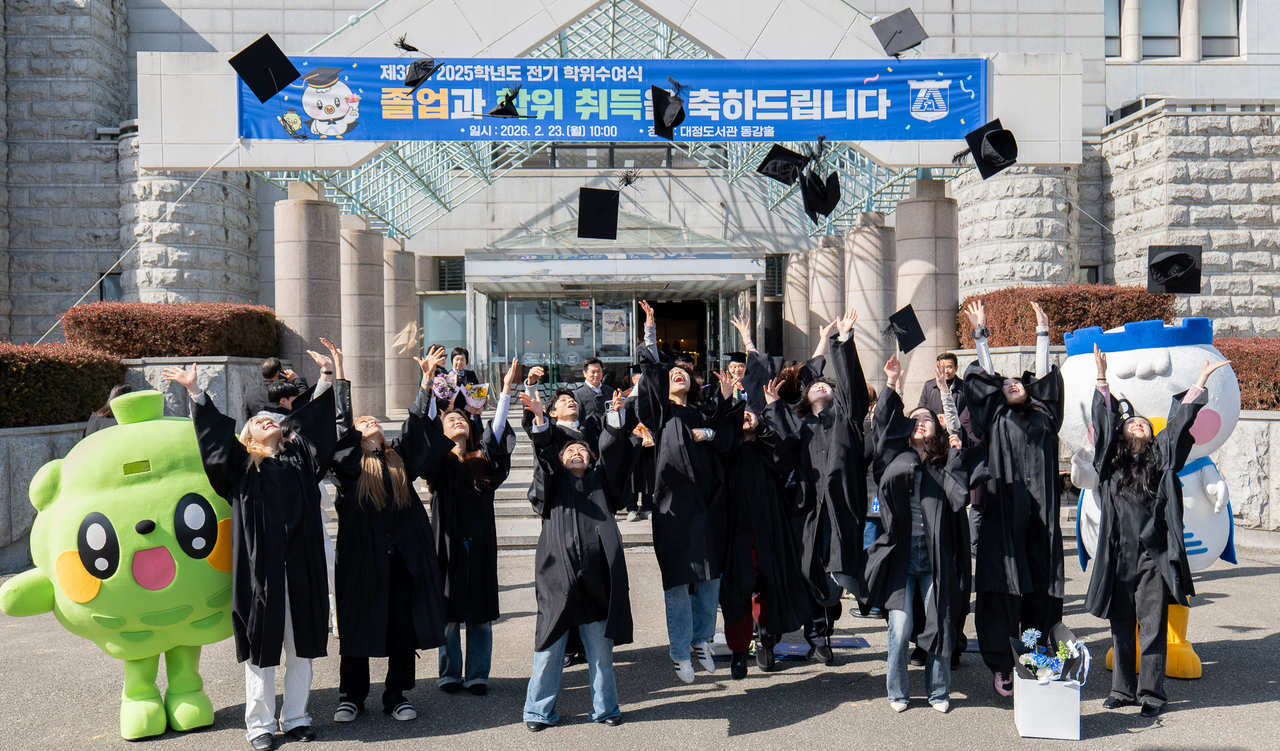
 Graduates of Dongshin University celebrate at a graduation ceremony on the university campus in Naju, South Jeolla Province, Feb. 23. (Yonhap)
 Nearly 1 in 5 newly minted Ph.D.s in natural sciences in South Korea say they are planning to move abroad, raising concerns about a potential outflow of highly trained researchers from key science and technology fields.
About 17.7 percent of doctorate recipients in natural sciences and 11.5 percent in engineering said they were considering migration in 2025, according to a study released Tuesday by the Korea Research Institute for Vocational Education and Training.
The findings come as policymakers face growing pressure to expand research opportunities and career paths for elite scholars in science and engineering.
The institute analyzed the international migration intentions of 70,167 doctorate recipients who earned their degrees between 2018 and 2025.
Among natural science Ph.D.s, the share planning to go abroad fell from 16.4 percent in 2018 to 13.1 percent in 2022 before rising again, reaching its highest level in 2025.
Engineering doctorate recipients showed a similar pattern. The proportion dropped to a low of 7.3 percent in 2021, but has climbed each year since, also peaking in 2025.
Compared to other academic disciplines, doctorate holders in natural sciences and engineering showed the strongest intention to migrate. These two fields were the only ones where the share of respondents planning to leave the country exceeded 10 percent during the survey period, surpassing humanities, social sciences, medicine, education and arts.
Most doctorate recipients who planned to move abroad said they intended to do so for postdoctoral research.
Between 79.7 percent in 2021 and 85.4 percent in 2024 cited postdoctoral work as their main reason for leaving the country.
Among natural science Ph.D.s, more than 90 percent said their move was aimed at postdoctoral research each year until 2025. In that year, medical doctorate recipients slightly surpassed them, with 92.4 percent citing postdoctoral research compared with 91.3 percent in natural sciences.
“This shows that new doctorate recipients leaving Korea is not simply an outflow of talent, but part of a process of pursuing research careers,” said Song Seung-won, a researcher at KRIVET.
Song said government policy should focus on encouraging scholars to return after completing postdoctoral programs abroad.
Possible measures include expanding fellowship programs for returning researchers and strengthening links between doctoral training and research careers in corporate research and development, the report said.
The survey also showed a growing number of doctorate recipients hoping to work abroad rather than only conduct research. The share citing overseas employment rose from 6.1 percent in 2018 to 12 percent in 2025.
Some scientists have previously pointed to limited opportunities in South Korea as a reason for leaving. Yi So-yeon, the country’s first astronaut, once said she left the Korea Aerospace Research Institute because she could not spend her career “just giving lectures” about her experience in space.
After earning a doctorate in biotechnology in Korea, she later pursued a Master of Business Administration at the University of California, Berkeley and is now reportedly working in the US.
minsikyoon@heraldcorp.com