
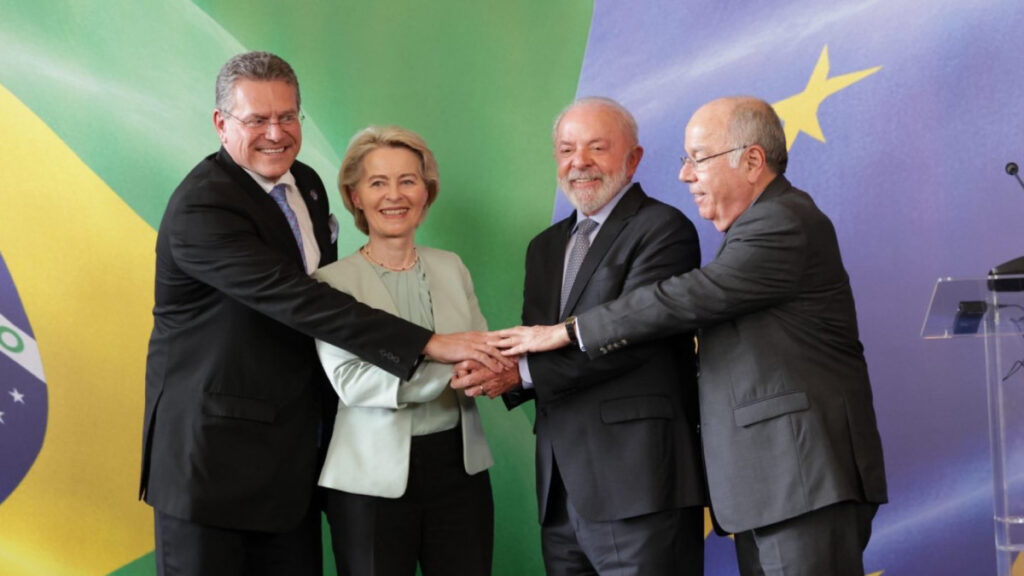
After 25 years of negotiation, the European Union has wrapped up and signed the association agreement with Mercosur: Brazil, Argentina, Uruguay, and Paraguay. The length of that process is no bureaucratic anecdote but reflects the complexity involved in reconciling regulatory demands, political priorities, and sensitivities related to production on both sides of the Atlantic. And the slowness of the process speaks to something else: the magnitude of this agreement, which is no mere tariff treaty or technical gesture. It is an exercise in reaffirming sovereignty by establishing a firm framework of relations that combines the gradual opening of markets, economic cooperation, and political dialogue.
“Global trade is fragmenting, geopolitics are coursing through the economy, and supply chains are increasingly used as instruments of power”
The international context surrounding this agreement could not be more significant. Global trade is fragmenting, geopolitics are coursing through the economy, and supply chains are increasingly used as instruments of power. At the same time, logics of spheres of influence, economic coercion, and unilateralism have all been making a strong comeback. Washington’s modern-day reading of the Monroe Doctrine – the notion of a Western Hemisphere under U.S. tutelage – is no rhetorical device: it is a political program. If Europe wants to remain an actor and not the object of other people’s decisions, it must respond with policies and with real alliances, while rejecting the temptation of sweet vassalage. As relates to Latin America, that response cannot be reduced to nostalgia, cultural rhetoric, or historical links. It must be institutional, measurable, and sustained over time. EU-Mercosur is all of that. In essence, it is Europe’s proposal for the region: partnership between equals, rules, stability, and cooperation. And, in political terms, it is the instrument that allows for a leap forward in relations between Europe and South America.
The EU now finds itself with a clear need to strengthen its strategic autonomy. Russia’s war of aggression against Ukraine and the return of Trump have changed Europe’s perception of security in lasting ways. Global competition has tightened. And Europe has learned – rather late – that economic openness without strategy creates vulnerabilities. Geopolitical alliances, market access, the reliability of supply chains, and the protection of the European social model are not separable debates: they are all part of the same conversation about sovereignty and the ability to act. In that context, the agreement with Mercosur takes on a dimension that transcends trade practices: it is also a foreign policy decision and one of economic security.
One basic fact is worth recalling: until now, despite a dense economic relationship, Mercosur has been the only major Latin American partner with which the EU did not have a preferential agreement. According to the latest available data, the 27 EU Member States export around €55 billion in goods and €29 billion in services to Mercosur, with the EU accounting for about 17% of the South American bloc’s total trade. Nonetheless, that relationship was developed under an incomplete framework, subject to uncertainty, tariffs, and barriers that discouraged long-term investments. This agreement corrects that anomaly and establishes predictability. Tariff reductions will be gradual, with long transitions, precisely to avoid disruptions and permit adaptation. Its value lies not only in reducing trade costs. It lies in the stability of rules, in orderly access, and in the possibility of building an economic relationship more oriented to strategic objectives.
“Spain also has a differential advantage: in-depth knowledge of the region and a business presence cultivated across decades”
For Europe, at a time of recurring trade tensions and protectionist temptations, opening a solid framework with a market of more than 700 million people has a direct effect: it diversifies opportunities, reduces dependencies, and offers our companies – industrial, technological, and services – more competitive access. For Spain, moreover, the agreement has particular relevance. Our economy combines export-oriented industry, a service sector with global projection, and a high-quality agri-food sector. But Spain also has a differential advantage: in-depth knowledge of the region and a business presence cultivated across decades. This makes our country a natural actor in promoting a more ambitious bi-regional relationship. Market opening doesn’t translate only into more exports; it also means more investment, more business cooperation, and greater capacity to build joint projects likely to endure.
The agreement is often presented as a simple exchange: Europe sells manufactured goods and Mercosur sells raw materials. That reading is reductionist and, furthermore, politically wrong. The agreement offers real opportunities for Mercosur that range far beyond the export of agricultural or mineral products. Preferential access to the largest integrated market in the world, under a stable framework, creates incentives to increase added value, modernize processes, invest in industrial upgrading, and strengthen productive capacities. Europe is, by definition, a market of high standards. Better access to that market requires traceability, quality, sanitary improvements, innovation, and industrial capacity. That effort is not a burden; it is a lever for modernization. And in employment terms, it means greater potential to generate qualified work, greater industrial density, and more robust regional chains. In other words: the agreement can help Mercosur move from an old pattern excessively dependent on primary exports while combating extractivist pressures within a more balanced and more industrialized model.
Another aspect should be emphasized: an association agreement with the EU can also serve as an element of institutional strengthening for Mercosur itself. In a world that tends to be organized into large economic areas, regional blocs can be sustained only if equipped with common rules, internal coordination, and real capacity for external negotiation. This agreement introduces incentives to strengthen cohesion within the bloc, harmonize policies, and consolidate a regional project that has at times been tempted to retreat or fragment. For the Mercosur countries, association with the EU isn’t only about trade; it is also an opportunity for political consolidation and strategic strengthening.
At the same time, for Europe, this agreement contributes to a goal that has become central: guaranteeing resilience and economic security. The European debate on strategic autonomy is no longer limited to defense or energy. It now includes the ability to sustain our industry and our green transition without over-reliance on a handful of suppliers or routes. Secure access to critical raw materials and essential resources for future technologies, as well as the construction of diversified supply chains, is part of a European industrial survival strategy. South America has relevant resources and productive potential in this field, and the agreement provides a framework for building predictable, rule-based, and cooperative relations. This is not a question of promoting an extractive relationship, but of building value chains through investment, technology transfer, and standards. That approach, moreover, is consistent with the European vision of partnership: shared prosperity and common rules.
“In a world where pressure and subordination are reemerging as a method, Europe needs to demonstrate that there is another way of exerting influence”
All of this would be incomplete without the political dimension. The EU-Mercosur agreement should not be read as a trade treaty with a diplomatic veneer. Geopolitics is at its core. In a world where pressure and subordination are reemerging as a method, Europe needs to demonstrate that there is another way of exerting influence: not through tutelage, but through agreements; not through imposition, but through institutions; not through blackmail, but through rules. Trump’s Monroe Doctrine proposes a hierarchical relationship for the Western Hemisphere. Europe responds with a different offer: horizontal cooperation, respect, and institutional stability. EU-Mercosur is the principal materialization of that alternative.
At this point, the role of Brazil is decisive. Due to its economic, demographic, and diplomatic weight, Brazil is the axis of Mercosur and the actor without which this agreement would not be politically viable. Within Brazil, it is difficult to separate the culmination of this agreement from the significance of Lula’s return. Under his government, Brazil has recovered an active diplomacy, with a multilateral vocation and regional leadership capacity. It has made Amazon protection and the energy transition priorities, and has once again established itself as a credible global interlocutor. That change was a necessary condition for unblocking the agreement in Europe. Not because of sympathy, but because of political credibility: Europe needed a counterpart capable of sustaining commitments, integrating sustainability into the agenda, and defending international insertion based on cooperation and rules.
Sustainability has rightly been one of the central debates in recent years. Following an agreement in principle in 2019, the political context in Brazil at that time and the deterioration of environmental policies made forward movement unfeasible without additional instruments. The EU worked to incorporate environmental safeguards that went beyond those normally found in trade agreements, combining commitments with cooperation. It is important to note this: the European approach cannot be one of unilateral imposition or paternalism. For obvious historical reasons, South America rejects any logic that sounds neocolonial. The key lies in mechanisms that work: verifiable commitments, technical cooperation, and the right incentives. An agreement is not a substitute for national policies; but it creates a framework to raise standards and align interests.
In agriculture, the agreement requires rigor. Concerns from some in the European countryside are legitimate and need to be addressed seriously. But the facts matter: this is not an unlimited opening. There are quotas, long transitions, European health requirements, and safeguard mechanisms against significant shocks. In parallel, the European agri-food sector will also gain access, protection for designations, and expanded markets for quality products. European agricultural policy is committed to accompanying these processes with adaptation instruments and financial support. Our strategy cannot consist of denying the world; it must consist of managing change without sacrificing social cohesion.
“In a Union of 27, complex agreements do not advance through inertia: they advance when some governments choose to assume the political cost of defending structural decisions”
One element that shouldn’t go unnoticed is the role played by Spain and Germany. This agreement would not have been revived without clear European leadership. Together with Germany, Spain has been one of the driving forces behind its approval in the Council. Spain, for obvious reasons: capacity for dialogue, in-depth knowledge of the region, and strategic conviction in favor of the bi-regional link. Germany because an export-oriented industrial power needs stable frameworks and open markets with rules. In a Union of 27, complex agreements do not advance through inertia: they advance when some governments choose to assume the political cost of defending structural decisions. This is one such example.
EU-Mercosur has therefore arrived at the right moment. It is a decision that responds to economic interests, yes, but above all to political interests: European strategic autonomy, economic security, institutional strengthening of the link with South America, and an alternative offer to the logic of spheres of influence. For Europe, it means diversifying markets, strengthening industrial resilience, and consolidating alliances with partners with whom rules can be shared. For Mercosur, it means preferential access, investment, modernization, industrialization, and institutional cohesion.
In the world to come, influence will be exerted either by force or through consolidated agreements and alliances. Europe projects and chooses the path it wants to follow in this dilemma through the EU-Mercosur Agreement. And now that its sovereignty is under pressure from all sides, it is making a firm exercise of strategic sovereignty. This is an essential starting point if Europe wants to remain a relevant actor and if South America aspires to strengthen its global position through development, industrialization, and cooperation. That is the opportunity. And that is also the responsibility.