
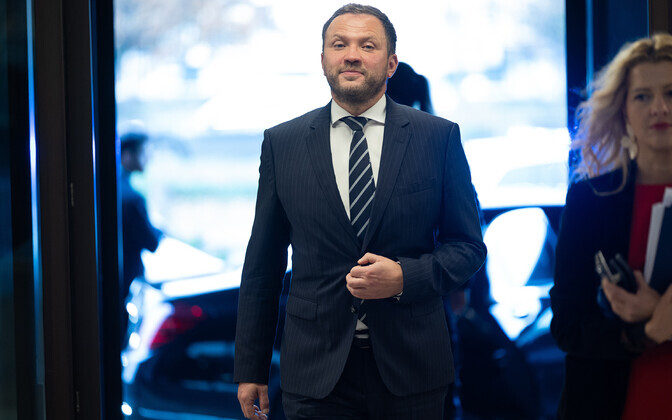
Minister of Foreign Affairs Margus Tsahkna (Eesti 200) said Estonia is ready to discuss how it can contribute to the U.S.’ mission in the Strait of Hormuz if an official request is made by Washington. It is not yet clear what Tallinn could offer.
Oil prices have surged after Iran effectively shut the world’s busiest oil shipping channel to tankers after the U.S. and Israel launched a war against the country just over two weeks ago.
Trump has urged the UK and other countries to send warships to the Gulf to help protect the shipping channel. Iran has threatened to attack any ships it considers linked to the US, while there is also a risk from sea mines.
However, allies such as the UK and Germany have ruled out assisting Washington.
On Tuesday, Tsahkna said that the situation in the Strait of Hormuz is very complicated and that he does not see any de-escalation.
“The President of the United States has said that he expects support from NATO allies, but providing it does not happen in the abstract. Estonia’s position is that if the United States raises this issue, for example, within NATO or bilaterally, we are certainly ready to discuss these questions,” he added.
The foreign minister said it is first necessary to determine what kind of assistance and support the United States is seeking and what the objective would be.
“If we are talking about military assistance, there must be very clear plans,” he stressed. “At present, we can say that the European side is not aware of the strategic objectives of the United States. To be honest, we were not aware even when this war began, so in that sense, there are many questions.”
Tsahkna said Estonia has been a reliable partner to the United States, highlighting missions in Iraq and Afghanistan. He said Estonia always supports its ally when needed.
What is the U.S. asking for?
Estonia has three mine countermeasure vessels, and active-duty personnel participate in foreign operations in both larger and smaller units. It is not yet clear what Estonia’s contribution would be.
“All of this actually depends on what the United States asks for, if it asks. As of now, no official request has been made at the NATO level. There are various allied countries that are ready to discuss the issue, but there are also those—for example Germany and the United Kingdom—that have said they do not forsee sending their troops there. All of this is still very preliminary,” Tsahkna said.
The foreign minister also acknowledged that Estonia does not have many capabilities to contribute.
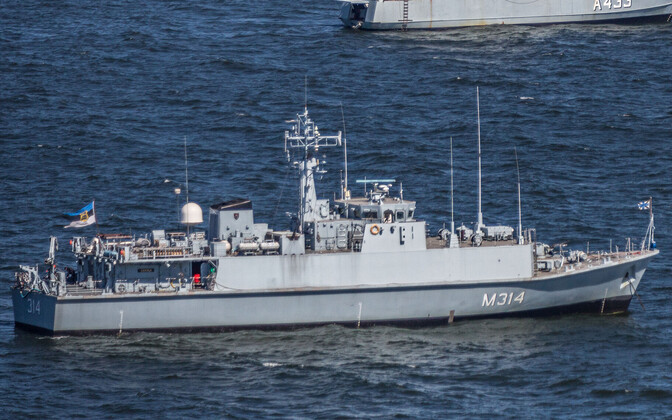 Minehunter Sakala Source: Estonian Defence Forces
“We must also take into account that the Strait of Hormuz is just over 30 kilometers wide in places. If we are talking theoretically about ships or maritime navigation, this would mean that the coastline would also have to be brought under control, since from there it is very easy to strike anything moving at sea,” Tsahkna said.
He reiterated the complexity of the situation and stressed that the threat from Russia to Europe has not disappeared.
“It is waging a full-scale war in Ukraine and is likewise threatening our region, so this is a more complex picture. I do not see this situation in the Middle East being resolved easily or quickly,” the minister added.
Another Coalition of the Willing?
If NATO or the European Union does not reach a consensus, then Estonia could also contribute as part of a separate coalition.
“If we look at various missions over recent decades, these have usually taken place in the form of coalitions, meaning that some kind of grouping of countries is formed. Launching a full NATO mission—its purpose is defense—is always much more complicated, as it requires the consent of all member states, which we may not even see at the moment,” Tsahkna said.
Asked whether Estonia is pressuring allies in intergovernmental negotiations to assist the United States, Tsahkna replied: “Estonia has stated its political positions: we support the United States and also Israel in terms of weakening the Iranian regime and dismantling its weapons programs. We support that side politically, but our role is not to conduct negotiations or to call on other member states to intervene militarily — each country decides for itself.”
“Estonia, as a NATO ally, is at the table and communication is active. Just last night I spoke with our ambassador Jüri Luik and received an overview of who has discussed what with whom. Estonia is active in this community,” he added.
—
Follow ERR News on Facebook and Twitter and never miss an update!