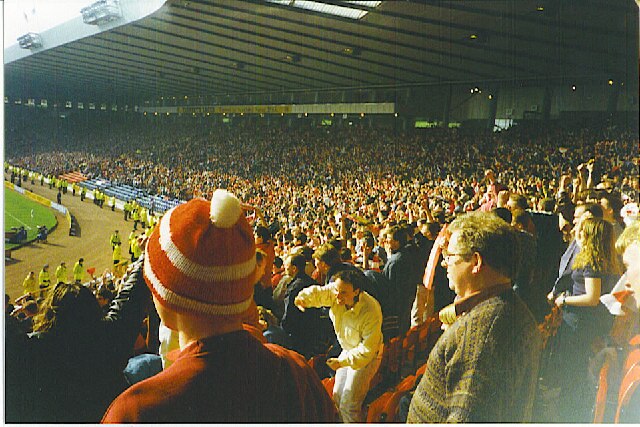
Blue and red flares, deafening renditions of ‘Four Lads Had A Dream’, the smell of Scotch Pies wafting through the air. Scottish football is truly an assault on the senses. This is the scene that would greet you if you were to walk down Edmiston Drive towards Ibrox on any given Sunday.
UEFA’s European Club Talent and Competition Landscape report has revealed that top flight Scottish football is the best attended per capita in Europe. The report shows that 18.49 out of every thousand people attend the Scottish Professional Football League (SPFL) every week.
Hamish Husband from the Association of Tartan Army Clubs said: “Let’s just say, often we live our patriotism through football.”
The next best attended league is Liga Portugal with 10.45 attendees per capita. In fact, Scotland’s figures are so impressive that there is a bigger gap between the SPFL in first with 18.49 and Liga Portugal in second with 10.45, than there is between Portugal and 18th place Poland.
Comparing Scotland to Europe’s top five leagues shows the gap between perception and reality. ‘The home of football’ England places 11th with 6.52 attendees per capita only mustering 35% of Scotland’s attendance. Current European champions Spain languish in 12th with 6.15, 2020 Euro’s champions Italy are 13th with 5.23, four time world champions Germany sit 15th with 4.15, and 2018 World Cup winner France are down in 17th with 3.65, less than 20% of Scotland’s attendance per capita.
Perhaps surprisingly, the top five best attended leagues per capita are Scotland’s SFPL (18.49), Portugal’s Liga (10.45), Norway’s Eliteserien (10.12), the Netherlands’ Eredivisie (9.97) and Denmark’s Superliga (9.90).
All of the top five nations on this list have populations under 20 million. In fact, the combined populations of the top five nations on this list is 46.07 million, over 15 million people less than England’s 61.80 million.
With England being hailed as the ‘home of football’, why has the ‘home of golf’ Scotland have almost triple the attendance per capita of their southern neighbours?
Scottish football historian and curator of the Scottish Football Museum Andy Kerr thinks the answer may lie within Scotland’s 20th century stadiums.
Pre-WW2 Scotland was home to three of Europe’s top five largest stadiums. The iconic Hampden Park was the largest in Europe at the time with a capacity of 149,415.
Kerr said: “I think it was very much a case of build it and they will come.
“These people didn’t have a lot of outlets for leisure. Along comes football in the 1860s and 70s.
“It’s cheap, it’s easy to understand and just about anyone can play it. And it elevated working class people to become champions of the community
“That then led to Queen’s Park building the first Hampden Park, which was the first purpose built football stadium in the world.
“From there, the game blossomed and went from strength to strength.”
Husband added: “I myself have been in a crowd at Hampden of 137,000 in 1970.”
As well as being home to the original cathedrals of football, both men point to another factor in Scotlish football’s impressive attendance, their style of play.
When modern football was in its infancy at English public schools in the 18th century the game looked more like rugby with feet, says Kerr. North of the border however, the Scotts were cooking up something slightly more eye-catching.
Kerr said: “It was Queen’s Park Football Club who in the 1860s and early 1870s refined the idea of the short passing game.”
Husband adds: “We’re brought up on it, it’s almost as if it’s part of our school curriculum.”
Husband argues, in England’s elite public schools football was shaped by individualism whereas in a more egalitarian, working class society in Scotland they favoured teamwork. It was this quick short passing game that truly made football the world’s religion, and Scots were the missionaries.
Husband said: “Uruguay, Brazil and Argentina owe their style of football to Scottish coaches going over.
“We took football to the world, Johnny Harley in Uruguay taught them how to play football at the turn of the century.
“Harley and others, Scottish and English folk, taught Uruguay how to play football.
“They (Uruguay) then won the World Cup in 1930.”
Kerr adds: “the way that association football is played now, even in all corners of the globe, is inherently Scottish.”
Just as important as their style of play is where it comes from. Kerr said: “at the museum, our temporary exhibition looks at the link between coal mining and football.
“You just have to look at three of the greatest Scottish managers, Shankly, Stein, Busby. All three of them were coal miners.”
“All three of them knew that football was an escape for them because if they weren’t good at football, the chances are, especially for someone like Bill Shankly from the tiny village of Glenbrook, which no longer exists.
“If you don’t escape that mine via football, you will not escape the mine because there are no other opportunities to do so”
This was the reality for many fans too. Being in the terraces sharing a beer with friends provided a much needed escape from menial jobs, miserable conditions and measly pay, says Kerr.
The fans are incredibly loyal to the clubs because of the escape their teams provide. Husband reminisces about a time his father drove some 750 miles from Utrecht to Gothenburg to watch his beloved Aberdeen play Real Madrid in 1983, simply because the game wasn’t on TV in Holland.
The great Scottish coaches, Stein, Shankly, Busby and Ferguson, were well aware of how much the teams meant to the fans but also how important the fans were to the teams.
Husband said: “Sir Alex ran a cruise ship across to Sweden, to Gothenburg from Aberdeen.
“When the boat arrived back, he got all the players and himself to shake the hands of every fan that came off. That’s the passion. That’s the passion.
“Stein, Shankly, Busby, and Fergie. They’re all local guys.”
Kerr believes this connection has survived to the modern day and explains high attendances and unity within Scottish football.
He said: “if anyone comes up with the lazy comparison of, oh, Farmers League, et cetera, suddenly fans of Rangers, Celtic, Dundee United, Inverness, Caledonian, Thistle, will all immediately turn on that person and defend their game to the hilt.”