
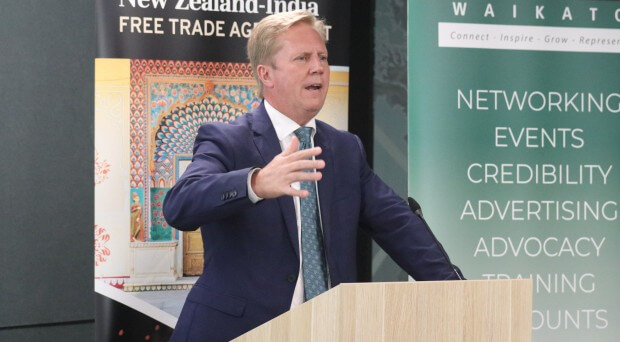
Minister of Trade & Investment Todd McClay
Stronger sheep prices, lower costs and new export markets are restoring confidence on farms as rural communities grapple with more extreme weather events, reports senior writer Mary Anne Gill.

Listening to details of the New Zealand-India Free Trade Deal from third left, Waikato chamber chief executive Don Good, his Excellency Dr Madan Mohan Sethi – Indian Consul General, Company X’s David Hallett, Waipā District Council chief executive Steph O’Sullivan and mayor Mike Pettit, Fieldays chief executive Richard Lindroos and Vangelis Vitalis, Ministry of Foreign Affairs and Trade chief negotiator. Photo: Mary Anne Gill
Flooding across parts of Waipā and Ōtorohanga has added fresh strain to King Country farmers already weathered by years of low prices, rising costs and uncertainty, but Agriculture Minister Todd McClay says rural resilience is once again showing through.
Speaking exclusively to Good Local Media, McClay said he “absolutely” felt for farmers dealing with yet another extreme weather event, describing farming as one of the most resilient – but also most isolated – professions in the country.
“Farming can be very lonely, even though rural communities are incredibly strong,” he said.
“When it’s wet, when you’re worried about your animals, and you’re dealing with damage day after day, you can feel very alone.”
For many in Waipā and the King Country, the floods have come on top of several already difficult years – marked by low commodity prices, rising compliance costs and uncertainty about land use.
But McClay rejected suggestions that it is “too late” for sheep and beef farmers, saying the picture on the ground is starting to improve.
“They are very resilient, and we need to recognise just how challenging it’s been,” he said.
“But if you look at the prices many sheep farmers are getting at the works right now, they’re better than they’ve been for a long time. Farmers are making money again.”
He said that was translating into renewed confidence.
“They’re getting debt down, they’re investing back into their farms, and for the first time in a long time they’re thinking about increasing production.”

Todd McClay the minister of Trade & Investment, with at left Vangelis Vitalis, Ministry of Foreign Affairs and Trade chief negotiator and his Excellency Dr Madan Mohan Sethi, Indian Consul General to New Zealand. Photo: Mary Anne Gill
McClay said the government’s focus on resilience goes beyond farm balance sheets to the wellbeing of farming families and rural communities themselves.
In last year’s Budget, the government set aside $4 million specifically to support community-led resilience initiatives – programmes designed by farmers, for farmers.
“This isn’t about business resilience – a lot of that already happens,” he said. “It’s about the resilience of individuals, families and communities.”
Examples include initiatives that encourage farmers to get off farm, connect with others and talk openly – from “surfing for farmers” to informal gatherings like “blokes on gateposts”.
“If you live in town, you can pop out and see your mates or go for a meal. That’s not always easy in rural New Zealand,” McClay said.
“When rural communities are strong, the people in them do well and when rural New Zealand does well, all of New Zealand does well.”
McClay said part of restoring resilience has been rebuilding trust with farmers by reducing unnecessary regulatory costs.
He pointed to reforms removing what he described as rules that “added cost but didn’t deliver environmental outcomes”, and changes to stop largescale full farm conversions to forestry – an issue that has reshaped landscapes across the King Country.
“That law was backdated, and it’s working. Forward orders for pine seedlings have virtually disappeared. What we’re seeing now is legacy planting from years ago, not new conversions.”

Waikato regional councillor Keith Holmes, a former Federated Farmers president, listens as Agriculture minister Todd McClay outlines the New Zealand-India Free Trade agreement.
While recovery from flooding is immediate and physical, McClay said long term resilience depends on confidence that there will be markets for what farmers produce.
That is where improved sheep prices and access to new export markets become critical.
“Our job as a government is to reduce costs and open up markets,” he said.
“If a farmer wants to put more ewes on the farm, there needs to be certainty there will be a market for that lamb.”
As part of a recent briefing to Waikato business and farming leaders, McClay said the proposed India-New Zealand Free Trade Agreement could deliver that certainty for rural communities such as Waipā and the King Country.
India is becoming part of that equation, he said.
India already imports New Zealand lamb and wool, using the country’s high quality fibre to blend with its own. With trade barriers coming down, McClay said demand from India’s rapidly growing middle class could help underpin prices.
“There are around 500 million people in India who eat meat and who we would class as middle class,” he said.
“Lower tariffs mean they can buy New Zealand products at better prices – and that means better returns at the farmgate.”
McClay acknowledged the floods have been “exceptional” and said government agencies are continuing to work through issues around waterways, forestry slash and catchment based rules to reduce future risk.
But he remained optimistic about the sector’s future.
“Farmers are resilient – they always have been,” he said.
“What we need are smart, fit for purpose rules that support them, and markets that reward the quality of what they produce. If we get that right, rural New Zealand will continue to lead this country forward.”
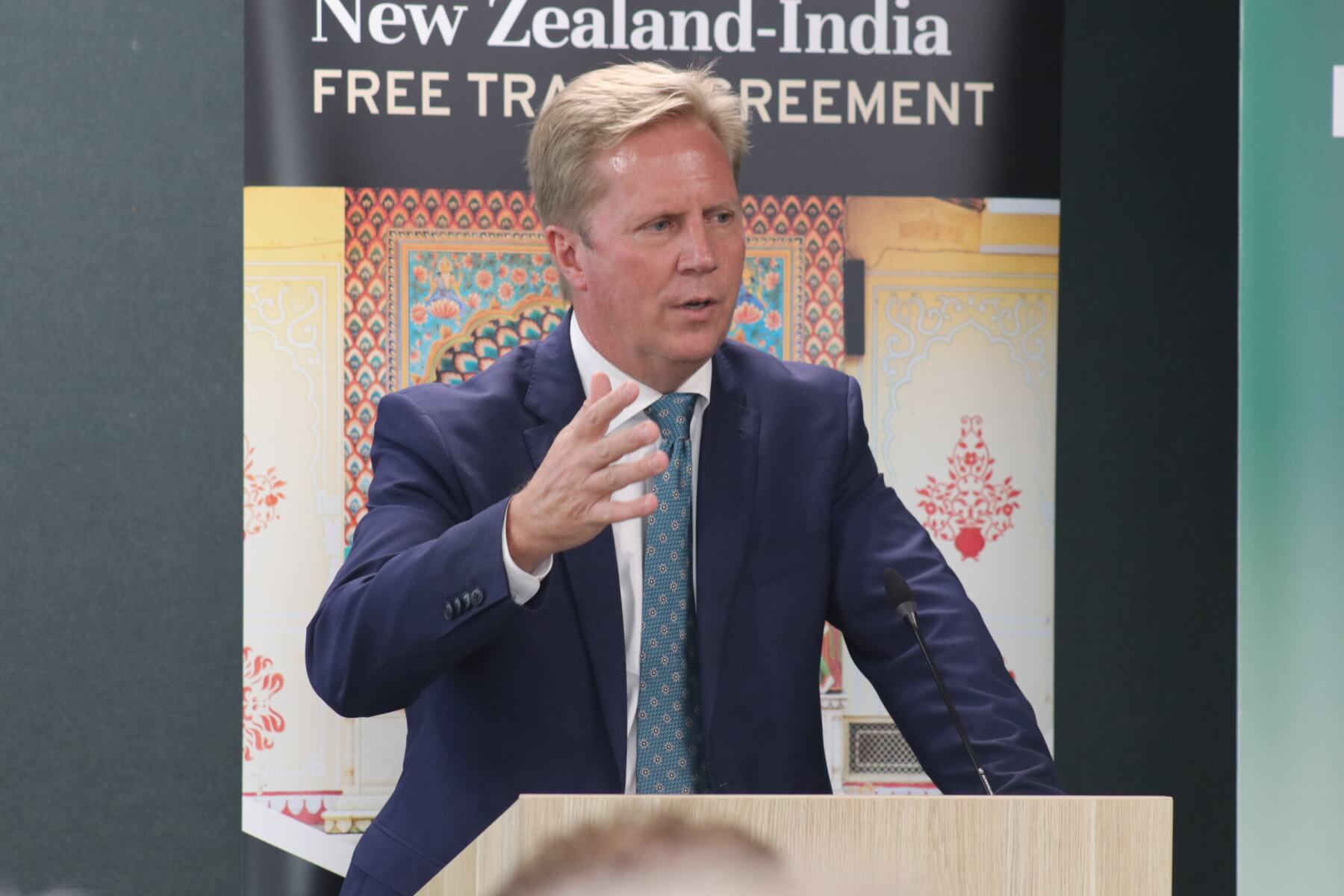
Trade, forestry and agriculture minister Todd McClay talks about the benefits farmers will get from the New Zealand-India Free Trade Agreement. Photo: Mary Anne Gill