
Zadar
The growing potential for Croatian diaspora members to return and settle in their homeland was the focus of a recent roundtable discussion held in Zadar.
Organised by the Institute for Migration Research and the City of Zadar, the event brought together policymakers, academics and diaspora representatives to explore ways of encouraging Croatian emigrants and their descendants to return, while highlighting the social, economic and development opportunities they bring.
The discussion focused on institutional policies, education and local initiatives that could strengthen Croatia’s ability to attract returnees.
Young returnees choosing Zadar
According to data from the Institute for Migration Research, Zadar has seen a steady number of returnees in recent years.
In 2020 and 2021, 44 people returned each year, while 77 returnees were recorded in 2022. By October 2023, another 35 had moved back to the city.
Most returnees come from Bosnia and Herzegovina, Australia and Germany, with an average age of around 32 years, suggesting the trend is driven largely by young professionals and families.
Zadar Mayor Šime Erlić noted that roughly 100 people return to the city each year, highlighting a particularly interesting trend among younger generations of the Croatian diaspora.
“Second, third and later generations of emigrants from South America often first come to Zadar through scholarships to study the Croatian language at the University of Zadar. Experience shows that about a third of them stay permanently,” Erlić said.
He added that the city has also seen increasing relocations from Australia in recent years.
Many returnees cite quality of life, safety for families and good conditions for raising and educating children as key reasons for moving back to Croatia.
The roundtable’s opening panel focused on the institutional and public policy framework for encouraging return migration.
Speakers included Vanda Babić Galić, special adviser to the Minister of Foreign and European Affairs; Marina Perić Kaselj, director of the Institute for Migration Research; Ivana Lončar, vice-rector of the University of Zadar; and Mayor Erlić. The discussion was moderated by Petar Bilobrk from the Institute.
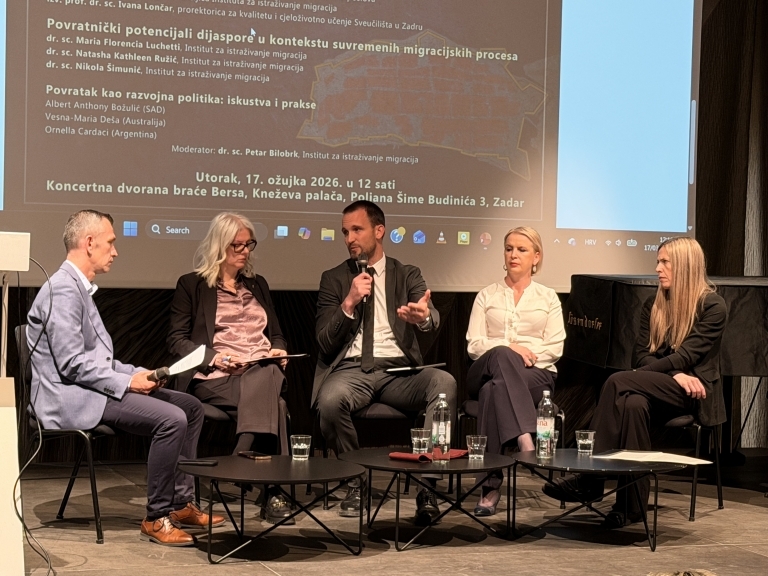
Roundtable held in Zadar (Photo: Grad Zadar)
Babić Galić highlighted the role of Croatian diplomatic and consular missions abroad in supporting diaspora engagement and return.
“Our embassies and consulates work systematically to encourage Croats and their descendants to return to Croatia,” she said, adding that Zadar could host a central national roundtable on the topic in the future, as many returnees choose Zadar, Zadar County and Split-Dalmatia County as their destination.
Education and language learning were identified as essential elements in successful integration. Ivana Lončar explained that many returnees are second-generation emigrants who have lost the Croatian language, making language programmes crucial.
“The University of Zadar offers them the opportunity for high-quality integration. Without language integration, there is no integration,” Lončar said.
Many participants in these programmes are descendants of Croatian emigrants from South America.
Marina Perić Kaselj emphasised that Croatia is increasingly becoming a country of immigration, making it essential to recognise the value of returnees.
“Our research shows enormous potential for return, especially in Zadar and Zadar County. Many of those returning are young and highly educated,” she said, stressing the importance of cooperation between cities, universities and state institutions.
Additional panels examined diaspora return potential in the context of modern migration trends, while several returnees shared their personal experiences of moving back to Croatia from the United States, Australia and Argentina.
Positive migration trends in Zadar
Zadar has recorded a positive migration balance since 2018, reflecting the city’s growing appeal.
According to national statistics, the city’s population grew by 4.2% between 2021 and 2024, the highest level in the past decade.
Zadar
The demographic trend is also reflected in rising birth numbers, with 682 children born in Zadar in 2024, compared with 623 in 2023.
At a national level, it is estimated that around 10,000 people return to Croatia each year, with approximately 30,000 returning over the past three years alone.
Many of them are young families with two or more children, often of pre-school or early school age.
The Croatian Government has introduced several measures to support returnees, including financial incentives for business development, housing support and tax relief, aimed at making the transition back to Croatia easier.