
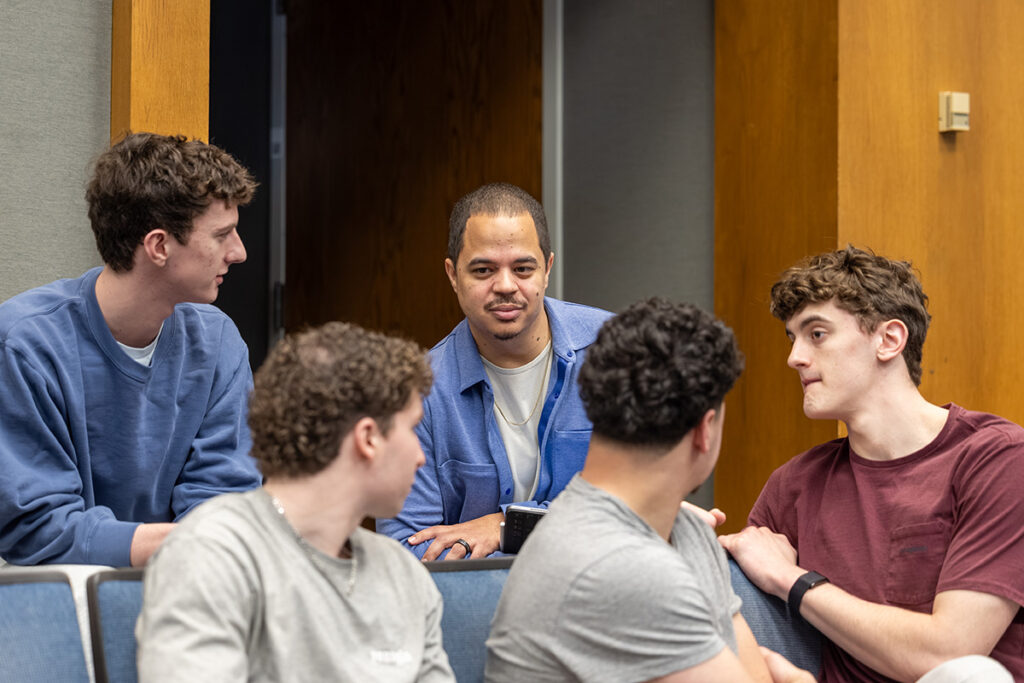
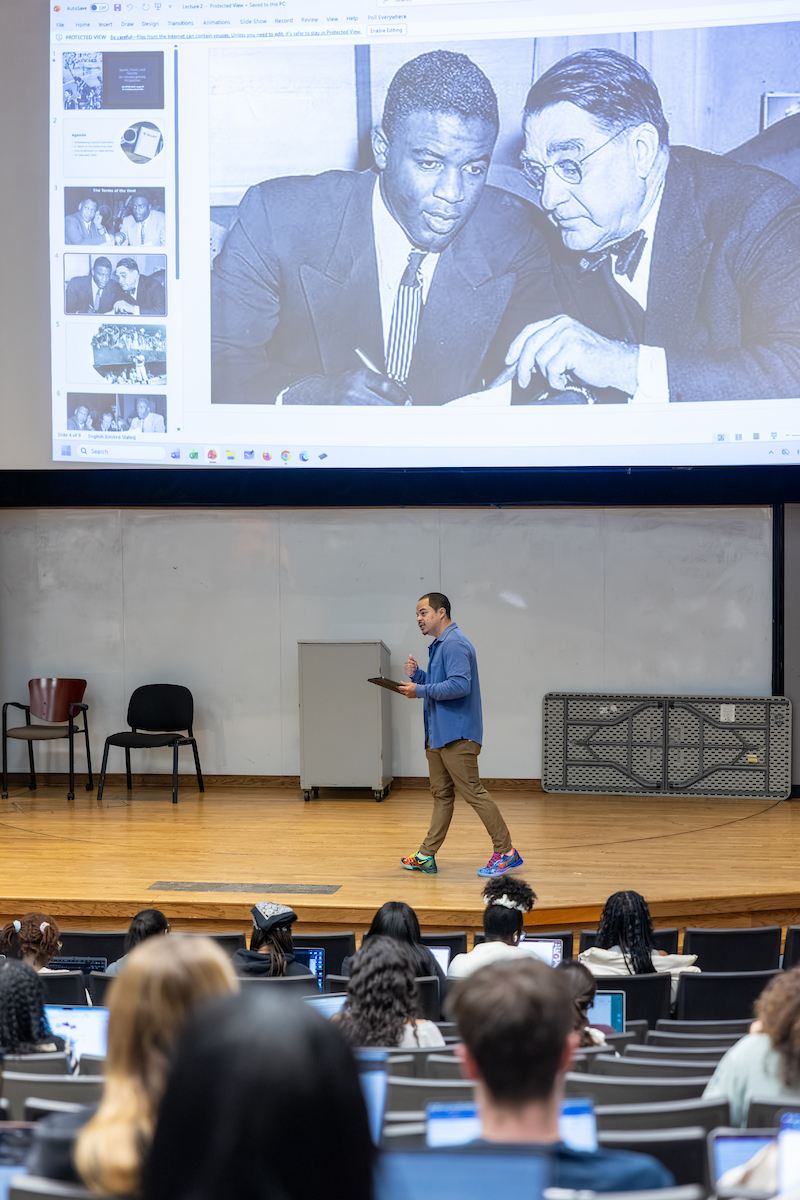
Just before the 2026 Winter Olympics began in Italy, Emory College students packed into a White Hall lecture room to study and discuss how bigotry and nationalism collided during the 1936 Games in Berlin.
They already knew Jesse Owens had become a symbol of American greatness with his dominance in track and field events, challenging then-German Chancellor Adolf Hitler’s vision of Aryan superiority. What they learned was the way Black athletes had historically used the world’s most prominent sporting stages to assert equality through the sheer force of their performance.
Welcome to “Sports, Power and Society,” an interdisciplinary course that analyzes how sports intersect with economics, fashion, global power, politics, race and urban planning.
Co-developed by Emory College professors Karida Brown and Carl Suddler, the course builds on distinguished sociologist and civil rights icon Harry Edwards’ “Last Lectures” series.
Students meet twice each week. The first time, they watch one of Edwards’ 12 recorded lectures, which cover the historical forces that have shaped the world of sports from the Civil War to modern day. The second time, participants discuss the lectures, additional readings and the “Footwork” programming on campus in anticipation of Atlanta hosting World Cup matches this summer.
Emory is one of just a handful of universities with access to Edwards’ lectures, and students are making the most of the immersive coursework and discussions. Cross-listed in African American studies, history and sociology, the class offered 100 seats. Only three went unfilled.
“Even with such a large class, we have the eagerness to be as hands-on as possible,” says Suddler, who is a historian. “You don’t have to be a fan to realize how much sport is a microcosm of our broader society.”
First-year student Aduwa Ajie — who wouldn’t describe herself as a sports fan — decided to take the class after taking Suddler’s fall semester class on urban history, where he discussed the displacement of historically Black neighborhoods for the construction of Atlanta’s Mercedes-Benz Stadium.
As an Atlanta native, Ajie thought learning more about that development would be her favorite part of “Sports, Power and Society.” Instead, it’s been learning about “jockey syndrome,” the reflex by white-dominated sports establishments to sabotage Black athletes. It draws its name from the systemic exclusion that ended a history of Black jockeys as the most prominent riders in Thoroughbred racing.
“It’s a world I never even imagined before this class, but now I can’t unsee it,” says Ajie, who plans to pursue a business major and an investment career. “I want to internalize what I am learning so I can be a different kind of business leader.”
Senior Ben Pearce, a double major in sociology and business, is fully immersed in the world of sports. A standout guard on the Emory men’s basketball team, he served as the university’s sole representative to the 2024 NIL Summit, the professional development conference to help student athletes navigate the Name, Image, Likeness (NIL) policy, which allows them to be compensated for their personal brand.
Pearce has led the Emory Sports Business Association since his sophomore year and hopes to secure an agency or league job in the NBA after he graduates, eventually parlaying his background and experience into work as a sports agent.
First, though, he plans to play professionally overseas, where he is eager to see how sports reflect and influence power dynamics in different parts of the world.
“When you recognize that sports have mirrored and shaped societal trends for over a century, it reframes them as more than entertainment,” Pearce says. “Global events like the World Cup influence culture, politics and local identity, even here in Atlanta, which we will see this summer. That perspective pushes us to think about sports as a real site of power, not just play or competition.”
Brown, a sociologist whose resume includes a stint working in the front office of the L.A. Lakers, is especially eager to lift the veil on sports careers, which span beyond athletes and coaches to include roles in team operations, sports marketing, trainers, data analytics, event coordinators and more.
She is bringing in artists, marketers and 11-time Emmy Award-winning documentarian Jonathan Hock, who produced Edwards’ lectures, to share potential avenues to the myriad careers available in the industry.
Between those visits, trips to Footwork and other events outside the classroom, Brown hopes to emphasize her scholarly research showing how sports can transcend race, age, nationality and more to bring people together.
“When you’re in the stadium, you are just a fan,” Brown says, adding that Atlanta adds to the conversation as one of only two American cities, along with Los Angeles, to have hosted both the Olympics and the World Cup.
“We want to prepare our students to think about Atlanta as a living classroom,” she adds. “L.A. hosted the Olympics in 1984 and will do so again in 2028, and Atlanta hosted the 1996 Olympics and will host the 2026 World Cup. That kind of global stage gives students a powerful opportunity to understand how sports shape our lives every day.”