
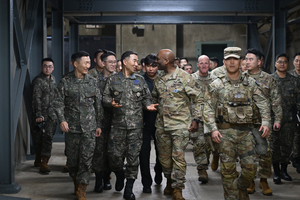
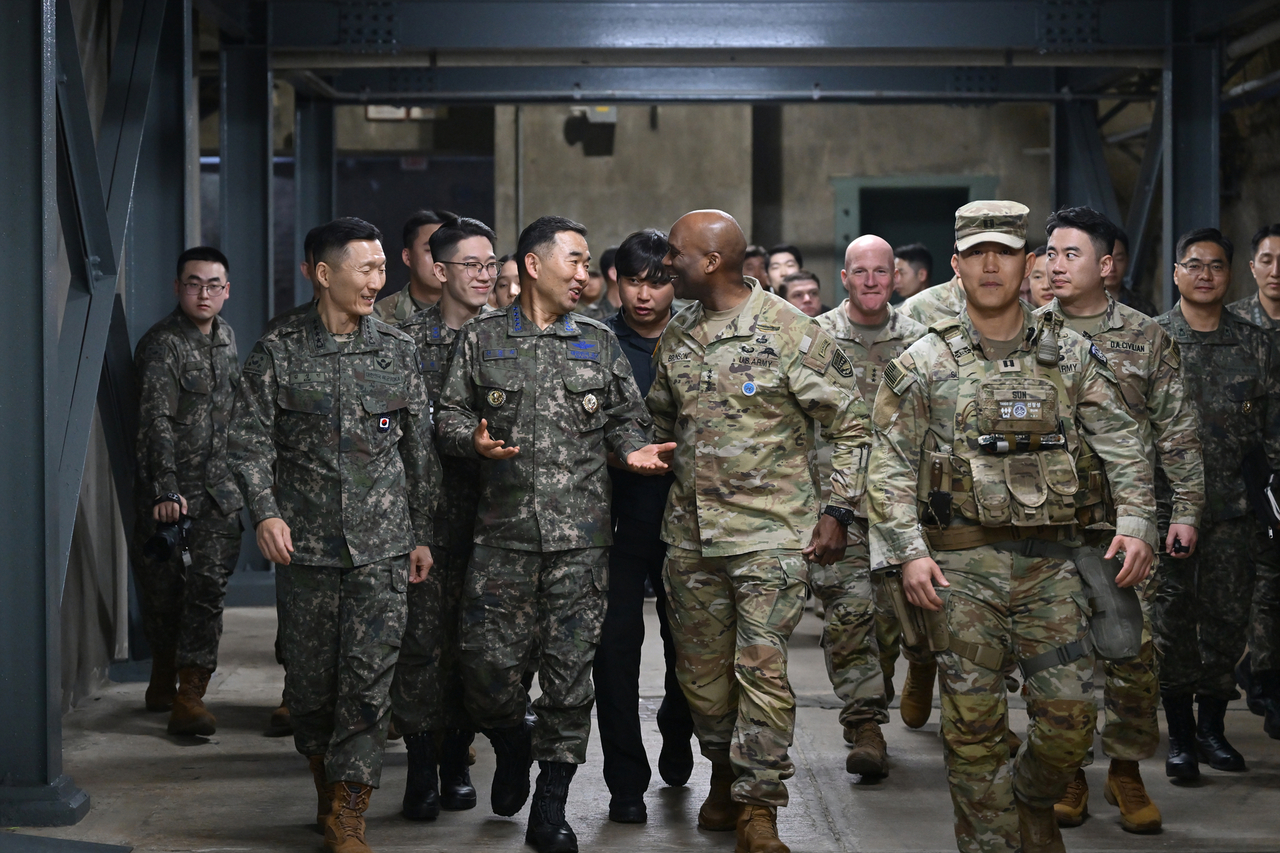
 Joint Chiefs of Staff Chairman Gen. Jin Yong-sung (center left) and Gen. Xavier Brunson (center right), commander of the South Korea-US Combined Forces Command, move to the operations room during a visit to a Combined Forces Command wartime command post on March 11. (Joint Chiefs of Staff)
 South Korea and the United States concluded their annual Freedom Shield exercise on Thursday, with officials saying the drills marked a meaningful step toward wartime operational control transfer, a goal Seoul aims to achieve during President Lee Jae Myung’s term through 2030.
The assessment comes amid concerns that reduced field training — part of Seoul’s efforts to improve ties with North Korea — could weaken readiness, as Pyongyang has long denounced the drills as a rehearsal for an invasion.
The 11-day exercise involved some 18,000 troops, a scale similar to last year. The allies are currently in the Full Operational Capability phase, the second of three stages in the wartime operational control transition process, with plans to complete verification within the year.
Wartime operational control has remained under US authority since the 1950-53 Korean War. The three-phase process includes Initial Operational Capability, achieved in 2019, FOC, and Full Mission Capability.
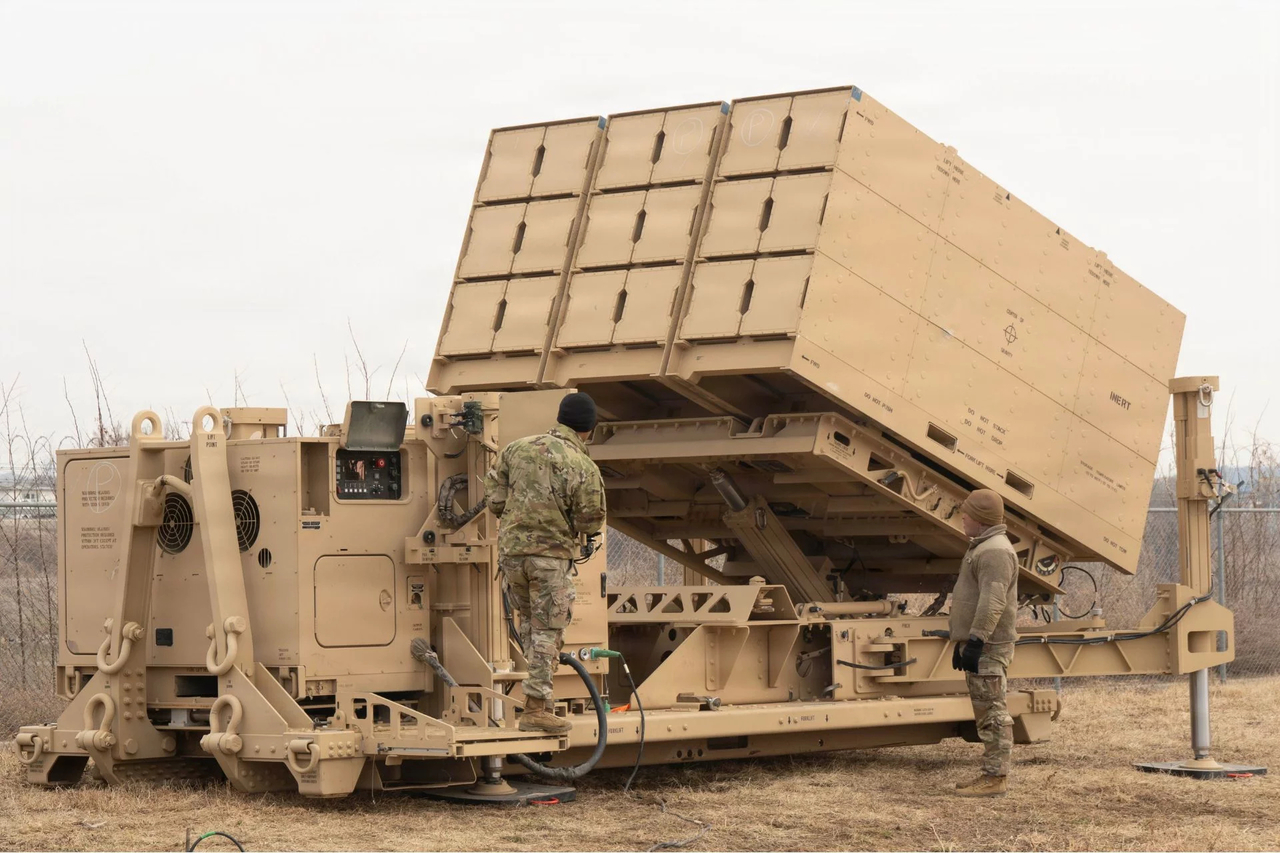 Soldiers from the 35th Air Defense Artillery Brigade prepare for an Indirect Fire Protection Capability mobilization exercise at Camp Humphreys in Pyeongtaek, Gyeonggi Province on March 8. (US Department of Defense)
 A notable feature of this year’s drills was the first public display of the US Army’s Indirect Fire Protection Capability, a next-generation air defense system designed to intercept cruise missiles, drones and other low-altitude threats.
Often referred to as the US version of the “Iron Dome,” the system is believed to have been deployed to US Forces Korea in September, marking its first overseas deployment. Its integration into the combined exercise underscored efforts to enhance operational capabilities across all domains, including land, sea, air, space and cyberspace, officials said.
“Freedom Shield demonstrates the strength of our alliance and our ability to train, build readiness and operate seamlessly as one force,” said Gen. Xavier Brunson, commander of USFK and the Combined Forces Command.
“No other alliance trains as we do from competition, to crisis, to conflict — all with an eye to peace and stability on the Korean Peninsula and in Northeast Asia,” he added.
Joint Chiefs of Staff Chairman Gen. Jin Yong-sung also underscored the significance of the exercise in the context of OPCON transition.
“As we prepare for the OPCON transfer, this year’s FS reaffirmed the common value of peace and stability on the Korean Peninsula shared between the Republic of Korea and the United States, and elevated our combined defense posture and operational capabilities to the next level,” Jin said, referring to South Korea by its official name.
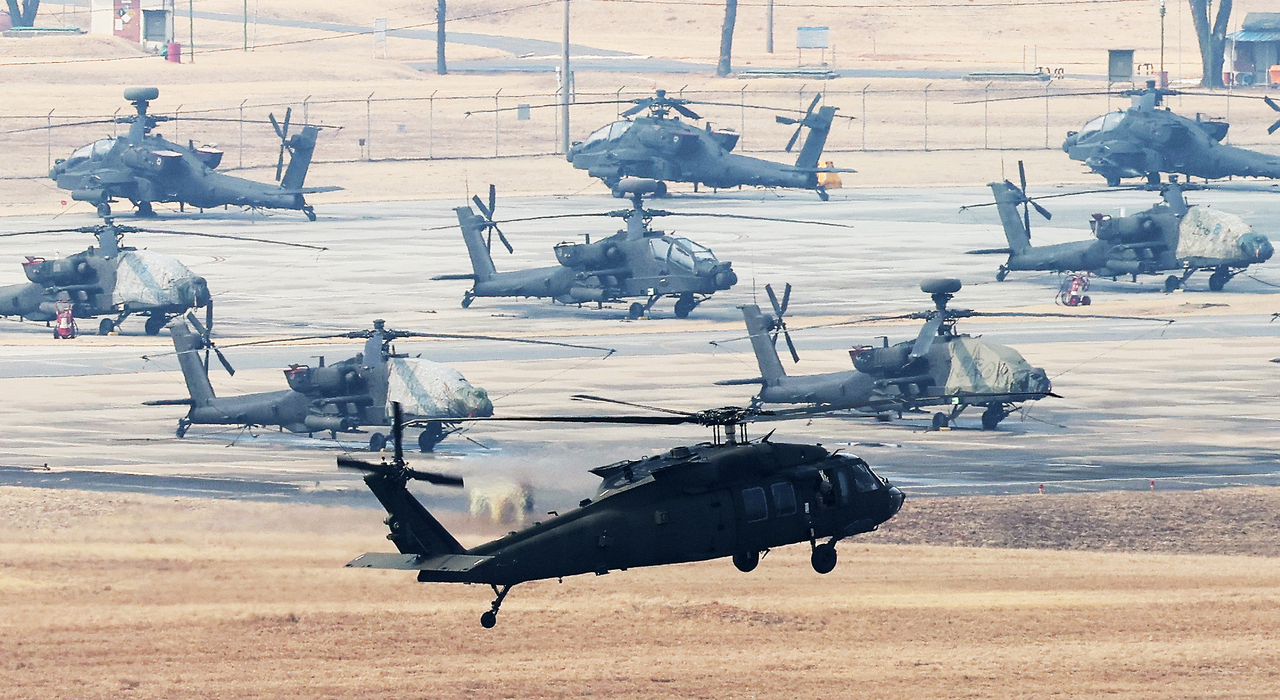 A UH-60 Black Hawk helicopter flies over Camp Humphreys in Pyeongtaek, Gyeonggi Province, on March 9, the start of the South Korea-US Freedom Shield exercise. (Yonhap)
 According to Naval Capt. Jang Do-young, spokesperson for the Joint Chiefs of Staff, 17 out of 22 planned field training exercises had been completed as of Thursday, with the remainder set to conclude by next week.
The number of field training exercises conducted alongside this year’s Freedom Shield dropped to 22, less than half of the 51 carried out during last year’s spring drills.
The Lee administration has sought to disperse such drills throughout the year, a move seen as part of broader efforts to ease tensions and create conditions for possible dialogue with North Korea. Despite the scaled-back drills, Pyongyang reacted sharply, denouncing the exercise as a “war rehearsal” and carrying out a series of weapons tests.
On March 10, a day after the start of the exercise, Kim Yo-jong, the powerful sister of North Korean leader Kim Jong-un, issued a statement criticizing the drills and warning of strong countermeasures.
On March 14, North Korea launched cruise missiles from a naval destroyer and fired more than 10 rounds of 600-millimeter multiple rocket launchers into the East Sea in what it described as a firepower strike drill. The system, widely believed to be capable of carrying tactical nuclear warheads, has what the North claims is a range of up to 420 kilometers.
This year’s drills also come as US President Donald Trump is expected to visit China later this month, a trip that could open the door to renewed talks with North Korean leader Kim Jong-un.
flylikekite@heraldcorp.com