
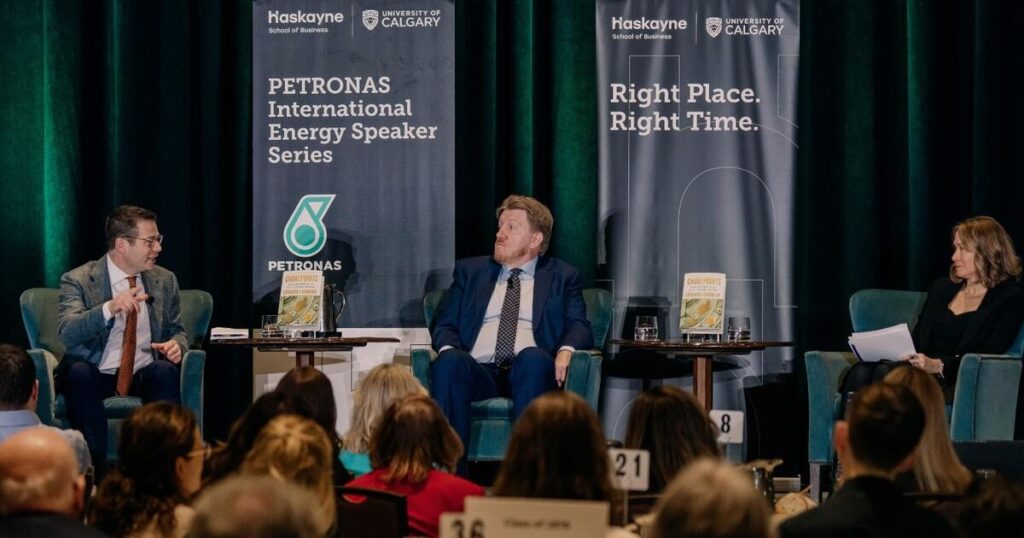
Experts explored how Canada can position itself amid rising economic competition and shifting global alliances at the eighth annual PETRONAS International Energy Speaker Series, hosted by the University of Calgary’s Haskayne School of Business.
The sold-out event on Feb. 11 drew more than 500 business leaders, policymakers, faculty and students to the Hyatt Regency Calgary.
The speaker series focused on how sanctions, tariffs and supply-chain pressures are redefining energy markets — and what that means for Canada as it seeks new international partnerships and responds to U.S. trade measures.
Understanding Canada’s position
Shannon Young, LLB’98, general counsel and vice-president of external affairs at PETRONAS Canada, says the conversation explored how Canada fits within a changing economic and political order, where energy is increasingly tied to geopolitics and national security.
This year’s theme examines how sanctions and economic statecraft are reshaping global energy trade and investment, and what that means for Canada as it looks to position itself as a reliable supplier amid growing geopolitical competition.
“This year’s theme couldn’t be more relevant,” says Young.
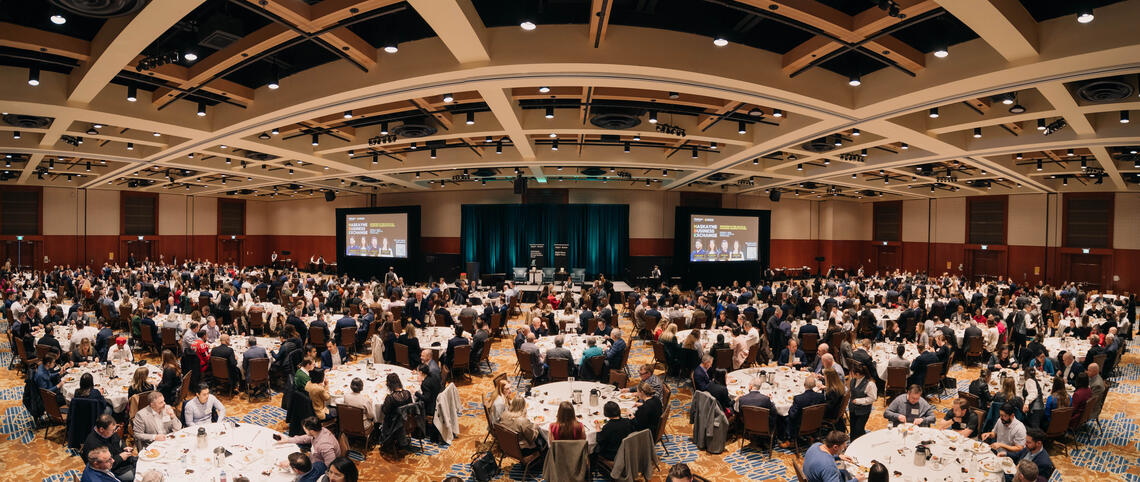
Panoramic perspective of attendees enjoying lunch.
Kelly Hofer
Insights on economic “warfare” and competition
The event featured Edward Fishman, author of Chokepoints: American Power in the Age of Economic Warfare and an adjunct professor at Columbia University. Fishman’s work has appeared in major publications including the New York Times, Wall Street Journal and Washington Post.
As a former U.S. State Department official, Fishman offered insight into how sanctions, geopolitical tensions and shifting alliances are influencing energy markets and global stability.
“We are living in an age of economic warfare in which sanctions, tariffs and export controls have become the primary way great powers compete with each other,” said Fishman.
He said the rapid spread of sanctions, tariffs and export controls reflects a “haphazard attempt” by countries around the world to retrofit the global economy to today’s geopolitical realities.
Diversifying Canada’s economy
Fishman was joined by Robert (RJ) Johnston, director of energy and natural resources policy with UCalgary’s School of Public Policy.
As Canada looks to build new global partnerships and reduce reliance on its American neighbours, Johnston said progress is underway, but moving slowly.
Other countries, he said, have already succeeded in exporting their products to new markets, including Brazil. Johnston said Brazil has spent the past 25 years developing ways to move agricultural goods and metals from the country’s interior to coastal ports capable of handling the world’s largest vessels bound for China.
“We can build more market access to Asia-Pacific. We’ve done it with TMX. We’ve done it with LNG Canada. It’s just taking too long,” he said.
The Trans Mountain Expansion Project (TMX) involved the construction (or twinning) of a second pipeline along the Trans Mountain pipeline. TMX runs from Edmonton, Alta., to the Westridge Marine Terminal in Burnaby, B.C.
LNG Canada is a joint-venture company comprised of Shell, PETRONAS, PetroChina, Mitsubishi Corporation and KOGAS.
When it comes to building diversifying strategies, Johnston said it comes down to Canada’s patience and determination: “We have such a large relationship with the U.S. that it is going to be much harder for us to diversify than Brazil.”
The conversation was moderated by Jackie Forrest, BSc (Eng)’96, executive director of the ARC Energy Research Institute.
A recording of the event is available to watch online.