
NATO jets have been scrambled to fend off a Russian warplane that entered Estonian airspace.
The violation occurred near Vaindloo Island in the Gulf of Finland, off Estonia’s northern coast, where a Russian SU-30 fighter aircraft entered Estonian airspace and remained for around one minute, Estonian Foreign Minister Margus Tsahkna said on Thursday.
‘There was no threat to Estonia’s security,’ he added.
NATO’s Baltic Air Policing mission responded swiftly, deploying Italian Air Force units, according to Tsahkna.
It was the first time this year that a Russian aircraft has violated Estonian airspace, Tsahkna said.
Estonia summoned the acting head of the Russian diplomatic mission in Tallinn in protest at Wednesday’s incident, the foreign ministry said.
The Russian embassy in Estonia did not immediately respond to a request for comment when contacted by Reuters via phone and email.
Several politicians have responded to Russia’s violation.
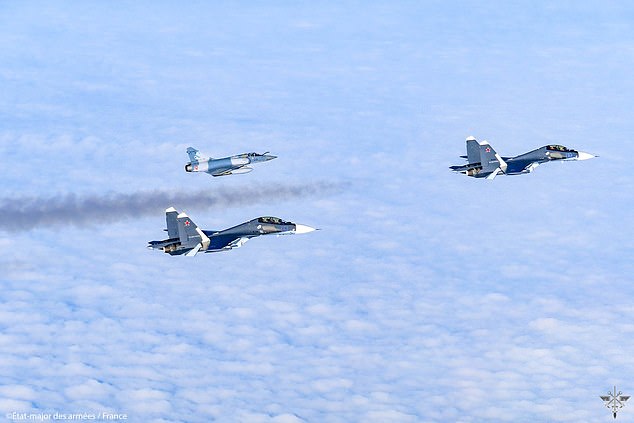
SU-30 fighter jets are intercepted over the Baltic Sea (file picture)
Estonian Prime Minister Kristen Michal wrote on X: ‘Russia’s pattern does not change.
‘Nato works. Our skies are monitored, protected and defended at all times.’
Riho Terras, the former chief of Estonian Defence Forces, wrote: ‘Allies reacted, and there was no threat to Estonia’s security.
‘Every such violation, now and in the future, must be met with a firm and consistent response.’
In September last year, Estonia said three Russian military jets violated the Baltic country’s airspace in an ‘unprecedentedly brazen’ incursion, while Russia‘s Defence Ministry rejected the claim as false.
Tallin said at the time that three MiG-31 fighter jets entered Estonian airspace without permission and stayed there for a total of 12 minutes.
Alliance duty warplanes – Italian F-35s – were scrambled to repel the Russian war planes.
‘Russia has violated Estonian airspace four times already this year, which is unacceptable in itself, but today’s violation, during which three fighter jets entered our airspace, is unprecedentedly brazen,’ said Foreign Minister Margus Tsahkna after the incident last September.
‘Russia’s ever-increasing testing of borders and aggressiveness must be responded to by rapidly strengthening political and economic pressure.’
Czech president Petr Pavel warned at the time that NATO must be ready to respond firmly to Russian airspace violations, even if that means shooting down their planes.
Pavel said the organisation should act decisively to stop any breach of allied skies and make clear there are consequences for crossing the line.
He said: ‘Russia will realise very quickly that they have made a mistake and crossed the acceptable boundaries. Unfortunately, this is teetering on the edge of conflict, but giving in to evil is simply not an option.’
The September violation into Estonian airspace came after Moscow’s unprecedented intrusion into both Polish and Romanian airspace in the space of just a few days, triggering condemnation from NATO.

Two Russian Air Force MiG-31 fighter jets fly above Moscow (file picture)
Between 19 and 23 drones entered Polish airspace on September 9 in an unprecedented intrusion of the country’s territory, with NATO scrambling a multinational force of jets to shoot several down.
Meanwhile in February of this year, five Russian war planes were spotted heading towards Alaska.
The North American Aerospace Defense Command (NORAD) said on February 20 it detected and tracked multiple Russian military aircrafts operating in the Alaskan Air Defense Identification Zone (ADIZ) off Alaska.
NORAD said it responded by launching two F-16s, two F-35s, one E-3, and four KC-135s to intercept, positively identify, and escort the aircraft.
The Russian military aircraft remained in international airspace and did not enter American or Canadian sovereign airspace, NORAD said, adding that the aircraft were escorted until they departed the Alaskan ADIZ.
NORAD said Russian aircrafts are regularly seen in the ADIZ, and the activity is ‘not seen as a threat’.