

Starlink is far more than a commercial connectivity service. It is strategic infrastructure that increasingly shapes how wars are fought, how states manage internal unrest, and how criminal networks operate in ungoverned spaces. What makes Starlink so politically consequential is not just its globe-spanning reach but also the governance model behind it.
A private company is now a gatekeeper in orbit, helping decide who connects as well as where, under what conditions, and with what technical constraints. In a growing number of conflicts, these decisions carry military and political effects that states struggle to replicate or control. If many strategic supply chains now depend on private firms, Starlink is an unusually concentrated case of private discretion over public security functions.
Starlink’s geopolitical weight is a function of scale. As of mid-December 2025, there were 9,357 Starlink satellites in orbit. In January, the U.S. Federal Communications Commission authorized SpaceX to deploy an additional 7,500 second-generation satellites, which would take its total to nearly 17,000. SpaceX has long signaled ambitions of running up to 42,000 satellites.
Starlink’s reach is also widening. The service is now active in 160 markets, multiplying the number of militaries, telecoms regulators, and law enforcement agencies that must contend with its decisions. The company’s dominance becomes clearer when set against the competition: Eutelsat OneWeb, its nearest rival in low-Earth orbit, operates around 650 satellites, while Amazon’s Kuiper constellation remains far smaller, surpassing just 200 satellites in February. Starlink is a quasi-monopoly with no near-term peer.
Starlink says it now has more than 10 million active customers worldwide, and SpaceX is aiming to more than double that figure by the end of 2026. Its growth has been reinforced by partnerships with mobile operators, including T-Mobile in the United States, while Deutsche Telekom plans to launch Starlink-powered satellite-to-mobile coverage in Europe starting in 2028.
Starlink’s commercial edge lies in connecting rural, remote, and disaster-hit areas beyond the reach of terrestrial towers or fiber. But that same control over a critical communications layer also gives the company outsized geopolitical influence—especially in conflicts; emergencies; and other settings where connectivity can shape military, political, and humanitarian outcomes.
Ukraine offers the clearest illustration to date of how Starlink can affect battlefield communications and cause strategic dependence. After Russia’s full-scale invasion in 2022 disabled terrestrial networks, Starlink terminals became operational infrastructure in a war defined by drones, distributed command, and rapid targeting cycles. By early 2025, Ukraine had secured at least 47,000 Starlink terminals, with the vast majority supplied through partner governments and other donors, including Poland, Germany, the United States, and SpaceX itself. Without resilient mobile bandwidth, Ukrainian forces could not transmit drone feeds, coordinate logistics, or sustain the decentralized fire-support networks that have characterized the conflict. The terminals were not a convenience, but a condition of effective resistance.
That dependency immediately created an attack surface. Russian forces reportedly obtained Starlink access through third-party channels, and use of the network in Russian-held territory became a recurring concern in 2024. The problem was serious enough that SpaceX and the Ukrainian Defense Ministry imposed authentication controls to curtail unauthorized connections. Ukrainian officials said Russian use on the front line had been disrupted, and military advisors described the effect as a significant setback for Russian operations.
The sequence is instructive: Decisions made inside a company by engineers applying commercial access policies altered the tactical balance in an active war. No treaty authorized it. No parliament voted on it. The governing logic was a firm’s terms of service.
The strategic and geopolitical dimensions are starker still. In early 2025, U.S. negotiators allegedly threatened to limit Ukraine’s access to Starlink if it did not accept a critical minerals deal. SpaceX owner Elon Musk denied a linkage, but the credibility of the threat and the anxiety that it generated in Kyiv mattered more than its precise contours.
A previous episode had already set the precedent: In 2022, Musk reportedly declined to enable Starlink coverage near Russian-occupied Crimea to support a Ukrainian naval drone operation, citing his personal opinion on the risk of escalation. When a private supplier can decide which operations a front-line state is permitted to conduct based on personal intuition, the relationship has ceased to be commercial. It is a delegation of sovereignty, a strategic function exercised by an unaccountable executive.

An apartment building of at least six stories high with several old satellite dishes set up on narrow balconies in front of exterior windows.
Satellite dishes dot the windows of a residential complex in downtown Tehran on Jan. 20. Morteza Nikoubazl/NurPhoto via Getty Images
Iran provides another example of Starlink’s geopolitical effects. After the eruption of mass protests in January, the regime imposed one of the longest and most severe internet shutdowns ever recorded, reducing national connectivity to roughly 4 percent of normal. Tens of thousands of Starlink terminals—smuggled into the country and traded on the black market in recent years—appear to have become an important channel through which images of the crackdown reached the outside world. Subscription fees were reportedly waived for users in Iran, and the Trump administration covertly moved roughly 6,000 additional Starlink kits into the country, treating the terminals not simply as consumer goods but also as instruments of U.S. foreign policy.
Tehran’s response was unprecedented. Authorities deployed ground jammers, GPS spoofing, and mobile interference units in neighborhoods. Security services reportedly conducted door-to-door searches, used drones and informants to locate satellite dishes and terminals, and accused users of espionage. Iranian lawmakers had already criminalized unauthorized possession and use of Starlink devices, with prison penalties for ordinary violations and much harsher penalties, including death, tied to espionage or collaboration charges. Iran had lodged formal complaints with the International Telecommunication Union, arguing that Starlink violated its national sovereignty.
The second phase opened on Feb. 28, when the United States and Israel launched coordinated strikes on Iranian military, nuclear, and government targets. The assassination of Supreme Leader Ali Khamenei triggered waves of Iranian missile and drone retaliation against Israel, U.S. bases across the Middle East, the Gulf states, and several other countries. Connectivity in Iran collapsed further, falling to about 1 percent of normal levels.
In this phase, Starlink’s role became genuinely paradoxical. Smuggled terminals enabled some Iranians to document strikes on government buildings and circulate footage despite official efforts to restrict communications. But access to satellite connectivity does not appear to have been limited to dissidents. As conventional networks deteriorated, Starlink may also have been accessed by actors linked to the state. Cybersecurity researchers allege that some activities linked to Iran’s Ministry of Intelligence and Security appeared to originate from Starlink IP ranges during the internet shutdown. At the same time, Iranian authorities were reportedly jamming or degrading Starlink access by civilians seeking to circumvent censorship.
Separately, a cybersecurity group identified surveillance malware that used Starlink-themed lures, illustrating how the same communications platform could be used by protesters, surveillance operators, and state-linked cyber actors.

A rocket streaks across the sky at dusk, appearing as just a tiny pinprick of white light with a long, snaking white chemtrail extending behind it, nearly horizontal across the blue-to-pink gradient of the sky. Palm trees and telephone wires are visible at the bottom of the image.
A SpaceX Falcon 9 rocket carrying 28 Starlink internet satellites rises after launching from Vandenberg Space Force Base in California on Sept. 28, 2025.Mario Tama/Getty Images
The U.S. Defense Department has treated Iran as a revealing case for how low-Earth orbit systems perform under sustained electronic interference and wartime disruption. If sustained pressure can meaningfully degrade Starlink resilience, assumptions underpinning its role in a Taiwan contingency, for example, require revision. That does not invalidate the system’s utility. It means that resilience cannot be assumed simply because a network is space-based.
Starlink technology is also diffusing into criminal and insurgent networks. Crime groups grasp the power of distributed communication to facilitate their operations. For weaker states with poor governance and little leverage over SpaceX, the challenge is immediate: When connectivity arrives from above rather than through local towers and cables, it becomes harder to regulate access in remote terrain or contested environments—and harder still to negotiate the terms under which a private operator will help.
Brazil’s Amazon rainforest offers a concrete example. In June 2025, the country’s Federal Prosecutor’s Office struck a deal with Starlink to curb the service’s use in illegal mining and criminal operations. The agreement requires identification and proof of residence for new users in the Amazon region and allows for sharing data with Brazilian authorities for devices under investigation. Under the agreement, service may be suspended for devices linked to suspected illicit activity. Hugo Loss, an operations coordinator for Brazil’s environmental agency, has underlined how criminal groups were using Starlink to transmit the real-time locations of enforcement teams, anticipating raids and undermining the safety of officers in the field. Brazil secured a workable arrangement, but only after the problem had embedded itself in the operational landscape of environmental crime.
Mexico’s organized crime landscape points to a related risk. Cartels have adopted drones for smuggling, surveillance, and attacks against security forces in an expanding technical arms race along the U.S. border. That escalation is now spilling into civilian airspace management. In February, the U.S. Federal Aviation Administration abruptly shut down the airspace around El Paso, Texas, amid concern over the deployment of U.S. counter-drone measures, before lifting the restriction hours later. The episode showed how criminal drone threats can trigger not just tactical security responses, but also acute diplomatic and aviation disruptions.
-

The arm and patches of a soldier are visible in the foreground, partly obscuring another another soldier in a camouflage uniform beyond, facing away as they hold a rectangular missile-launcher-like device.
- Members of the Mexican Army’s special anti-drone battalion give a demonstration for the media in Naucalpan state, Mexico, on Feb. 17. Alfredo Estrella/AFP via Getty Images
-
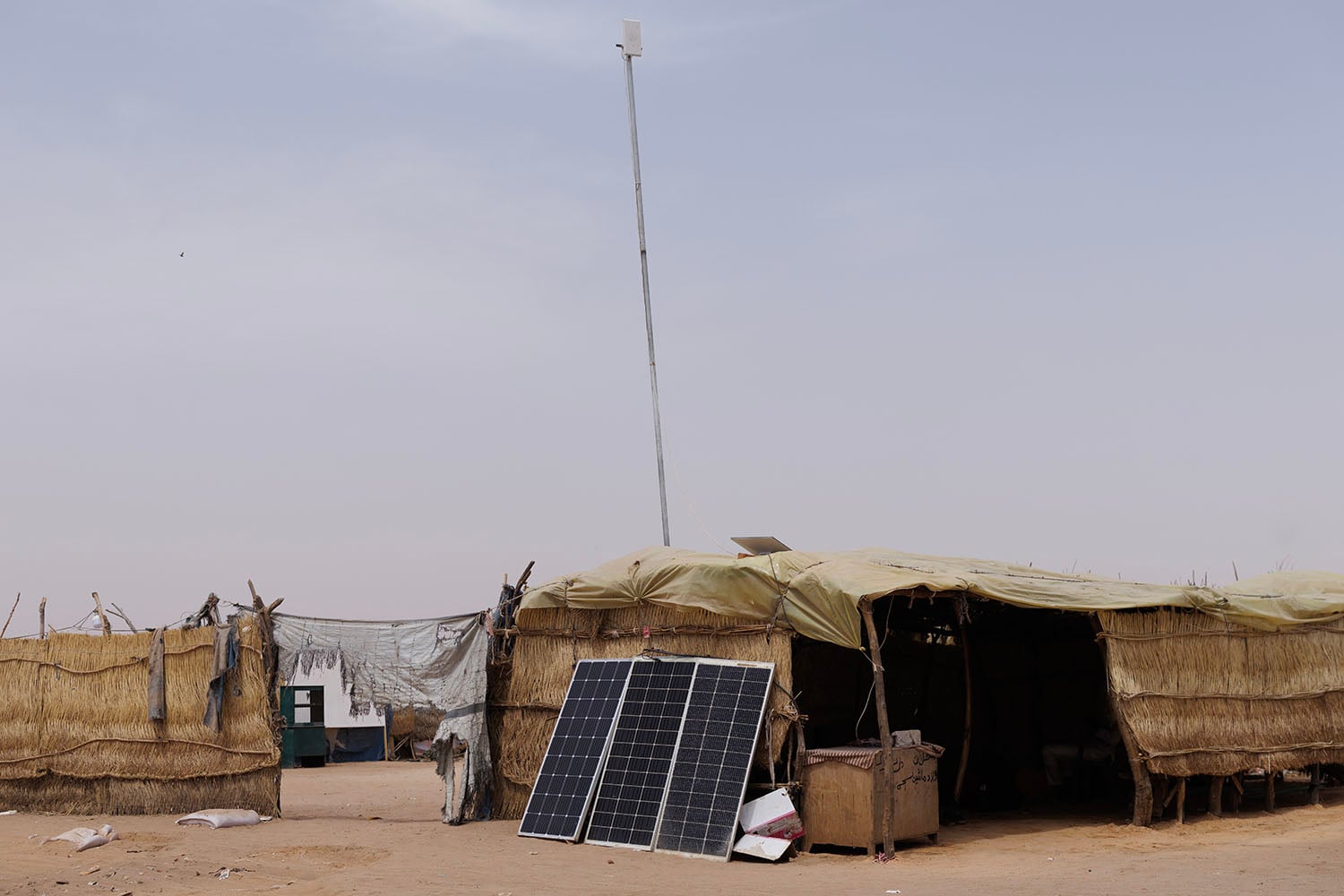
A hut sits on a sandy lot, with solar panels propped up beside it and a tall pole with a Starlink device on top of it. Other small huts are visible beyond it.
- Solar panels next to a temporary hut power a Starlink connection in a refugee camp in Adre, Chad, on Feb. 19. Dan Kitwood/Getty Images
In Africa’s Sahel region, the pattern is more alarming still. Insurgent groups such as the Jama’at Nasr al-Islam wal Muslimin (JNIM) and Islamic State West Africa Province have built illicit supply chains for Starlink kits running from Libya and Nigeria into Mali, Niger, and other conflict zones. In June 2024, JNIM released a video that appeared to show a Starlink terminal during an operation in Mali’s Gao region. Nigerian army raids on Boko Haram last year recovered Starlink equipment from a commander in the Sambisa Forest.
Throughout 2025, jihadi groups increasingly used satellite connectivity to coordinate dispersed units, distribute propaganda, and evade the intercept-based surveillance that had benefited from state control over terrestrial networks. Niger and Chad moved to legalize and regulate Starlink in early 2025 to improve oversight, but smuggling networks are likely to continue regardless.
Starlink is not the only game in town. The commercial space sector is filling with players that are increasingly central to national defense and military capability. The result is a widening marketplace of strategic services that states are simultaneously embracing and trying to govern. On the communications side, Iridium remains deeply embedded in defense communications. In 2024, the company announced a five-year contract with the U.S. Space Force for enhanced mobile satellite services and associated sustainment, reflecting continued reliance on commercial providers for mobile beyond line-of-sight connectivity.
Eutelsat OneWeb and Amazon’s Project Kuiper also compete in the defense and government market, while the European Union’s IRIS2 initiative reflects the bloc’s ambitions for sovereign capacity. Commercial imagery from Maxar, Planet, and BlackSky, alongside radar data from Capella and ICEYE, is now embedded in military targeting and situational awareness.

A white rectangular Starlink device sits in a snowy field, surrounded by low plants, dead or dormant for winter. The sky overhead is pale gray with complete cloud cover.
A Starlink device, part of a drone reconnaissance and strike unit, stands in a snowy field on the front line near Robotyne, Ukraine, on Jan. 23, 2024. Andre Alves/Anadolu via Getty Images
Recent conflicts have deepened all these arrangements. Commercial satellites, terminals, and data subscriptions are now part of the military supply chain. And just like ammunition and air defense systems, their delivery can be restricted, redirected, or weaponized under political pressure. Commercial space is becoming part of how states exercise and withhold power.
What Iran has exposed most sharply is the governance deficit that Ukraine and other Starlink use cases only partially revealed. International humanitarian law requires states to distinguish military objectives from civilian objects, but a terminal serving a dissident in the morning may support a military strike by afternoon.
There is no settled international framework for deciding when the jamming of a commercial satellite network should be treated as use of force under the United Nations Charter. No rules address whether the covert delivery of commercial hardware is an act of information warfare. No mechanism exists to hold a private operator accountable when the opinions of its CEO shape battlefield outcomes. Nor is there a clear consensus on the obligations of commercial satellite operators whose systems oscillate between civilian and military use in real time.
Strategic connectivity is now a matter of governance rather than geography. Bandwidth arrives from orbit. Intelligence is purchased by subscription. Sovereignty is increasingly exercised through relationships with private firms, negotiated access agreements, and contested technical settings. The state that fails to treat commercial satellite infrastructure as a strategic dependency—with all the discipline, redundancy, and legal architecture that implies—will find that dependency managed by others in a crisis.
The new geopolitics of Starlink is already here. The question is whether states will govern it or merely react.