
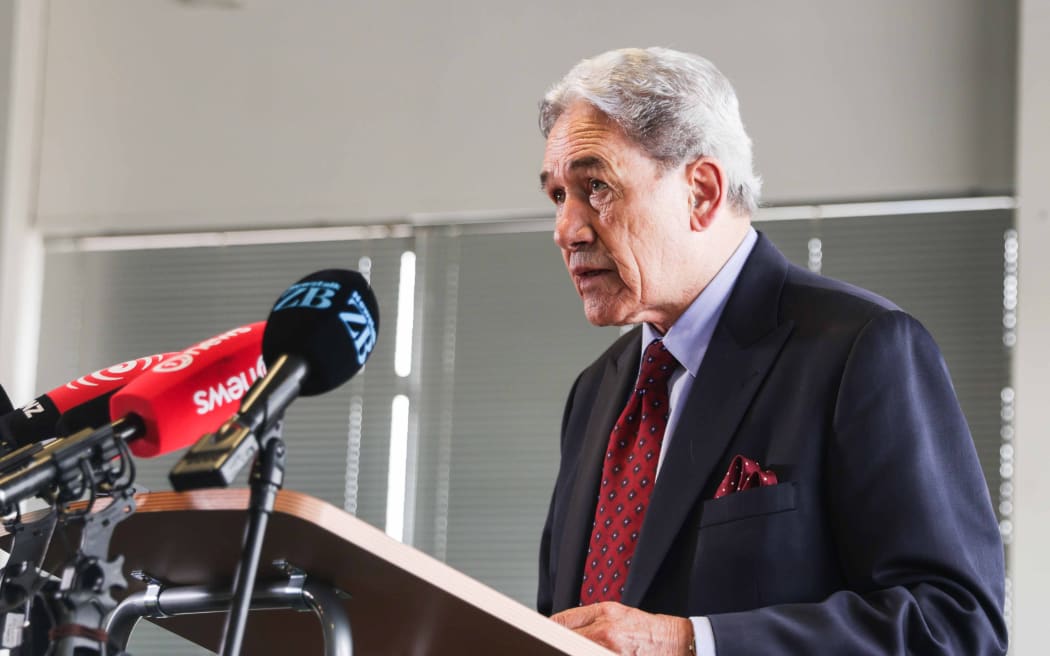
Winston Peters.
Photo: RNZ / Samuel Rillstone
Winston Peters will be making his State of the Nation address in Tauranga on Sunday, purposely timed after the release of the quarterly GDP figures.
It also comes off the back of heavy questioning by the New Zealand First leader about the previous Labour government’s decisions during the Covid-19 pandemic, following the release of the second phase of the royal commission of inquiry.
Peters has been accusing Labour ministers of not passing on critical vaccine information to the public, which Labour strongly denies.
Currently, NZ First is trending upward in the polls. In the latest RNZ Reid Research poll, the party sat at 9.8 percent in the party vote, which would result in 12 seats in parliament – four more than what it currently holds.
Peters was third in the preferred prime minister ranking, at 12.6 percent. Labour’s Chris Hipkins was at 21.1 percent, with Christopher Luxon on 19.4 percent.
Last year, Peters faced disruptions from hecklers during his State of the Nation speech to a packed crowd on a range of topics, including the “war on woke”, diversity targets, water fluoridation and the Paris Climate Agreement.
This year, it was expected Peters would address the cost of living and the state of the economy, as well as make an election policy announcement.
Recently at Parliament, he said he would not make his State of the Nation speech until after the GDP figures were released. He noted other party leaders were premature making their speeches before this information was available.
On Thursday, Stats NZ data showed gross domestic product (GDP), the broad measure of economic growth, rose an anaemic 0.2 percent in the three months ended December, to be 1.3 percent higher than a year ago. On an annual average basis, the economy grew 0.2 percent over the year.
Expectations were for quarterly growth in a range of 0.2 to 0.5 percent, although the growth of the previous quarter was revised lower to 0.9 percent from 1.1 percent.
Late last year, Peters signalled he was willing to criticise his coalition partners after he savaged National’s suggestion of asset sales as a “tawdry silly argument”, which he said it was falling back on after having failed to fix the economy fast enough.
“Because they’ve failed to run the economy properly, they want to go to the assets of a time when the country was run properly, when we were number two in the world and built up by our forefathers and to start to flog those off … to so-called balance their books,” Peters said.
The recent attack on Iran by the United States and Israel had the government monitoring developments, along with how fuel and supply chains could be disrupted in New Zealand.
And last week the finance minister indicated the worst-case scenario Treasury had outlined was a rise in inflation to 3.7 percent.
Peters will likely address the global instability, and how that will impact New Zealanders.
He will also likely take a swipe at the opposition. In 2024, Peters used roughly half of his State of the Nation speech to criticise the previous Labour government, along with the media and the Green Party, before outlining New Zealand First’s plans for the country.
Sign up for Ngā Pitopito Kōrero, a daily newsletter curated by our editors and delivered straight to your inbox every weekday.