
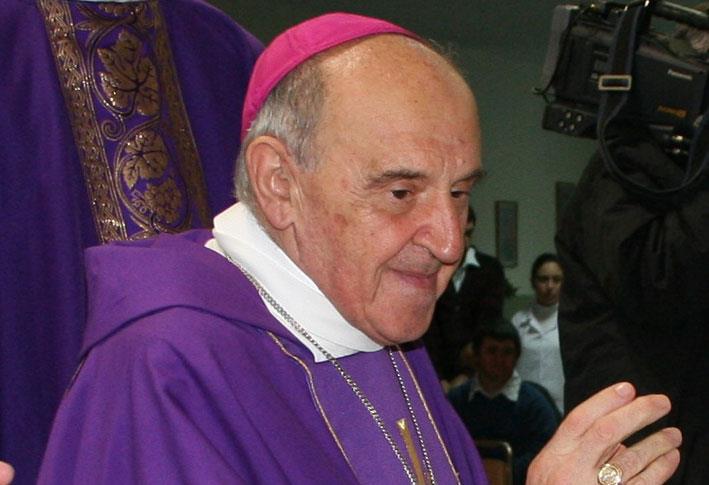

21 March, 2026, marks the tenth anniversary of Archbishop Mgr. Mercieca serene returning to the House of the Father.
Born in Victoria, Gozo, on 11 November, 1928, Joseph Mercieca was ordained priest on 8 March, 1952, when he was still studying at the Gregorian University in Rome.
Soon after returning to Malta after graduating in Theology and Canon Law, he started teaching theology and canon law at the Gozo Seminary where, in 1959, he also became Rector. He continued serving the Church in Gozo until 1969, when Saint Pope Paul VI called him to the responsibility of a Sacra Romana Rota judge.
In Rome, Fr. Joseph Mercieca used to reside at the Capranica College. However, in the first half of the year 1974, he started looking for an alternative because the college administration needed the room where he used to stay. Moreover, at the age of 46, he had started to think that his service to the Church was to keep him permanently in Rome.
Precisely at that moment in time, the Holy See was envisaging the need of a new Auxiliary Bishop to Archbishop Michael Gonzi. This necessity was brought about by the fact that Archbishop Emanuel Gerada (1920-2011), who was Bishop Coadjutor to Mgr. Gonzi, on 8th November, 1973, was called to serve the Church as Apostolic Nuncio for Guatemala and El Salvador.
On 20th July, 1974, Archbishop Gonzi celebrated the Golden Anniversary of his episcopate. Seven days later Mgr. Joseph Mercieca was notified that Pope Paul VI chose him as Auxiliary Bishop to Mgr. Gonzi.
Mgr. Mercieca was consecrated bishop on 29th September, 1974, and on 12 December, 1976 became Archbishop of Malta. He led the Church in Malta for 30 years up to 26 January, 2007, and passed away on 21 March, 2016.
Close to the sick
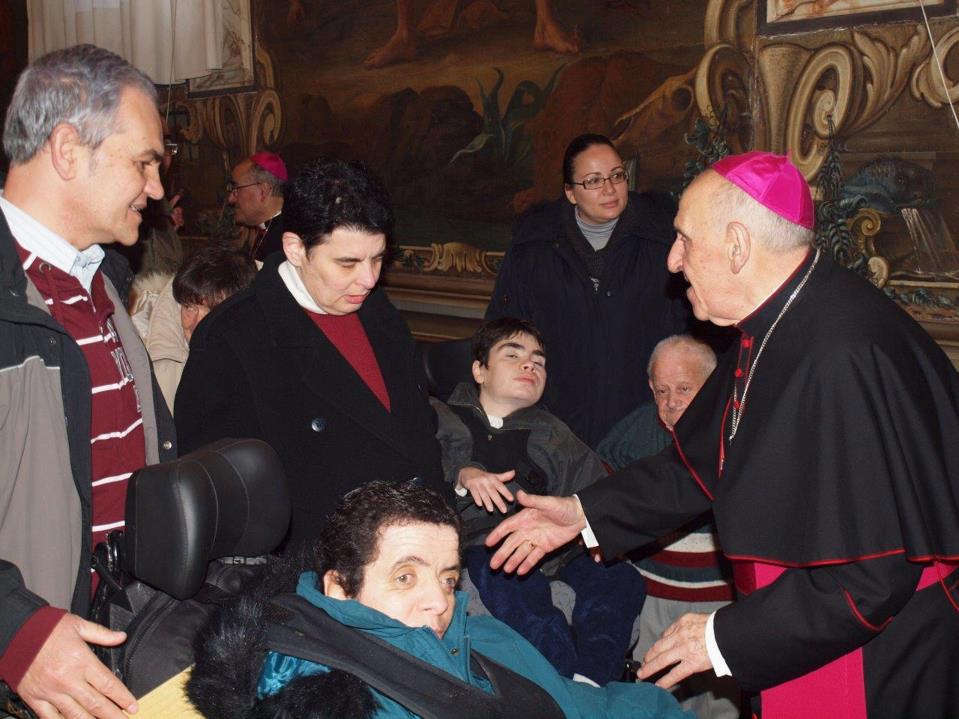
Of the bright things that used to enrich Mgr. Mercieca’ pastoral witness was his love and closeness to sick people. For him, frequently but silently visiting sick people in their homes or in hospital was part and parcel of his priestly mission.
He also used to visit politicians or former politicians experiencing difficult times in their health, whatever their past relations with him and the Church. They used to be very happily surprised with his visits.
The late former labour Minister Dr. Joseph Micallef Stafrace, who used to view Mgr. Mercieca as a “distinguished prelate”, is on record stating : “When I used to be in hospital, I don’t know how the Archbishop used to come to know about me there, because I used to find him in front of me with words of encouragement.” (It-Torca, 27th March, 2016.)
Mgr. Mercieca also cherished joining sick people on their annual pilgrimage to Lourdes.
A particular character
Few people knew, then, that this love of his towards the sick had a particular personal disposition.
When Mgr. Mercieca was still serving at the Sacra Romana Rota, he started planning something that he had wished to focus on for a long time but never had the opportunity to follow: to deepen his study in the field of science.
This led him to contact the Università Degli Studi Di Roma. However, he found that as a non-Italian person, to apply to study at this institution he had to make his application and present his documents through the Italian diplomatic representation in Malta, because the University did not accept documents presented personally.
On 9th October, 1971, he wrote to the Royal University of Malta to ask for the necessary documentation regarding his studies there.
On 20th October, 1971, the Registrar of the University, Mr. J. Bartolo, provided him with a declaration that according to the Regulations that were in place in 1946/47 and the certificates Joseph Mercieca obtained in English, Maltese, Latin, Italian, Mathematics and General Science, he was eligible to register as a Matriculation Student to begin an Entry Course in Science at the same University.
The Registrar sent this declaration to Joseph Mercieca and copied it to the Italian Ambassador in Malta.
Joseph Mercieca was accepted by the Università Degli Studi Di Roma to begin a course leading to a Degree in Medicine and Surgery. He started these studies in the academic year 1971-1972.
Still, due to the very heavy load of work that his duties as a Romana Rota judge imposed on him, together with the additional pastoral work he used to do in Rome, Fr. Mercieca discovered that he did not have enough time to carry on with these studies. Even so, he continued to renew his registration with the Università Degli Studi Di Roma. According to the Libretto D’Iscrizione that he had, he stayed renewing this registration, year after year, until 1980/1981 – that is, even after he became Archbishop of Malta.
His smile told me everything
What Mgr. Mercieca used to share with me led me to believe that had he not become a priest, most probably he would have become a medical doctor. On one particular occasion, I told him something to the following effect: “I think that if you had not continued preparing for the priesthood, you would have studied to become a medical doctor.” He didn’t pronounce himself verbally when I told him so. However, he looked at me with a smile that, for me, was a very strong indication that the possibility did exist.
Some weeks after the death of Mgr. Mercieca, I had the opportunity to visit his priest-brother John, at their family home in Victoria Gozo. Without mentioning anything to Fr. John about his brother’s interest in the field of science and what I understood, I asked him: “Had your brother, the Archbishop not become a priest, what profession do you think he would have followed?” Fr. John gave me an immediate and straight answer: “I think he would have become a medical doctor.”
Fr. John continued as follows: “At the Gozo seminary, he did not have the opportunity to study physics, because they did not use to teach this subject there. Neither did they use to teach chemistry. My brother, however, wanted to continue studying. There was, here, (in Gozo) a certain Mgr. Joseph Farrugia who used to teach physics at the De Soldanis girls’ secondary school in Victoria. Mgr. Farrugia used to come to our home, here, to give private lessons to my brother. I remember myself asking him: ‘What are you studying? For what use is this going to be for you?’ He told me: ‘No need to worry; I want to study.’ He used to love studying a lot. During the summer holidays, after he had been ordained a priest, there was a time when he used to go to study English in England.”
Fr. Joseph Mercieca’s contact with England was not limited to studying. His nieces remember him accompanying sick Gozitan people in need of medical procedures in England. They also remember that after their return home, certain people used to want to give him valuable gifts as a sign of gratitude. However, he used to refuse to accept such gifts and used to insist on them, especially when children were involved, to keep everything for their family’s needs.
After January 2007, when his service at the helm of the archdiocese came to an end, Mgr. Mercieca had the opportunity to concentrate better on being close to the sick and the afflicted – the pastoral work that was so close to his heart. One of the special niches he had in his heart was reserved to Id-Dar tal-Providenza. He used to describe this institution as the apple of his eye (il-mimmi ta’ għajnejh).
In his own unassuming and humble way, Mgr. Mercieca also continued to give true witness to his belief that whoever one may be, whatever one may have gone through in one’s life, God and Christ’s Church remain with their arms wide open to embrace one anew.
Charles Buttigieg is the co-author of the Memories of Archbishop Mercieca (2014) and a biography of Mgr. Mercieca (2017) – both published by Midsea Books.