
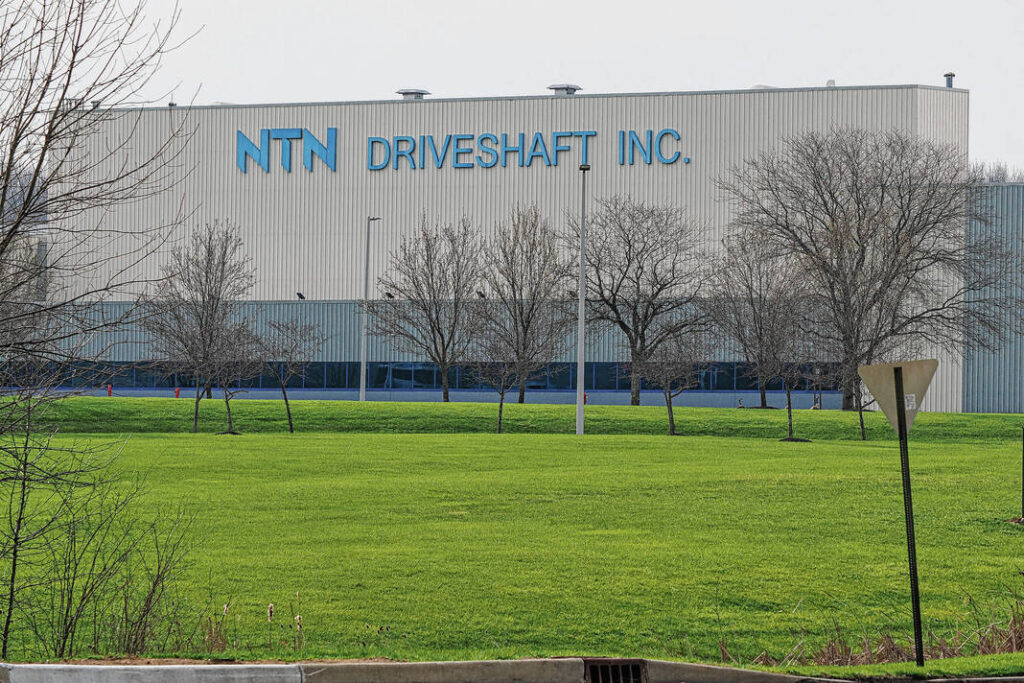
On Thursday, Illinois-based NTN USA Corp. announced that it is undertaking what it describes as a “significant transformation” of its North American manufacturing operations and will ramp down and close its CVJ East Plant in Columbus within the next two years.
NTN USA Corp. is the headquarters and holding company for Japan-based NTN Corp.’s entities in the Americas, including NTN Driveshaft Inc. in Columbus.
NTN Driveshaft has been producing constant velocity joints, or CV joints, in Columbus since 1991, according to the company’s website. CV joints are used to connect a vehicle’s transmission to its wheels.
While NTN Driveshaft plans to close the CVJ East Plant within two years, the company said it expects its CVJ West Plant and Forging Plant in Columbus to remain fully operational as production capacity is adjusted. The company said it also plans to close a plant in Anderson, Indiana, and Alabama, as well as consolidate operations at one Illinois facility and shift the focus of another Illinois facility.
In a statement on Thursday announcing the changes, NTN USA Corp. said the initiative “will streamline its manufacturing footprint, improve overall effectiveness and efficiency across the business segment while maintaining quality and delivery to customers.”
Currently, it is unclear how many people the CVJ East plant employs. Local NTN officials referred questions to their corporate office in Illinois. NTN USA Corp. did not respond to multiple requests for comment. As of 2018, NTN Driveshaft employed around 1,700 people across all plants, The Republic reported previously. A 2021 news release by NTN Driveshaft put the number at 1,650.
General Motors Co. and Toyota have been among some of NTN Driveshaft’s customers.
“In the short term, (the plant’s closure) is definitely going to be detrimental,” said Steven Mohler, assistant professor of management at IU Columbus. “…U.S. vehicle sales have been slowly but surely declining. So, this shouldn’t be a total surprise that if we see vehicle sales in the U.S. either flat or down a little bit that, sooner or later, we’re going to see some impact on employment. …I think near-term for the next two, three or four years, it’s going to be a challenge for us.”
Local officials said they were “disappointed” about the plant’s closure but struck an optimistic tone on Friday.
“We’re disappointed to hear the news,” said Greater Columbus (Indiana) Economic Development Corp. President Phil Wagner. “…However, I will say that … we’re pleased that they’re still in the community, (and) they’re going to have a significant presence in the community. But secondly, we’ve got a lot of great manufacturing presence within Columbus, within Bartholomew County, companies that are growing. We’re going to be taking an active role trying to find opportunities for those individuals, those families that might be impacted by this news and feel confident that our existing manufacturing can absorb a very significant amount of these individuals that are going to be impacted.”
Tariff lawsuit
The announcement from NTN USA Corp. came just two days after the company and several of its subsidiaries, including NTN Driveshaft Inc. in Columbus, filed a federal lawsuit demanding a refund for U.S. tariffs that the Supreme Court ruled were unlawful last week.
The lawsuit, filed Tuesday in the U.S. Court of International Trade, seeks a full refund of all duties that the companies paid under tariffs that the Trump administration imposed using the International Emergency Economic Powers Act (IEEPA), according to a copy of the complaint.
In February, the Supreme Court found those tariffs to be unconstitutional under the emergency powers law, including the sweeping “reciprocal” tariffs President Donald Trump levied on nearly every other country, according to wire reports. The majority ruled that the president could not unilaterally set and change tariffs because taxation power clearly belongs to Congress.
The lawsuit names U.S. Customs and Border Protection, the agency that collects tariffs, and its commissioner Rodney Scott, as defendants. The complaint does not say how much the companies paid in tariffs under the IEEPA.
It is unclear the extent to which Trump’s tariffs contributed to NTN USA’s decision to undergo a manufacturing realignment, if at all.
NTN Corp. had been implementing a medium-term management plan released in 2024 that includes, among other things, “structural reforms” aimed at improving “asset efficiency” by reorganizing its production bases in the Americas and elsewhere. It also includes the consolidation of its CV joint and axle business.
However, NTN Corp. Outside Director Tatsuhiko Toshita said on Jan. 20 that “business environments have changed significantly” since the company drafted the plan — including U.S. tariff policy and responses to geopolitical risks.
At the same time, NTN Corp. Outside Director Yasuo Kitani said the company is “maintaining a solid profit structure and reasonable level of financial discipline, even amid very challenging sales conditions, such as the Trump tariffs.”
NTN Corp. President and CEO Eiichi Ukai said during an earnings results briefing on Feb. 3 that the company’s CV joint and axle business saw a decline in demand, except in Asia, over the first nine months of its fiscal year, which ends March 31.
‘More cloudy than sunny’
Locally, NTN USA Corp.’s announcement has raised questions about Columbus’ economy, which is heavily rooted in automotive manufacturing, officials said. When one local employer pulls back, it raises concerns that other companies in similar industries may follow, officials said.
Several factors may be impacting the local economy, including tariffs, regulatory uncertainty, labor market weakness and declining U.S. auto sales, Mohler said.
“It’s just starting to feel like the overall economy, the demand for the labor market is weakening,” Mohler said. “(It’s) definitely not a nosedive, but weakening. …I see a weak economy for us, particularly for Columbus, for a while. The average price of a car in the U.S. is $50,000, and if we see any weakness in the labor market, that could be one of those tipping points for automotive sales.”
At the same time, the Trump administration recently ended emission limits for U.S. automakers, which could increase uncertainty as automakers navigate multiple state and regional rules and ultimately impact vehicle exports.
“If we lower our standards, we change that for our vehicles overall, then other countries won’t accept our cars,” Mohler said. “…It may limit the exportability of vehicles at the same time that we see a decline in U.S. vehicle sales. That’s not a good omen for a manufacturing economy built on automotive products like Columbus. …There’s a lot of pieces to this puzzle, and it’s starting to look a little more cloudy than sunny.”