
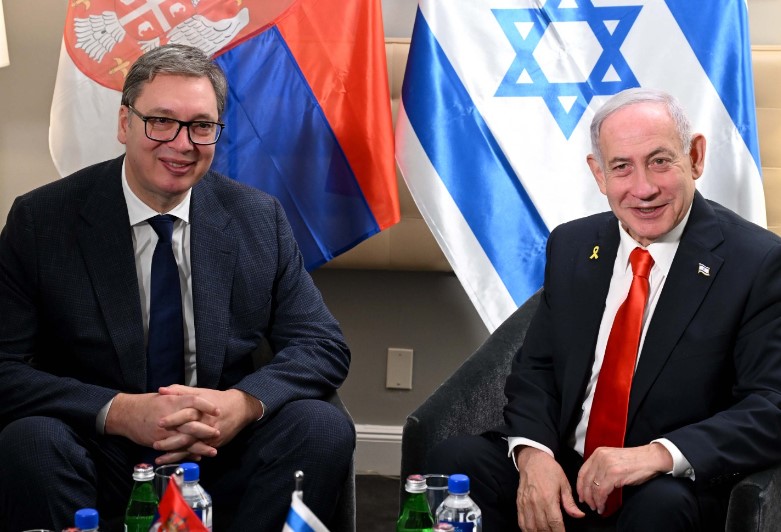
Serbian exports of arms and ammunition to Israel have skyrocketed, rising nearly 40-fold over two years amid ongoing conflicts in the Middle East.
These statistics, first highlighted by the Belgrade weekly Radar and later corroborated by the Israeli newspaper Haaretz, underscore the rapid intensification that began following the 7 October 2023, Hamas attack and Israel’s subsequent military operations in Gaza and Lebanon.
This surge has drawn international attention, highlighting not only the commercial aspects of the ties but also their political implications in a region where few European nations maintain such open military support for Israel.
In recent years, defence cooperation between Serbia and Israel has deepened dramatically, transforming a modest trade relationship into a strategic partnership marked by massive arms flows in both directions.
Explosive growth in Serbian arms shipments to Israel
The numbers tell a striking story of escalation. In 2023, Serbian arms exports to Israel totaled just €3 million. By 2024, that figure climbed to €48 million, and in 2025 it more than doubled again to a record €114 million (approximately $131 million). Official data from the Serbian Statistical Office confirm a 140 percent increase in 2025 alone, establishing a new high for bilateral military trade.
Open-source flight tracking reveals the logistical scale behind these figures. In 2024, 19 cargo flights carried weapons from Serbia to Israel; that number doubled to 38 in 2025. Since the start of 2026, at least 17 additional flights have been recorded departing from Belgrade, often bound for Israel’s Nevatim Air Base. Many of these involved Israeli military and civilian aircraft loading pallets at Belgrade airport. Investigations by Haaretz and the Balkan Investigative Reporting Network (BIRN) have documented that shipments included 155mm artillery shells, with photographs capturing crates being loaded onto planes despite public announcements to the contrary.
In June 2025, Serbian President Aleksandar Vučić declared a suspension of all military exports, yet deliveries to Israel persisted unabated.
Serbia halts arms exports to Israel amid domestic unrest and international scandals
In the second half of 2025 alone, more than $65 million worth of arms, primarily ammunition, were flown out. State-owned Jugoimport SDPR has been the primary supplier, joined by private firms such as Edepro and Romax, which sold ammunition to Israel’s IMI Systems (now integrated into Elbit Systems), a major producer of missiles, rockets, and artillery. Serbian authorities have declined requests to disclose precise details of the munitions, leaving much of the trade opaque.
This one-way flow of conventional ammunition addresses Israel’s wartime shortages, while the relationship extends far beyond exports. Serbia has become a key buyer of Israeli technology. Early in 2025, Elbit Systems secured a $335 million deal for advanced artillery and drones, followed by an August 2025 contract valued at $1.6 billion for drones, long-range missiles, electronic warfare systems, and other equipment. These deals, totaling nearly $2 billion, rival a significant portion of Serbia’s 2026 defence budget of about $2.7 billion. Past sales of Israeli cyber and surveillance systems have also supported Serbian authorities during periods of domestic unrest.
Adding complexity, Serbia has shielded Israel Einhorn, a Netanyahu adviser and suspect in Israeli corruption scandals, refusing extradition requests despite his alleged Balkan connections facilitating arms deals.
A broader regional shift toward Israeli defence partnerships
Serbia exemplifies a wider trend across Southeast Europe, where nations are forging closer military ties with Israel. The region offers a developed arms industry capable of supplying ammunition that Israel, focused on high-tech innovation, produces in limited quantities due to constant security demands.
In return, Israeli firms provide cutting-edge surveillance, drones, and defence systems. As Belgrade-based expert Branimir Djokic explained, this mutual benefit, combined with perceptions of Israel’s influence in Washington, has fueled the cooperation.
Albania has emerged as another active partner. Prime Minister Edi Rama visited Jerusalem in January, endorsing joint military production. Albania’s defence company KAYO partners with Elbit on drones, with discussions expanding to artillery. A 2025 bilateral agreement aims to boost local production, supported by a substantial portion of Albania’s 2026 defence budget allocated to Israeli equipment.
No EU-level arms embargo exists against Israel. Proposals for one (e.g., discussed in 2025 amid the Gaza conflict) have not been adopted due to lack of consensus.
Romania boasts long-standing collaboration with Elbit and Rafael, including multibillion-dollar deals for air defence systems and artillery cooperation since Russia’s 2022 invasion of Ukraine intensified regional security concerns. Moldova has acquired Israeli ATMOS artillery and opened diplomatic channels, while Bulgaria explores expanded projects with Israeli firms. Montenegro has secured Elbit weapon stations and munitions, and Croatia integrates Israeli Trophy systems on German tanks despite domestic political divisions.
Not all countries align with this pattern. Slovenia has banned arms trade and transit with Israel, citing humanitarian concerns in Gaza, and prohibited goods from occupied settlements. Nations like North Macedonia, Kosovo, and Bosnia and Herzegovina show minimal engagement.
President Vučić has described the Serbia-Israel relationship as “excellent,” stating bluntly that mutual weapons sales will continue. Israeli Foreign Minister Gideon Sa’ar praised Serbia’s tangible support in contrast to European embargoes. Yet critics, including UN Special Rapporteur Francesca Albanese, have labeled Serbia one of Israel’s most steadfast allies amid international legal scrutiny of Israel’s actions in Gaza, where casualties exceed 75,000, including over 20,000 children.
This burgeoning defence axis in Southeast Europe reflects pragmatic geopolitics: ammunition for technology, industrial partnerships amid global tensions, and strategic alignments in an uncertain world. While lucrative and militarily complementary, the ties raise questions about ethics, transparency, and alignment with broader European positions on conflict and human rights.
Sources: BETA, Radar, Haaretz, Seenews, Balkan Insight
Caption: Prime Minister Benjamin Netanyahu met with the President of Serbia Aleksandar Vučić in New York on 25 September 2025. (Israeli government)
Updated: March 21, 2026 – 10:03