
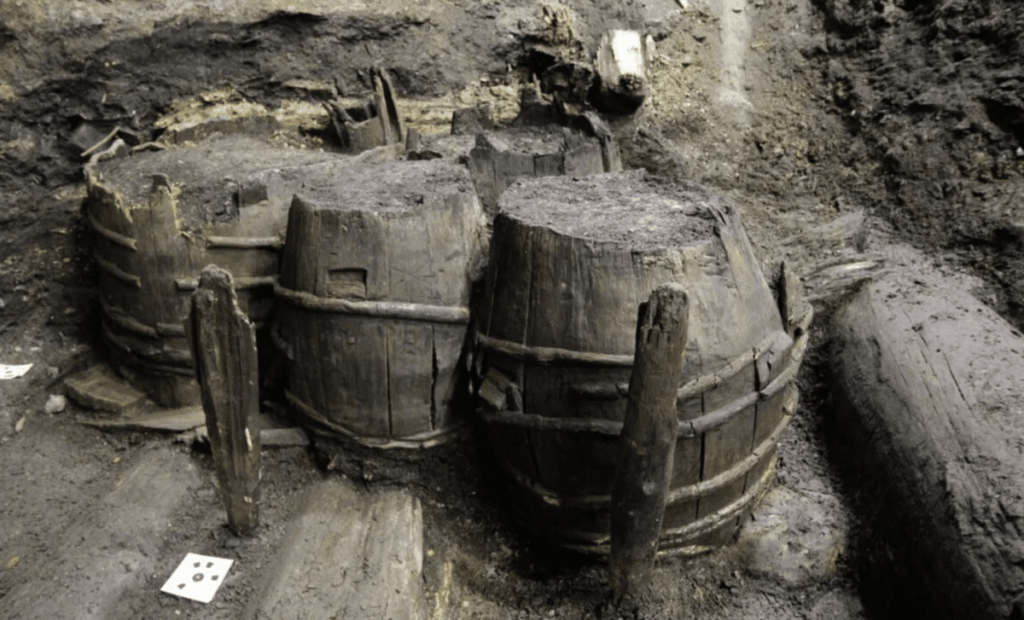
Archaeologists in Skien, Norway, have uncovered three perfectly preserved 17th-century oak barrels, offering a rare glimpse into the city’s early urban construction practices. The discovery, made during excavation work in Torggata, sheds new light on the material culture of early modern Scandinavia, revealing key details about the storage and handling of construction materials. The study, conducted by the Norwegian Institute for Cultural Heritage Research (NIKU), uncovers the profound historical significance of this remarkable find.
A Rare Discovery in the Heart of Skien
Skien, a city steeped in history, has long been known for its early harbor-based settlements, but this new discovery offers an unprecedented view of the area’s construction techniques in the 17th century. Three oak barrels, nearly intact after centuries underground, were unearthed as part of a municipal project to modernize the water and sewage systems in Torggata. These barrels, surprisingly well-preserved, provide crucial evidence of urban construction methods and material storage in an era long past. According to Heritage Daily, the barrels were found along with a large wooden rammer, deep within a rich deposit of lime.
This discovery, detailed by the Norwegian Institute for Cultural Heritage Research (NIKU), is exceptional not only because of the state of preservation but also because of the fascinating glimpse it provides into the practical, everyday aspects of early urban life. Archaeologists believe that these barrels, which contained slaked lime, were buried intentionally to maintain the lime’s chemical reactivity and prevent it from freezing in the harsh Scandinavian winters. This practice illustrates how early builders managed construction materials with great attention to environmental factors.
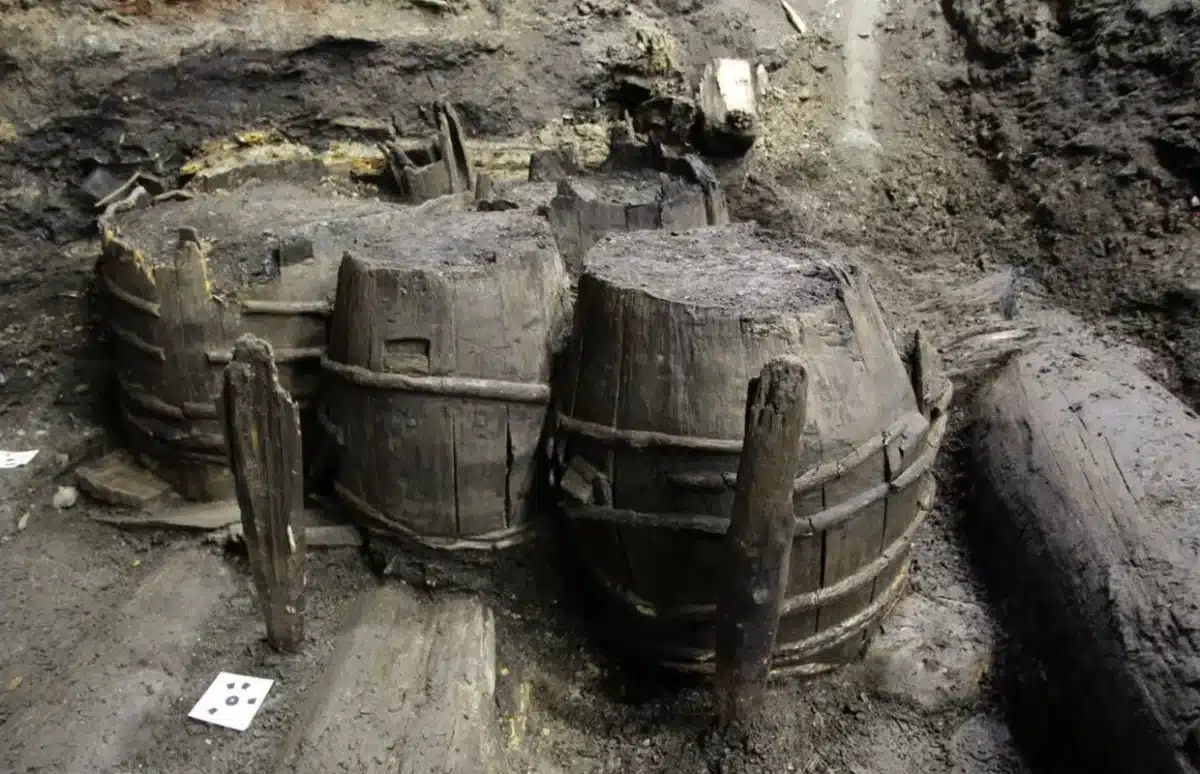 Image Credit : NIKU
Skien’s Hidden Past: Insights into Construction Practices
The discovery of these barrels, associated with high concentrations of lime, is a key moment for historians and archaeologists alike. Stratigraphic analysis has shown that the barrels date to the 17th century, but the layers beneath them tell a much older story. Underlying cultural layers go back to the 9th century, indicating that Skien was a prominent hub in regional trade networks, particularly in the trade of whetstones from Eidsborg. This find not only highlights the construction methods of the 17th century but also connects the city to its broader regional significance.
The barrels, with compacted lime residues at their base and layers of demolition debris on top, suggest multiple cycles of use. These findings point to the storage and handling of lime, a critical ingredient in the production of mortar for both masonry and surface finishes in construction. The decision to store lime underground would have ensured that it remained stable, with its properties preserved until it could be mixed with other materials like sand and water.
In addition to providing insight into material storage, the discovery helps archaeologists understand the early modern construction processes used in Skien’s urban center. It is likely that these barrels were part of post-fire reconstruction efforts that transformed the city following devastating fires. The presence of a wooden rammer suggests that the site was also used for on-site processing of materials, further confirming the area’s construction-related use.
Preservation and Community Engagement
The preservation of these artifacts is a significant achievement in itself. The barrels were preserved by the anaerobic burial conditions created by the surrounding lime, which helped to maintain the structural integrity of the wood. The alkaline environment, combined with the sealed conditions of burial, protected the barrels from decomposition. Archaeologists are now considering the possibility of conserving and reconstructing these ancient barrels, allowing them to become valuable historical exhibits.
Equally important is the public engagement aspect of this discovery. The excavation, although physically restricted to a small group of researchers, has generated significant local interest. Through digital media, updates on the progress of the excavation have been shared with the public, and guided tours have allowed residents and visitors to gain firsthand knowledge of the excavation process. This combination of scientific research and community outreach is crucial in fostering greater appreciation for the city’s history and the work of those uncovering it.