

WANA (Mar 22) – “If Iran doesn’t FULLY OPEN, WITHOUT THREAT, the Strait of Hormuz, within 48 HOURS from this exact point in time, the United States of America will hit and obliterate their various POWER PLANTS, STARTING WITH THE BIGGEST ONE FIRST!”
With this stark warning, U.S. President Donald Trump escalated tensions over the strategically vital Strait of Hormuz, signaling the possibility of direct strikes on Iran’s energy infrastructure.
Analysts and political figures warn that such a move may not secure maritime access but instead trigger a broader regional crisis.
A Nigerian politician, in a post on X, argued that the threat could push Persian Gulf Cooperation Council (PGCC) countries—particularly Saudi Arabia, the United Arab Emirates, and Bahrain—into the conflict.
According to the post, any U.S. strike on Iranian power facilities could provoke Tehran to retaliate by targeting energy infrastructure across the Persian Gulf while also moving to shut down both the Strait of Hormuz and the Bab el-Mandeb.
Such actions would effectively block key maritime routes, cutting off PGCC states from critical access to the Arabian Sea and the Persian Gulf.
The warning described the scenario as an existential threat to Gulf economies, where disruptions to energy exports, food imports, and electricity supplies could force regional states into direct involvement in the conflict.
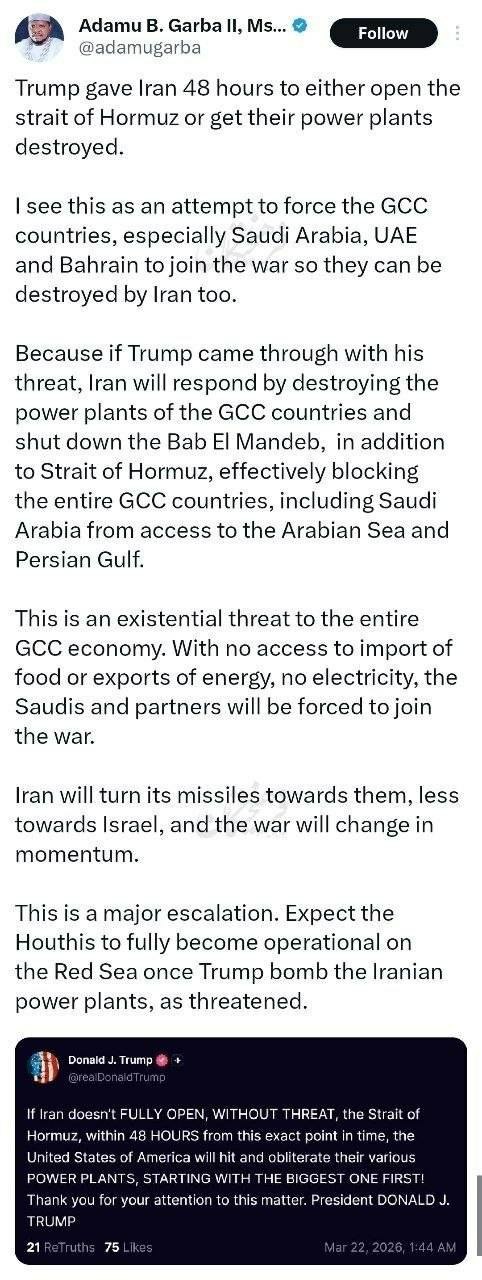
It also suggested that Iran’s military focus could shift toward Gulf targets, altering the trajectory of the war.
Earlier, Ali Larijani, the late secretary of Iran’s Supreme National Security Council who was assassinated during the current war, had also warned that if any disruption affected Iran’s electricity infrastructure, the entire region could experience a blackout within half an hour.
Additionally, the spokesperson for Iran’s Khatam al-Anbiya Central Headquarters stated that, following previous warnings, any attack on Iran’s fuel and energy infrastructure would prompt retaliatory strikes targeting all U.S. and Israeli energy, information technology, and desalination infrastructure in the region.
Taken together, the statements point to a rapidly intensifying standoff in which threats to critical infrastructure—and the waterways that sustain global energy flows—risk expanding into a wider regional confrontation.