
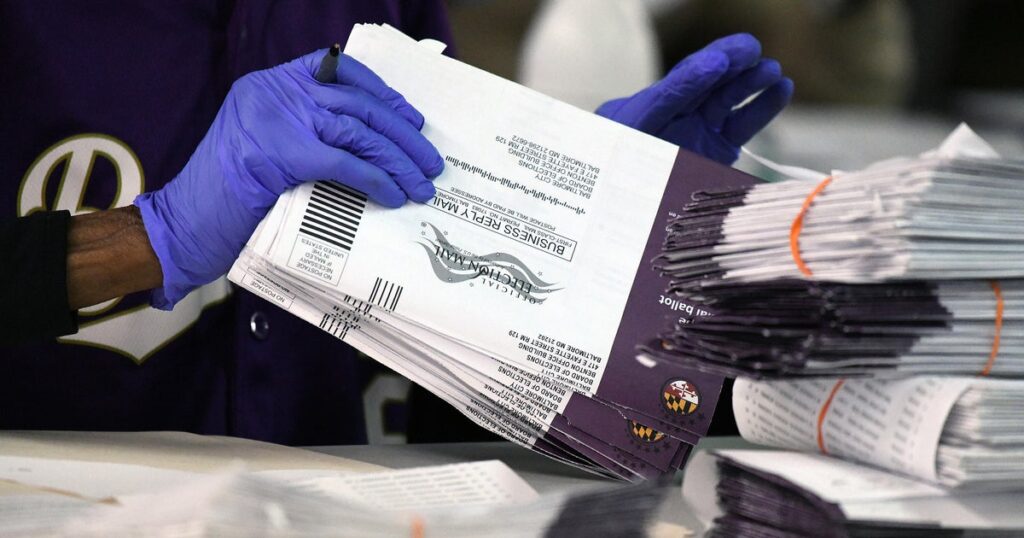
Washington — As voters gear up for the midterm elections in November that will decide control of the House and Senate, the Supreme Court is set to weigh Monday whether states can count mail ballots that are postmarked by, but arrive after, Election Day.
The dispute before the high court, known as Watson v. RNC, involves Mississippi’s deadline for late-arriving mail ballots and whether its law — and similar measures in 13 other states — conflicts with federal statutes that set Election Day as the Tuesday after the first Monday in November.
President Trump has continued to target voting by mail, which he claims is “corrupt as hell” and wants to sharply curtail. Since returning to the White House, the president and his administration have tried to gain more control of federal elections. He signed an executive order last March that sought to overhaul U.S. elections, though provisions have been blocked by a federal judge.
All 50 states require ballots to be marked and submitted by Election Day. But 14 states and the District of Columbia have enacted so-called grace periods, in which ballots that are postmarked by Election Day can be counted if they are received by election officials after the specified day. Twenty-nine states and the District of Columbia accept at least some military and overseas ballots that are received after Election Day, according to the National Conference of State Legislatures.
Four states — Kansas, North Dakota, Ohio and Utah — passed laws last year eliminating grace periods. They now require mail ballots to be received by Election Day in order to be counted.
“It’s not that people are casting a vote after Election Day. They’re not. This is just allowing us to make sure that we receive all of the timely cast ballots, no matter where they’re coming from or what political party they’re from,” said Kristin Connelly, clerk-recorder and registrar of voters for Contra Costa County, California. In California, ballots postmarked by Election Day can be received up to seven days after the election.
The battle is one of three involving elections that the Supreme Court is hearing in its current term, and all could usher in changes to voting rights and the rules surrounding campaigns and elections. One of the cases challenges federal limits on coordinated spending between political committees and candidates, and the other raises the constitutionality of race-based redistricting. A ruling in the latter case could lead to further weakening of the Voting Rights Act and impact minority representation in Congress.
The dispute over Mississippi’s deadline
Mississippi law allows ballots that are received up to five days after the election to be counted if they were postmarked by Election Day. In 2024, the Republican National Committee and the state GOP, as well as Mississippi’s Libertarian Party, filed lawsuits challenging the state’s ballot-receipt deadline.
Both suits, which were eventually rolled into one, argued that federal statutes enacted in the 1800s which set a uniform day for the election for president and Congress require ballots to be received by that date. Mississippi’s grace period, the Republicans alleged, conflicts with those federal laws.
A U.S. district court upheld Mississippi’s law. The judge found that it did not conflict with the federal election-day statutes because, when Congress enacted them, the ordinary meaning of “election” was the final choice of a candidate by the voter.
But the U.S. Court of Appeals for the 5th Circuit reversed that decision and ruled that federal law trumps Mississippi’s deadline, since “election” day is the day by which ballots must be cast by voters and received by state election officials.
“While election officials are still receiving ballots, the election is ongoing: The result is not yet fixed, because live ballots are still being received,” a panel of three judges on the 5th Circuit found.
Mississippi officials appealed the decision to the Supreme Court, and the justices agreed in November to take up the case.
“This is not a question of whether it’s a good idea to allow for grace periods or how long those grace periods should be,” said David Becker, a CBS News election law contributor and executive director of the Center for Election Innovation and Research. “What’s at issue here is whether the states have the power under the Constitution to determine that for themselves.”
In defending the law, Mississippi Secretary of State Michael Watson, a Republican, argued his state and others with post-Election Day deadlines have made a policy choice, which reflects the nation’s system of federalism. The Constitution’s Elections Clause gives states the authority to set the rules for federal elections, and offices at the state and local levels oversee their administration, though Congress can pass nationwide regulations.
Watson and others defending the grace periods have warned that if the Supreme Court adopts the 5th Circuit’s rule, it could jeopardize the laws of the 29 states that accept some ballots after Election Day, including from military and overseas voters. There are nearly 4 million servicemembers and U.S. citizens living abroad who rely on mail ballots to vote, according to a coalition of groups representing some of them.
“If the Supreme Court decides to read into the Constitution a requirement that election officials have ballots in their hands by Election Day, I don’t know how they carve out an exception for military and overseas voters. There’s nothing in the Constitution that says that,” Becker said. “I think it could possibly imperil the people who are serving our nation overseas, and it’s not just military. There are civilians serving, people in embassies, etc., people who work for corporations who are serving American interests. They could be disenfranchised as well.”
In filings with the Supreme Court, Watson argued that an “election” is the choice of a federal officer, and voters make that choice when they mark and submit their ballots. Under Mississippi law, all voters — whether voting in-person or by mail — must make their “conclusive” choice of candidates for office by Election Day.
“It does not matter — as far as the federal election day statutes are concerned — that election officials in Mississippi may receive some ballots after election day,” he wrote. “Only ballot casting is essential to an election.”
The argument against grace periods
But lawyers for the Republican National Committee urged the Supreme Court to strike down Mississippi’s law, arguing that the election ends when the ballot box is closed, not when voters make their selection. The term “election,” they argued in a brief, refers to the public process of selecting candidates for federal office.
Election Day encompasses the submission and receipt of ballots, and both must conclude on the date set by Congress, the Republicans and Libertarian Party of Mississippi said. They also argued that a patchwork of different ballot-receipt deadlines only replicates the problems Congress was trying to fix when it set a uniform day for the election in the 19th century.
“When you look at what Congress did and why, and if you look at the way elections were conducted for most of the nation’s history after those laws went into effect, up until just the last few years it was widely understood that ballots had to be in the hands of election officials, and they had to be in the hands of those officials before Election Day was over in order to be counted,” said Jason Snead, executive director of the Honest Elections Project, a conservative organization that advocates for election reform.
He continued: “This is a question of Congress long ago exercising its power and now the Supreme Court has an opportunity to bring states back into check that are violating that law.”
The RNC also warned that the laws allowing officials to count late-arriving ballots invites fraud and creates the appearance of fraud.
“In the eyes of many, they have hampered the efficiency and integrity of elections,” the Republicans argued.
Claims about fraud through mail voting have been perpetuated and amplified by Mr. Trump, who has said he wants to get rid of mail ballots altogether and, in 2020, demanded states “stop the count” of votes as his path to victory narrowed. He has pressured Republicans in Congress to pass the SAVE America Act, which would require proof of citizenship to register to vote and a photo ID to cast a ballot.
At least one GOP senator, Eric Schmitt of Missouri, is proposing a change to that legislation that would end mail ballots entirely, with some exceptions. It’s highly unlikely either Schmitt’s amendment or the SAVE America Act will become law given Democratic opposition.
“Having late-ballot deadlines is really just a choice, it’s a policy choice, and it’s premised on the idea that every vote must count,” Snead said. “But I think that when you actually look at the fact that it disenfranchises people, while making elections messier, while making delays more likely, while making it possible for election results to flip after the elections are over and on and on and on, it doesn’t deliver on its promise and it just makes elections messier and it makes fraud more likely.”
But instances of mail-voting fraud are rare, and there is no evidence of widespread voter fraud, Becker said.
“If someone is really interested in going to jail, they should submit a fraudulent mail ballot because they have committed a federal and state crime, and they have created an extensive paper trail relating to their crime. It will get caught and they will get prosecuted and there’s evidence of that in those very rare cases where it occurs,” he said. “But that’s why we know it is not widespread. Mail voting is not subject to significant fraud. Voting overall is not subject to significant fraud.”
The Trump administration is backing the GOP in the case and has argued that under federal law, states cannot count ballots in elections for president, the Senate or the House that are received after Election Day.
“[I]n setting a uniform ‘election day’ for the Nation, Congress mandated what those words have always required: On election day, the ballot box must close, and every vote must have been received,” Solicitor General D. John Sauer wrote in a friend-of-the-court brief.
The looming midterm elections
A decision in the case is expected to come by the end of June or early July. Experts and officials say they’re concerned that a ruling striking down grace periods could leave some states’ election officials scrambling to inform voters of changed deadlines just months before the November midterm elections.
“For those minority of states, red and blue, that allow for grace periods for mail ballots to be received, that would require some radical changes on their part and a huge burden of voter education, because voters are going to have to understand these new terms and understand that they shouldn’t be putting ballots into a mailbox close to an election,” Becker said.
Connelly, the clerk-recorder and registrar of voters for Contra Costa County, said it is best practice to have the same voting procedures in place for the primary and general elections. That can’t happen if the Supreme Court hands down a decision invalidating post-election ballot-receipt deadlines after the state’s June 2 primaries.
If states have to get rid of their grace periods, municipalities could increase the number of drop boxes so voters don’t have to rely on the U.S. Postal Service and can ensure their mail ballots are received by Election Day. But Connelly said even that comes with difficulties.
“If you’re from a smaller county, having to educate voters about this change would be really difficult,” she said. “I question what problem they’re trying to solve. This is not making things more secure. This is making things more chaotic.”
In the November 2024 general election, Contra Costa County received 12,223 mail ballots during California’s seven-day grace period. Of those, 871 were not postmarked on time, so 11,352 were eligible to be counted, Connelly said. A total of 467,835 mail ballots were cast in that election.
Connelly noted that Congress has passed crucial legislation governing federal elections, including the Voting Rights Act and the Help America Vote Act, which established the Election Assistance Commission. But she said states are best equipped to enact policies that reflect their voters.
“There is a role to play for the federal government,” Connelly said, “but in terms of states deciding how things should best work, I would hope that, in this case that’s going to be heard by the Supreme Court, there is actual deference given to the lawmakers in Mississippi who decided [that ballot-receipt deadline] works for them.”