

FuelCell Energy is repositioning itself as a power solution for AI data centers, with more than 80% of its proposal pipeline now driven by that market — a dramatic shift for the Danbury company, which is betting on an expansion of its Torrington factory.
Danbury-based FuelCell Energy is betting its next chapter on the artificial intelligence boom, shifting its commercial focus almost entirely toward powering data centers while scaling back investment in the hydrogen-based technology it touted two years ago as the future of clean power.
The pivot is still in the pipeline stage, but if demand materializes it could lead to an expansion of the company’s Torrington manufacturing facility, which is currently operating at less than half capacity, CEO Jason Few said in a recent interview with the Hartford Business Journal.
FuelCell Energy, which has long struggled to reach profitability, has not yet signed a data center customer, but the company reported this month that more than 80% of its proposal pipeline — totaling more than 1.5 gigawatts in the first fiscal quarter — now comes from data centers. The company said its business development pipeline has grown 275% since February 2025, with nearly all the increase driven by data center customers.
Fuel cells generate electricity through a chemical reaction rather than combustion. They run on natural gas or other fuels and produce power on-site without relying on the electric grid, which is already strained.
For data centers, Few said fuel cells offer a practical solution as utilities cannot add generation capacity fast enough to meet rising demand. Policymakers are also beginning to require new data centers to secure dedicated power generation.
“The challenge facing data centers today isn’t just how much power they need — it’s how quickly they can get it,” Few said.
The International Energy Agency projects global data center electricity demand will roughly double to 945 terawatt-hours by 2030, driven largely by artificial intelligence.
Xiao-Dong Zhou, director of the Center for Clean Energy Engineering at the University of Connecticut, said the nation’s electrical grid was not designed for this kind of surge. The grid matured in the 1950s, he said, when no one could have anticipated the scale of demand that data centers are now creating.
 Xiao-Dong Zhou
“Our current grid is not built to handle this level of demand. That is the reality,” Zhou said. “How do we meet the rapid growth in electricity demand coming from data centers? It requires more distributed generation and producing power on-site.”
Zhou, a chemical and biomolecular engineering professor who also serves as special adviser on sustainability to UConn President Radenka Maric, said demand could accelerate further as 6G wireless technology approaches, which is expected to require roughly 10 times more power than current 5G networks.
Focused R&D spend
FuelCell Energy recently unveiled a new product designed for data center developers that bundles multiple fuel cell units into a 12.5-megawatt system — enough to power a small- to medium-sized data center.
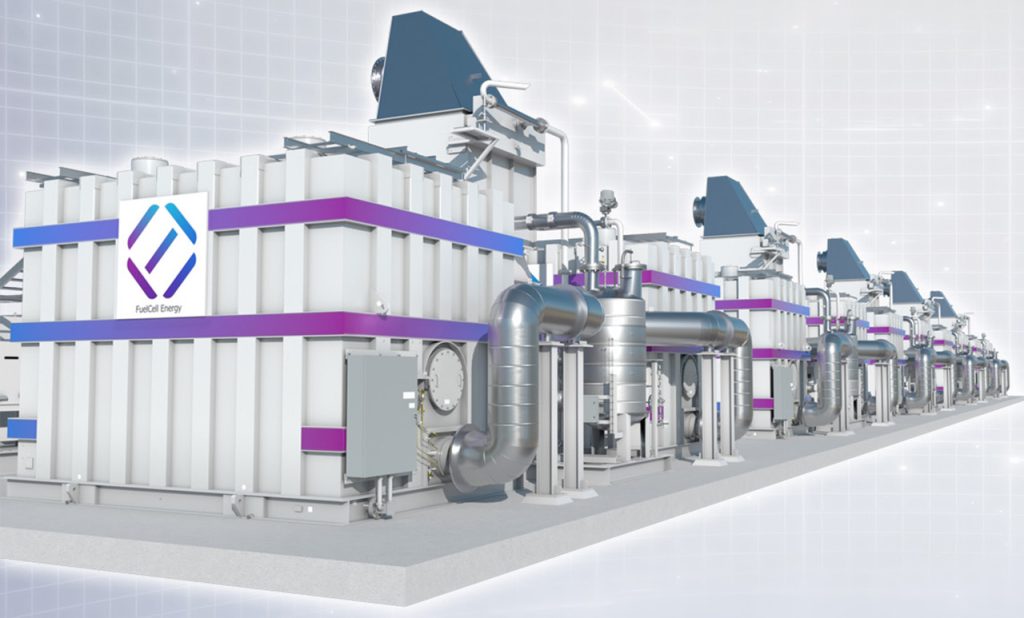 FuelCell Energy’s new 12.5-megawatt fuel cell system bundles multiple units into a package designed to power small- to medium-sized data centers. Contributed Photo
The company says its technology offers several advantages for data center operators. Because fuel cells have no combustion or moving parts, they operate quietly and may face fewer permitting hurdles than conventional generators.
FuelCell also says its systems produce electricity in the format data centers use internally. Meanwhile, heat generated by the system can be captured and reused to help cool the facility — a major energy expense for data centers, which can devote 20% to 30% of their electricity use to cooling.
FuelCell Energy’s data center focus marks a sharp turn from just two years ago. In early 2023, Few told the Hartford Business Journal the company was aggressively hiring and pivoting toward hydrogen-powered fuel cell technology — a cleaner but then-emerging alternative to the company’s established natural gas-based systems.
That bet has been scaled back as the company recovers from recent financial struggles. Research and development spending fell by $4.1 million year over year in the most recent quarter, largely due to reduced investment in hydrogen-powered technology. The company also cut about 17% of its global workforce in late 2024, and announced an additional 22% reduction in mid-2025, leaving roughly 426 employees.
Few said the company has not abandoned hydrogen-backed technology entirely, but its priorities have narrowed.
“What’s different is our focus,” Few said. “We had a much broader mandate for R&D previously. Today, our R&D is very focused on our existing platform and how we continue to drive improvement.”
The company’s core technology is the molten carbonate fuel cell — a high-temperature system that generates electricity through a chemical reaction rather than combustion. FuelCell manufactures the systems in Torrington and has deployed them in the U.S., South Korea and other markets for decades.
The Torrington facility is currently producing about 41 megawatts of power systems annually — less than half of its 100-megawatt capacity. But Few said during the company’s recent earnings call that demand from data centers could change that quickly.
The company has outlined plans to expand the factory’s capacity to 350 megawatts within its existing footprint, and has begun investing in manufacturing equipment needed for the potential ramp-up. FuelCell expects to spend up to $30 million on the initial phase this fiscal year.
Few said a new partnership with London-based infrastructure investment firm Sustainable Development Capital LLP (SDCL) has already identified about 450 megawatts of potential projects.
FuelCell also has a memorandum of understanding with South Korean partner InuVerse to deploy up to 100 megawatts of fuel cell power for an AI data center, with a targeted 2027 start date.
‘Willing to pay’
UConn has experience with the technology FuelCell Energy is promoting to data center operators. The school has operated fuel cells at its Depot Campus since 2012, and in 2024 announced a partnership with FuelCell Energy to install systems at the UConn Tech Park in Storrs.
Zhou said the school’s fuel cell use shows the technology can generate power reliably for large facilities and potentially data centers. Still, he acknowledged the technology faces challenges, including high upfront costs, durability questions over long operating periods and supply chain constraints for some materials.
Even so, he said he remains optimistic about the technology’s long-term prospects. He noted that FuelCell Energy collaborates with the university on student research and workforce development.
However, not everyone is convinced FuelCell Energy’s project pipeline will translate into substantial revenue.
Jeff Osborne, a senior research analyst at TD Cowen, said the power sector has attracted attention amid surging data center demand, but investors remain cautious.
“Investors are skeptically watching the sector given historical execution issues, a path to profitability and unclear capital needs,” Osborne told the Hartford Business Journal.
He added that well over half of data center projects in development fail to come together.
FuelCell Energy continued to report losses in its most recent quarter, which ended Jan. 31, but revenue increased 61% to $30.5 million, driven largely by deliveries in South Korea. The net loss was $26.1 million, improved from $32.4 million a year earlier, and the company reported $379.6 million in cash and restricted cash.
The company’s strategy could benefit from a growing push by policymakers to require data centers to secure their own power generation. Gov. Ned Lamont has suggested Connecticut could slow approvals for new data centers unless they add their own power generation, while President Donald Trump made a similar argument during his State of the Union address, urging large technology companies to build their own power plants.
Few argued that fuel cells generating power on-site could help Connecticut attract data centers without passing costs on to ratepayers.
“We can do this without people having to pay for Microsoft’s, Amazon’s or Google’s progress,” Few said. “And by the way, those companies are willing to pay.”