

Air Serbia has, more than once, found itself pulled into history at speed. As tensions in the Middle East escalate—amid the U.S.-Israeli war with Iran—and civilians search for safe passage, the airline has stepped into a role that extends far beyond commercial aviation: an instrument of safe return, carrying not just passengers, but the urgency of getting people home.
A precedent was set in October 2024. A cinematic image circulated widely across international wires: an Air Serbia evacuation plane in the skies over Beirut, flames rising in the background. What emerged in that moment was not just an operation, but a brand identity.
Bringing people home safely
These days, amid the U.S.-Israeli war with Iran—which has sharply escalated tensions across the Middle East—that role is even more clearly defined. Airspace closures, mass flight cancellations, and government-led evacuations have turned commercial aviation into a critical lifeline for civilians seeking to leave the region. And yet, the mission remains deeply human: bring people home safely.
“At Air Serbia, we have always believed that our wings carry more than just passengers; they carry stories, hopes, and most importantly, people who belong at home,” said Bojana Knezevic, Head of Marketing and Guest Experience at Air Serbia, in an interview with The Pavlovic Today. “For us, flying has never been just about getting from one destination to another—it is about the deep-rooted connection we share with our people and the world.”
The Air Serbia’s recent evacuation efforts, she explained, were “much more than an operational task.” Working closely with the Serbian government and international partners, the focus remained singular: “ensuring the safe return of every individual to their loved ones.”
“For everyone involved,” Knezevic continued, “these missions carry a profound sense of responsibility.”
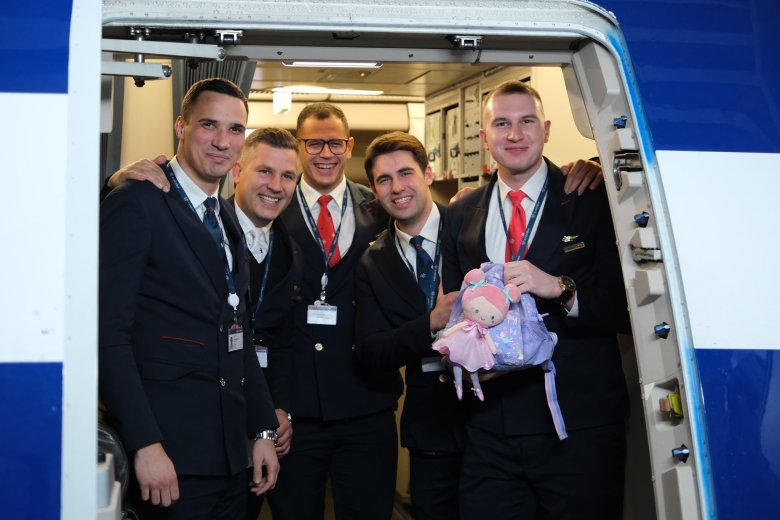 Air Serbia completes evacuation flight from Dubai, bringing 262 passengers and 14 infants safely back to Belgrade. [ Photo credit: Air Serbia press office]
It is a mindset that signals a leadership philosophy anchored in purpose. “These missions represent the pinnacle of what we call Tradition Elevated,” Knezevic said. “It is a commitment that goes beyond the cockpit and the cabin, reaching into the heart of our duty to the people we serve.”
In her framing, this is where brand, culture, and responsibility converge. “For us, tradition isn’t just about our history,” she added. “It is about a long-standing responsibility to be a pillar of support for our citizens in their most difficult moments.”
The question of balance—between commercial imperatives and humanitarian duty—sits at the core of every evacuation flight, every rerouted aircraft, every decision made under pressure.
The smiles of the people and especially the children we have been able to bring safely to their homes are truly priceless.
Air Serbia’s Head of Marketing and Guest Experience, Bojana Knezevic
Knezevic sees it as part of the mandate. “Balancing commercial operations with humanitarian responsibilities is part of the broader mission of any national airline,” she said. “Our primary responsibility is to maintain safe, reliable, and efficient operations for all passengers, but when extraordinary circumstances arise, we work closely with the government and relevant institutions to support national priorities.”
What enables that dual role, she argues, is not improvisation, but discipline. “Aviation requires precise coordination,” Knezevic noted, “and that same operational discipline allows us to integrate humanitarian missions into our schedule when needed, without compromising safety or service standards.”
In that sense, the balance becomes less a trade-off than a test—of systems, of people, and of whether an airline can remain both commercially viable and civically essential at once.
There is, however, a dimension that resists operational language. “At the same time, beyond operational planning and logistics, there is a deeply human dimension to these missions,” Knezevic said. “The smiles of the people and especially the children we have been able to bring safely to their homes are truly priceless. Those moments remind us that aviation is not only about connecting cities and countries, but also about bringing people back to safety, to their families.”
Knezevic: A single image can reveal the true soul of a brand
If the work is measured internally by precision, it is often understood externally through images. And images, as Knezevic points out, move differently.
“In the modern media landscape, a single image can transcend traditional marketing to reveal the true soul of a brand,” she said. For Air Serbia, the now-circulating evacuation photograph required no framing. It carried its own narrative—urgency, danger, return—and in doing so, recast the airline not simply as an operator, but as a presence. “Capturing a moment of crisis or relief is not merely a display of operational capability—it is a profound manifestation of our national identity.”
What resonates, Knezevic suggests, is not the choreography of aviation, but the human meaning attached to it. “Successful global brands are no longer built on logistics alone, but on emotional resonance—the ability to create a lasting human connection that outlives any advertisement.”
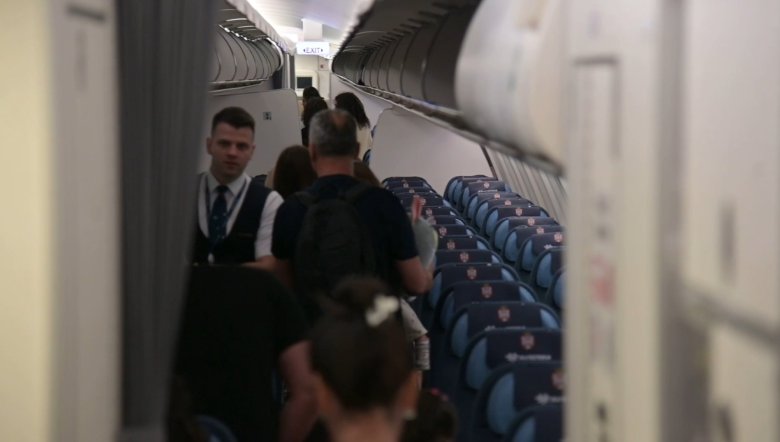 On a special Air Serbia flight from Dubai, 266 passengers were safely returned home. [Photo credit: Serbian MFA]
In those unscripted moments, the airline begins to stand in for something larger. “When global audiences witness these moments, they see Air Serbia acting as a flying ambassador for the Serbian people,” she said. The images, she added, project a distinctly cultural sensibility—gostoprimstvo, a form of hospitality that is not transactional but protective, where “every passenger is treated like family.”
That is where perception shifts—from competence to character. “By operating reliably under such intense pressure, we bridge the gap between technical excellence and genuine humanity,” Knezevic said. “We prove that we are more than a national carrier; we are a responsible guardian that carries the heart and the welcoming spirit of a Serbian home into the sky.”
Knezevic: Leadership is about clarity, resilience, and teamwork
 Bojana Knezevic, Head of Marketing and Guest Experience at Air Serbia [ Photo credit: Air Serbia press office]
Leadership, in this context, is not theoretical. It is practiced in real time—under pressure, across systems, and often with little margin for error. Knezevic describes it with characteristic precision. “Working in aviation teaches you very quickly that leadership is about clarity, resilience, and teamwork. The industry is fast-paced, highly competitive, and often unpredictable, which means decisions must sometimes be made quickly but always with a long-term perspective in mind,” she said.
That balance—between immediacy and foresight—extends into how she structures teams. “One of the most important lessons for me has been the value of empowering teams,” Knezevic added. “Marketing today is deeply connected to data, technology, customer experience, and brand strategy, so success depends on collaboration across many different departments. Creating an environment where talented people can contribute their expertise is essential.”
What emerges is a throughline that connects brand, leadership, and purpose. For Knezevic, motivation is less about a conventional career trajectory than about alignment—with identity, with scale, and with meaning.
For Knezevic, the decision to join Air Serbia was anchored in that distinction. “Joining Air Serbia was a decision driven by the desire to be part of something far greater than a corporate entity,” she said. “It was about joining a living symbol of our national identity.” As the country’s flag carrier, she added, the airline carries “a profound responsibility to represent our country on the global stage.”
That sense of representation is not symbolic alone; it is operationalized through reach. “Today, Air Serbia is a bridge between cultures, connecting people across more than 100 destinations worldwide,” Knezevic noted, describing the airline’s expansion as a source of both momentum and pride. “We aren’t just flying planes—we are elevating Serbian tradition and showcasing our world-class hospitality to every corner of the globe.”
What distinguishes the role, she suggests, is the intensity that comes with it. “There is a unique, powerful energy that comes with working for a brand that carries the national flag,” she said. “It is a role that demands excellence because you are the face of your nation.”
That pressure, in her telling, is also catalytic. The environment “doesn’t just challenge you—it encourages you and truly gives you wings to exceed your own limits.” It is, ultimately, a convergence of past and future: “being part of this journey, where we blend our rich heritage with a modern, ambitious vision, is deeply inspiring.”
“For me,” Knezevic added, “there is no greater professional honor than contributing to the strength and prestige of a national airline that the whole world now recognizes and respects.”
Knezevic: Stay curious!
 Bojana Knezevic, Head of Marketing and Guest Experience at Air Serbia [ Photo credit: Air Serbia press office]
As a woman in a leadership role, Knezevic speaks candidly about the structural realities that still shape the corporate landscape.
“The corporate environment, particularly at senior leadership levels, can still present certain structural challenges for women,” she said. “At different points in my career, I have encountered situations where expectations or perceptions were shaped by stereotypes rather than by professional merit.”
While acknowledging those constraints, she pointed to the importance of environment and execution. She noted she had been “fortunate” to work within teams that value competence, results, and diversity of perspective—and distilled the lesson into a clear directive: focus on outcomes.
“I believe the most effective response is to remain focused on delivering results, building strong teams, and supporting a culture where talent and dedication are recognized regardless of gender.”
That philosophy extends into the advice she offers younger women navigating similar terrain. “Stay curious, build strong expertise in your field, and don’t be afraid to take on challenging opportunities,” Knezevic said, emphasizing that careers “rarely follow a perfectly straight path,” and that the most consequential growth often occurs outside one’s comfort zone.
“Equally important is building a network of mentors and colleagues who support your development,” she added. “Leadership is not only about ambition but also about collaboration, continuous learning, and resilience.”
A symbol of national pride
Bojana Knezevic’s own leadership style reflects that synthesis. She describes it as “collaborative and strategic,” grounded in clear objectives but open to dialogue and creative thinking. “Over time, my approach has become increasingly focused on empowering others—creating space for talented people to take ownership of projects and bring new ideas forward,” she noted.
That emphasis on empowerment mirrors the airline’s broader trajectory. Air Serbia, she argues, is entering a phase where growth is defined not only by expansion, but by refinement. “The aviation market is evolving rapidly, and airlines that combine operational excellence with strong brand positioning will have a clear advantage,” she said.
In that context, marketing becomes less about promotion and more about architecture—shaping the passenger experience end to end. “It’s about how passengers experience the brand from the moment they begin planning their journey to the moment they arrive.”
Two developments, she noted, signal that shift. The introduction of a new loyalty program is designed to deepen personalization and strengthen long-term relationships with passengers. At the same time, the opening of a significantly expanded Premium Lounge at Belgrade Airport—twice the size of its predecessor—redefines the pre-flight experience as part of the brand itself: “a sophisticated and welcoming space where guests can begin their journey surrounded by comfort and the warmth of Serbian hospitality.”
Recognition has followed. Being named the “Best Airline in Eastern Europe” by Global Traveler for two consecutive years, alongside record passenger growth, underscores the Air Serbia’s trajectory.
For Knezevic, however, the endpoint is not awards, but identity. “My motivation is to ensure that Air Serbia remains a symbol of national pride,” she said—a brand that is at once modern and rooted, operationally precise yet emotionally resonant, “setting the gold standard for hospitality on the global stage.”
READ ALSO

In London, the language has shifted. “Trump can’t be reasoned with anymore,” a diplomatic source told me as the war with Iran intensified and the rhetorical temperature between Washington and Keir Starmer rose in tandem. The remark was not offered lightly, nor by someone predisposed to defend Starmer. It was, instead, an admission of a broader European…
Related