
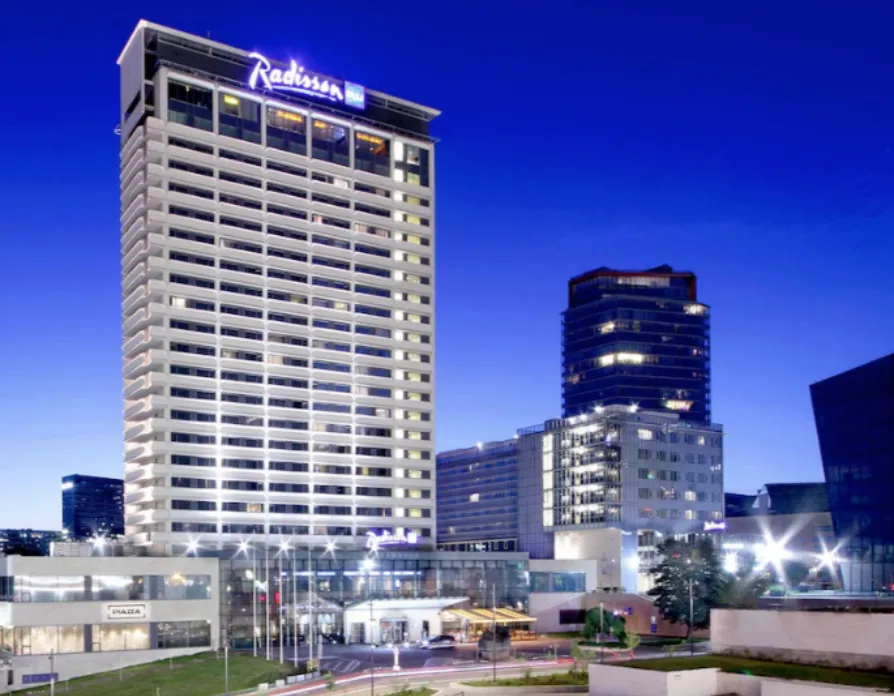
City’s laser heritage spans six decades. In 2026, Vilnius will host three major international photonics conferences, reinforcing Lithuania’s position as a global laser technology hub.
Laser focus at the Radisson Blu Lietuva in September
The Lithuanian capital, Vilnius is set to host a concentration of high-level laser and photonics events.
The events highlight the strong position of the city in the global laser industry. Built on more than 60 years of collaboration between science and industry, the country’s laser sector traces its origins to the first laser fired at Vilnius University in 1966. Today, the sector includes more than 60 companies employing over 2,000 specialists, with approximately 90% of production exported worldwide, placing Lithuania among the most export-oriented laser industries globally.
Lithuanian laser and optical technologies are widely used across industries, including semiconductor manufacturing, defence and security, healthcare and biomedical technologies, aerospace and aviation.
Between 2020 and 2024, Lithuania’s main laser export markets were the United States (16.3%), China (16.3%), and Germany (14.3%), with the sector growing at around 16% annually – well above the European average.
“Lithuania’s laser sector is built on a close relationship between research and industry, and Vilnius has become the centre of this ecosystem,” said Dr Gediminas Račiukaitis, president of the Lithuanian Laser Association. “Bringing leading minds together is crucial for sharing the latest advancements and learning from the people shaping the future of photonics. International conferences help connect scientists, engineers, and companies and accelerate innovation across the field.”
A key part of this ecosystem is the Centre for Physical Sciences and Technology (FTMC), Lithuania’s largest research institution in laser technologies, optoelectronics, nanotechnology, electronics, and advanced materials.
Among the 2026 line up of events is the International Conference on Laser Ablation (COLA 2026), one of the leading global conferences in laser ablation, taking place, 14–18 September 2026 at the Radisson Blu Hotel Lietuva.
During the same week, Vilnius will also host LHCb Week 2026, bringing together around 600 participants globally, including around 300 scientists attending onsite, with a similar number joining remotely, all involved in the CERN LHCb experiment. Vilnius University will host of the event. The conference marks an important step towards Lithuania’s full membership in CERN.
Later in the year, the Optica Laser Congress and Exhibition will take place 11–15 October 2026. Organised by Optica, the congress will highlight advances in solid-state laser development and applications, including quantum and free-space communications, An accompanying exhibition will showcase the latest photonics technologies and products.